Spain are world champions. But the 2026 FIFA World Cup will be remembered less for what happened on the scoresheet and more for everything that happened around it — a tournament that generated controversy from its opening days and ended with a mass brawl on the MetLife Stadium turf.
Trump, Balogun, and a suspension that vanished overnight
The most surreal storyline of the group stage had nothing to do with football tactics. Folarin Balogun received a legitimate red card against Bosnia and Herzegovina — his cleat caught Tarik Muharemović's ankle, VAR confirmed it, one-game ban handed down. Standard procedure. Then, 24 hours before the Round of 16 clash with Belgium in Seattle, the suspension was simply gone.
FIFA reversed it without detailed explanation. Belgium were furious. Their appeal was denied within hours of kickoff. Balogun started.
Then Donald Trump held a White House press conference and claimed personal credit, saying he'd phoned FIFA president Gianni Infantino and requested a review. Whether that's exactly how it unfolded or not, the optics were catastrophic for FIFA's credibility as an independent governing body. Co-hosting a tournament in a country and then appearing susceptible to pressure from that country's head of state is exactly the kind of thing the organisation has spent years insisting it isn't.
Belgium made the controversy irrelevant on the pitch, winning 4-1. Balogun was kept quiet throughout. Balogun himself later admitted: "I could almost see within my teammates a bit of nerves because it's something that is so unique." That's a diplomatic way of saying even the people who benefited from the decision were uncomfortable with how it happened.
VAR decisions that shaped — and ended — campaigns
The technology designed to eliminate doubt produced more of it than ever at this tournament. The volume and inconsistency of VAR interventions became a running theme across six weeks of football.
Egypt's elimination against Argentina was the flashpoint. Leading 2-0 with 11 minutes left against the defending champions, Mostafa Ziko put the ball in the net to make it 3-0 in the 58th minute. VAR pulled the goal back — reviewing a foot-stamp by Marwan Attia on Lisandro Martínez that had occurred 17 seconds before the ball crossed the line. Egypt were denied a 2-0 lead, the momentum shifted, and Argentina scored three times in the closing stages to win 3-2.
The Egyptian Football Association filed an official complaint against referee François Letexier. Professor Simon Chadwick, speaking to Al Jazeera, framed it sharply: "A sense of injustice was induced by the VAR decision. This technology was supposed to minimise doubt and bring consistency. Instead, its use during this match had significant cognitive and behavioural effects." Egypt also had a strong penalty shout waved away in the Argentine box in the closing minutes. Argentina scored the winner in the 92nd.
Germany exited in the Round of 32 under similarly disputed circumstances. Jonathan Tah appeared to head in the extra-time winner against Paraguay, only for VAR to flag Waldemar Anton for allegedly fouling the goalkeeper in the build-up. Paraguay won on penalties. Thomas Müller, not a man known for restraint when he has a point to make, was unsparing: "We, the Germans, feel used and cheated. This is wrong. This is daylight robbery on the biggest stage in football. If that's a foul, then football has completely lost its consistency because we've seen far stronger challenges allowed all tournament."
Norway's quarter-final against England produced another disallowed goal — Torbjørn Heggem's effort ruled out after VAR determined Erling Haaland had pushed Elliot Anderson before the corner that led to it. And in the final itself, Nico Williams' opening goal for Spain was chalked off after Mikel Merino was adjudged to have fouled Nicolás Otamendi in the build-up.
For anyone who backed goals or specific scorers throughout the knockout rounds, the sheer unpredictability of VAR's application made outcome-based markets feel closer to a lottery than usual. The standard across the tournament was simply too inconsistent to build any reliable framework around it.
The final's ugly ending
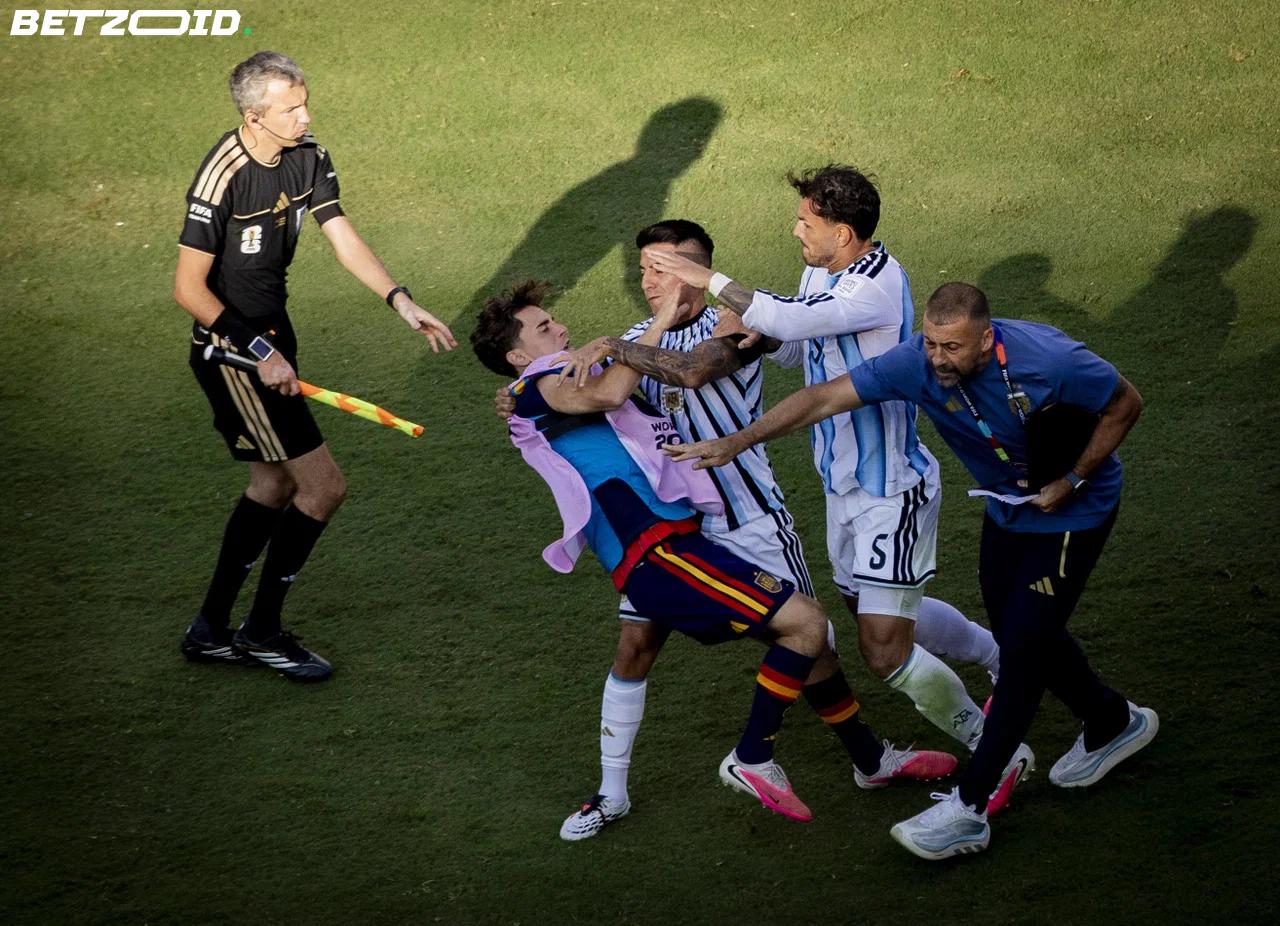
Spain won 1-0, confirmed champions, but the closing scenes in New York were grim. Enzo Fernández had already been sent off with two yellows, leaving Argentina to see out the final with ten men. When the whistle blew, the frustration boiled over into a full brawl — Nahuel Molina, Leandro Paredes, and Thiago Almada all involved, with Molina appearing to punch Spanish captain Rodri to set off the chaos.
It was almost certainly Lionel Messi's last World Cup. That story deserved a cleaner ending. Instead, the lasting image is of a tunnel brawl and a tournament that spent six weeks fighting itself as much as any opponent on the field.
FIFA also found time to refuse France's request to wear black armbands in honour of Didier Deschamps' mother, who passed away during the group stage — a decision that drew its own wave of criticism. The organisation then compounded it when French officials mistakenly believed a pre-match minute's silence was held for Ginette Deschamps, only to learn it was for victims of the Venezuela earthquake.
The hydration breaks — mandatory three-minute stoppages mid-half, which coaches like Ståle Solbakken and Deschamps openly criticised — were a minor irritant by comparison. Deschamps described them as splitting matches into "almost four quarters." He wasn't wrong. But next to everything else this tournament served up, that particular argument barely registered.