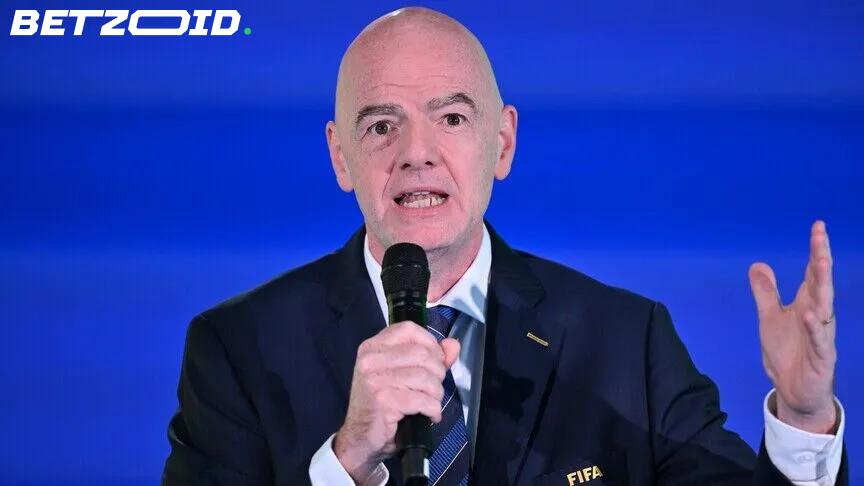
The Italian Football Federation has had enough of Gianni Infantino. FIGC announced Wednesday it will not back the FIFA president's expected reelection bid at next March's Congress in Morocco — a pointed rebuke from one of European football's most influential federations.
The trigger was the FIFA Forward Enterprise proposal, a summer scheme to sell stakes in a private company controlling commercial rights to the World Cup and other FIFA competitions to outside investors. The idea collapsed under the weight of its own opposition, but the damage to Infantino's credibility didn't go with it.
A growing list of defections
Italy isn't alone. England, Wales, and Ireland have already pulled their support. UEFA, the Asian Football Confederation, and CONCACAF went further, issuing a joint letter accusing Infantino of breaking trust "through deception" and demanding an independent review of the abandoned proposal. That's three of football's six continental confederations publicly calling out the man who runs the global game.
FIGC president Giovanni Malago framed Italy's exit from the Infantino camp in the language of principle rather than personal grievance. "We will continue to work alongside UEFA and the other European federations to promote a vision of soccer based on merit, solidarity, sustainability, and the centrality of fans," he said. Whether that reads as a genuine manifesto or a veiled campaign pitch for an alternative candidate depends on how far this opposition is willing to go.
Infantino has led FIFA since 2016 and has never looked seriously threatened — until now. The World Cup stake-sale plan wasn't just a bad idea that got shelved. It became a symbol of exactly what critics have always said about his leadership: decisions made in private, sprung on the football world, and withdrawn only when the backlash became impossible to absorb.
What happens in March
The FIFA Congress in Morocco is where this plays out. Infantino still has significant support across Africa and parts of Asia, where his infrastructure investment programmes have built real goodwill. European opposition, however loud, doesn't automatically translate into lost votes when the global ballot is counted.
But the optics are shifting. Each federation that withdraws support makes his path to a clean, uncontested reelection harder to sell. Whether a credible alternative candidate emerges in the next few months will determine whether this is a genuine power struggle or just Europe venting and then falling in line.
UEFA's joint letter called for a "fully independent review." That review hasn't happened. That's the detail that keeps this story alive.