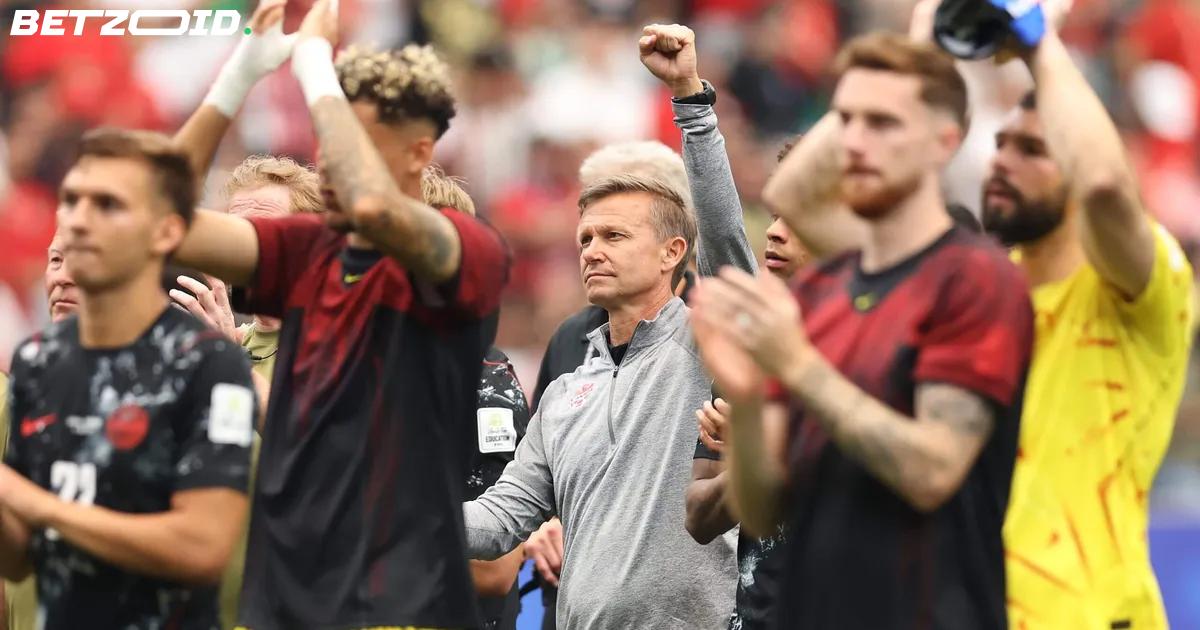
"I'm working on how I'm going to deal with that." That's Jesse Marsch — Canada's head coach, fresh off the program's best-ever World Cup showing — sitting down with a team psychologist to work on managing referee frustration. It tells you something about the Concacaf reality that awaits him over the next four years.
The round of 16 at a home World Cup was historic for Canada. It was also, to some degree, assisted by co-host status. No more. Canada must qualify for 2030, must improve its FIFA ranking to reach Pot 2, and must do it all while navigating the financial and structural gaps that still exist between them and the sport's serious powers. The friendly against the USMNT is a window into where this program actually stands.
The Alphonso Davies problem isn't going away
117 minutes across 29 matches. That's how little Canada has seen of its captain and best player since injuries and absences started piling up. Davies missed the Gold Cup. He wasn't the face of the 2026 World Cup — a tournament Canada hosted, a once-in-a-generation chance to make him a household name at home. That window is shut.
Marsch is measured about it: "If he's healthy, he'll be here. His commitment right now to the national team is bigger and better than it's ever been." He also told Davies directly to advocate for rest at Bayern Munich — to actually say "give me a game off" — which says everything about how this situation has been mismanaged at the club level for years.
The harder truth is that Canada no longer needs Davies the way it once did. The dependence has dropped. The bigger risk heading into 2030 is that his fitness status becomes a recurring distraction rather than an asset. Canada's qualifying odds shouldn't hinge on whether one player's hamstrings hold together — but his absence will always be the headline.
Money, youth camps, and a legitimate plan
Canada Soccer CEO Kevin Blue has overhauled the organization's finances in ways that would have seemed implausible three years ago. The "Canada Rising" campaign set a CAD $25 million target before the end of 2027. They've already raised $26.7 million, and the internal projection is now $10 million annually in philanthropic funding by 2030.
Where does that money go? Partly into youth camps — from eight in 2024 to around 20 this year, with more to come. Marsch went straight from the senior World Cup to coaching Canada's Under-20s at the Concacaf U-20 Championship. That wasn't an accident. He believes he can meaningfully accelerate development at that level, and two names to watch are 18-year-old Toronto FC defender Richard Chukwu and Feyenoord U-21 midfielder Kevin Khan.
The gap that money can't fully close: scheduling. Marsch wants two European windows and a South American trip before 2030 qualifiers begin in 2027. But booking elite opposition costs money Canada simply doesn't have at that level. "We're not a federation that can pay $5 million to bring in France, Argentina or Spain," Marsch said bluntly. Their stadiums don't generate the revenue to justify it. Canada's ranking improvement — they currently sit 30th, needing to crack the top 26 to hit Pot 2 — depends on getting those quality matches. It's a circular problem without an easy solution.
- Canada's current FIFA ranking: 30th
- Pot 2 threshold at 2026 World Cup: 26th (Australia, lowest-ranked Pot 2 team)
- Canada Rising fundraising target: CAD $25 million — already surpassed at $26.7 million
- Youth national team camps: 8 in 2024, ~20 in 2025, growing annually
- World Cup qualifying begins: 2027
The injury situation deserves more scrutiny than Canada Soccer is willing to give it. Alistair Johnston, Moïse Bombito, Ismaël Koné, Marcelo Flores, Cyle Larin, Derek Cornelius — that's not bad luck, that's a pattern. Marsch insists the training methods aren't the cause, and he may be right that most injuries originate at club level. But a high-press, high-tempo system over a four-year cycle with an aging core creates cumulative load. That's not an argument for going soft in training — it's an argument for smarter management of minutes, windows, and bodies.
"The idea that what we do in training is getting players injured is wrong," Marsch said. He's resolute. Whether that confidence holds through 2030 qualifying will depend on whether the injury list keeps growing.