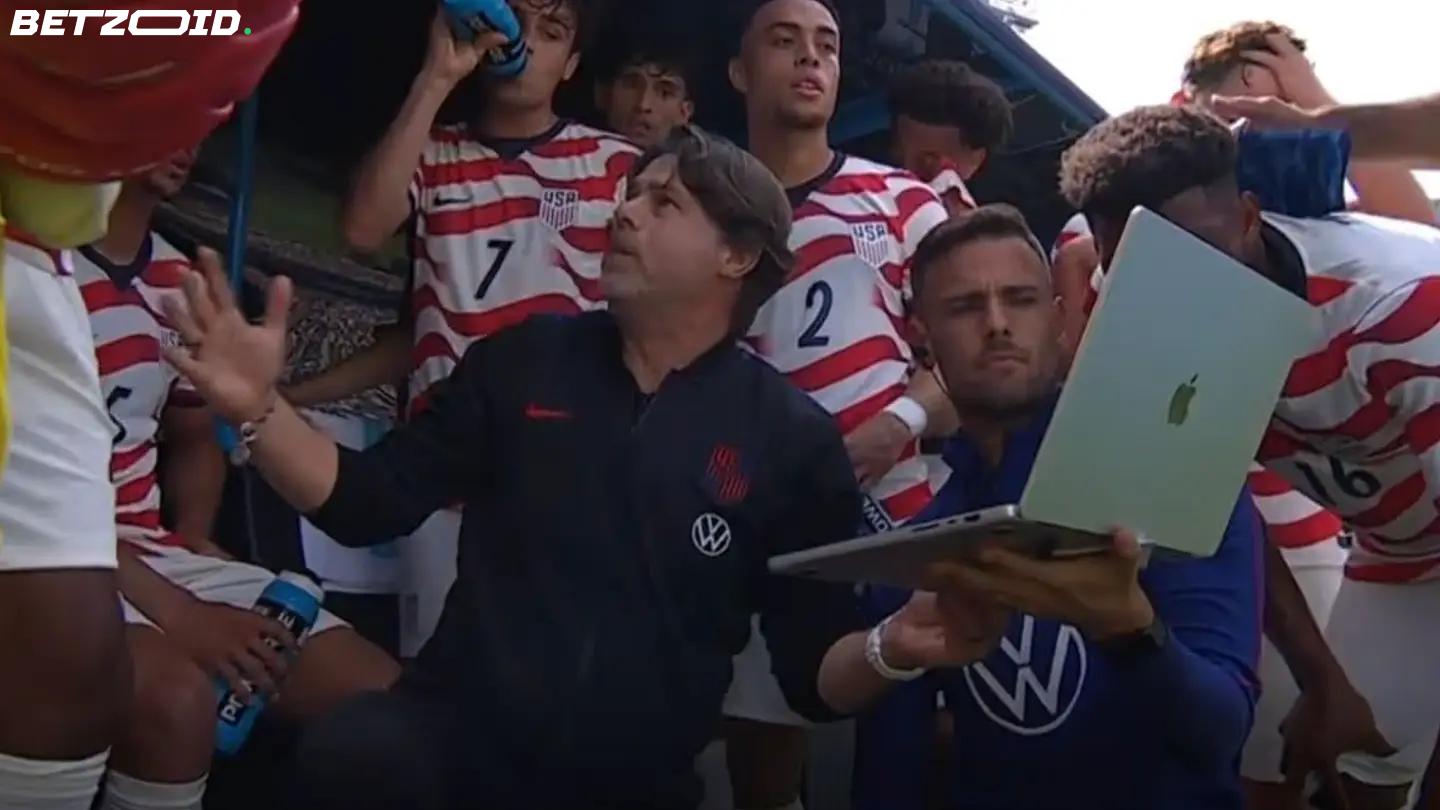
"We'll see now in the World Cup if they can allow that." Mauricio Pochettino said it himself after the USMNT beat Senegal 3-2 on Sunday, genuinely unsure whether FIFA would sanction what he'd just done. They will. And now every national team manager on the planet is thinking the same thing.
Twenty-two minutes into a friendly, Pochettino pulled out a laptop during a water break and waved his players around the screen for an impromptu tactical review. The internet laughed. Then the U.S. won. Then everyone got quiet and started wondering if Pochettino had just stumbled onto something real.
What the rules actually say
FIFA's position, confirmed to The Athletic by an anonymous source within the governing body, is straightforward: laptops are permitted on the sideline and during water breaks at all times. The only constraint comes from IFAB regulations — the device must be "mobile and handheld," so nothing bigger than a laptop. Tablets, laptops, fine. A wall-mounted screen and a projector? No.
There is one thing Pochettino got wrong on Sunday. Players currently on the field cannot cross the touchline into the dugout during water breaks — they have to stay on the pitch, hovering just beyond the line to see the screen. It's a minor logistical tweak, not a dealbreaker.
The 2026 World Cup format makes this more consequential than it sounds. FIFA has mandated two three-minute hydration breaks per match this summer — one per half — which will also double as advertising windows. In practice, that splits each game into four segments. Four natural pauses. Four moments where a prepared coaching staff can show players exactly what's going wrong, or right, in real time.
Why this changes the competitive picture
Historically, water breaks are for catching breath and hearing "keep your shape" from the touchline. Pochettino just turned them into film sessions. At a tournament level, that edge compounds — a tactical correction delivered at minute 22 that fixes a defensive shape could be the difference between group-stage exit and a quarterfinal.
The sides with the sharpest analytics setups — and the staff who can distil complex information into 90-second visual clips under pressure — will get the most from this. That's not necessarily the biggest nations. It's the best-prepared ones.
- Two mandatory three-minute water breaks per World Cup match in 2026
- Breaks occur midway through each half, effectively creating four quarters
- Electronic devices must be mobile and handheld — no larger than a laptop
- On-field players must remain on the pitch during breaks, not entering the dugout
- The 2026 World Cup begins June 11 across the U.S., Canada, and Mexico
Pochettino's players said the visual feedback helped. "When they see the image, it's really important now," he explained post-match. Whether it translates against opponents considerably better than Senegal remains an open question — but the tactic is legal, it's coming, and other managers are already paying attention.