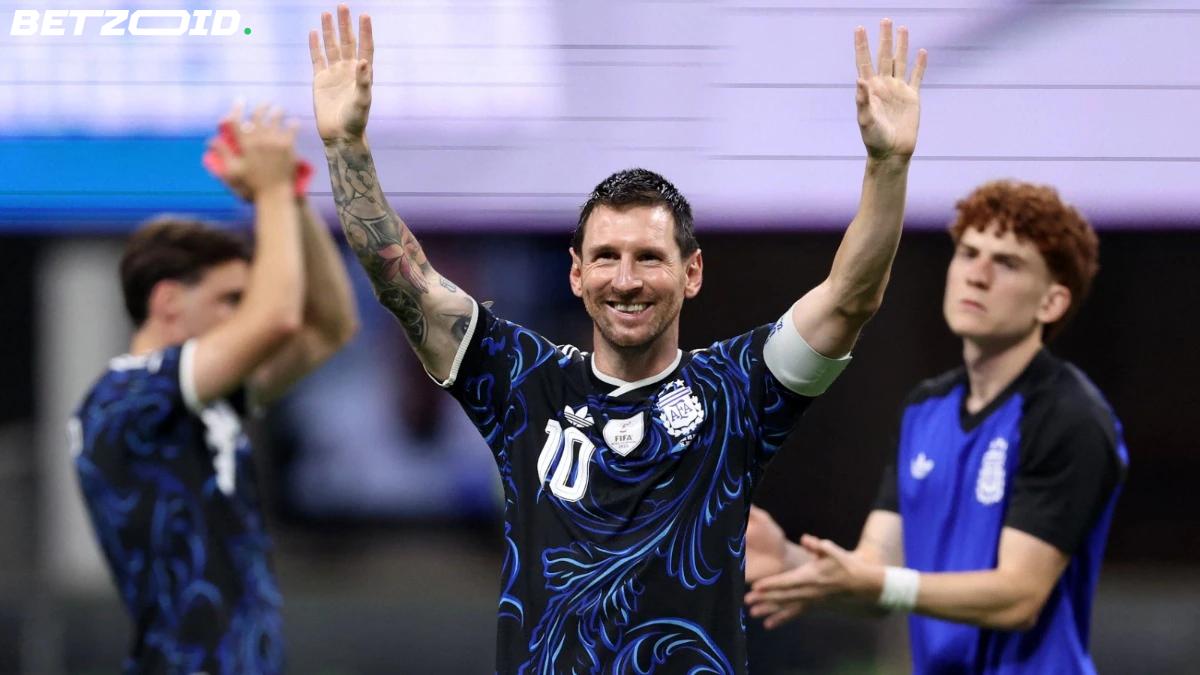
Giuliano Simeone — son of Diego, no stranger to hard men and big egos — got emotional talking about Lionel Messi before the 2026 World Cup final. "Leo is 39 years old, he has everything a footballer could dream of and is still fighting like the best," he said. "So for us, there's only one thing left: give everything we have, run for him and for Argentina."
That's not admiration for a great footballer. That's a teammate describing what it feels like to follow a leader.
Three days out from his third World Cup final, Messi stands as the emotional centre of the most successful Argentina side in a generation. Two Copa Americas, a World Cup, the Finalissima, and now another shot at the biggest prize. For a player who spent years being told he couldn't lead, the record is a fairly comprehensive rebuttal.
The failure years matter more than the trophies
Before any of that, there was Germany in Rio in 2014. Then Chile, twice, in back-to-back Copa America finals in 2015 and 2016. Each defeat tightened the narrative: Messi was a Barcelona player wearing Argentina colours, a genius who couldn't carry a national team the way Maradona once had.
After the 2016 Copa America Centenario final loss, he announced his retirement from international football. The criticism had become too much.
What followed tells you everything. Cities across Argentina filled with messages urging him back. Politicians appealed to him. Former players pleaded. The backlash against the backlash was instant and overwhelming. Even at his lowest point, Argentina still believed it needed him — which suggests the critics had fundamentally misread what his presence meant to the group.
He returned. And then everything changed.
Business schools love resilience as a concept. Messi's story gives it actual weight. The leader who lifted the World Cup in Qatar in 2022 was shaped by those failures as much as by anything Scaloni designed tactically. The defeats, the retirement, the criticism — they weren't detours. They were the process.
Trust built slowly, not performed loudly
When Lionel Scaloni took charge after Argentina's shambolic 2018 World Cup exit, he didn't rebuild around Messi in the obvious way. He didn't make Messi the entire system. He built a team that trusted him — which is a different thing entirely.
Rodrigo De Paul has described his role on the pitch as Messi's "bodyguard." Emiliano Martinez has spoken repeatedly about the squad's determination to win specifically for their captain. Younger players describe sharing a dressing room with him as both privilege and obligation. The language these players use isn't admiration — it's accountability.
Players like Enzo Fernandez, Alexis Mac Allister, Julian Alvarez and Cristian Romero emerged as genuine leaders in their own right during this cycle. Argentina's recent success isn't the story of Messi carrying a team, or a team carrying Messi. It's a genuinely distributed culture, with Messi as its anchor rather than its entire structure.
Harvard Business School developed a case study around David Beckham's recruitment of Messi to Inter Miami, examining how one individual reshapes an organisation's commercial trajectory and strategic ambition. The numbers were immediate and dramatic — attendance surged, merchandise sales soared, MLS's global profile expanded. But the Miami story is still relatively young. The Argentina story has been running for over a decade, through failure and renewal, and it's considerably richer.
What makes Messi's leadership genuinely unusual is that it never relied on the things leadership is usually assumed to require. He didn't dominate dressing rooms. He didn't deliver speeches. He's not Maradona — confrontational, magnetic, impossible to ignore. For a nation that had built its entire footballing identity around that archetype, Messi looked wrong for the role for a long time.
What he had instead: consistency, credibility, and the kind of trust that accumulates slowly through standards rather than declarations. His Barcelona captaincy from 2018 onwards showed the same pattern — young players understood what was expected because they watched him in training every day, not because he told them.
The PSG chapter is worth noting precisely because it complicates the picture. Messi later acknowledged he never settled in Paris, never enjoyed it the way he'd anticipated. The same qualities that made him transformative in Argentina produced nothing comparable at PSG. Different power structures, competing ambitions, no shared culture to anchor. Even exceptional leaders need the right environment. That's not a weakness in the argument — it actually strengthens it. Leadership isn't a portable personal attribute. It's a relationship between a person and an organisation.
Argentina go into another World Cup final with Messi at 39, still the first name on the teamsheet, still the player everyone else organises around. Whether they win or lose won't change the broader shape of what he built. The trophies are real, but they're almost beside the point.
The more interesting question — the one worth putting in front of a business school class — is how a man repeatedly told he lacked the leadership qualities to inspire a national team became the person an entire country learnt to follow. Without speeches. Without confrontation. Without trying to be Maradona.
"Give everything we have, run for him and for Argentina," Giuliano Simeone said. At 39, going into his third World Cup final, that's what Messi still generates.