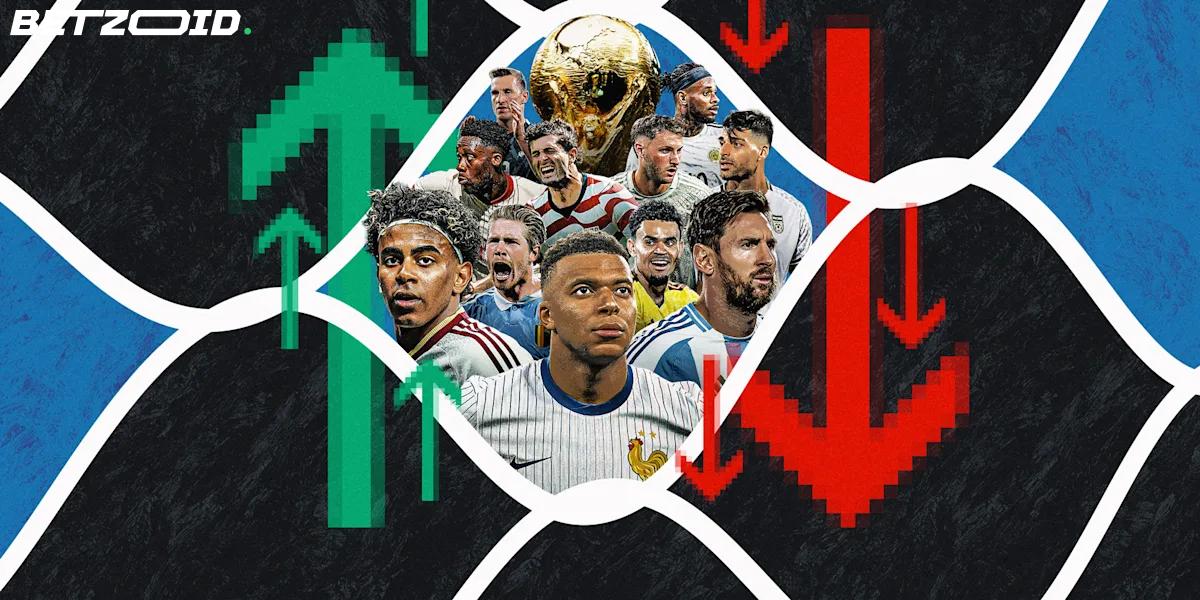
Two weeks from kickoff, France are the team to beat at the 2026 World Cup — and it's not particularly close.
The expanded 48-team format means more paths, more upsets, and more nights where a Tier 5 debutant holds a giant to a draw. But the gap between the elite and everyone else hasn't shrunk. If anything, the extra knockout round rewards depth, and nobody has more of it than the French.
Tier 1: The Six Real Contenders
France top the rankings. Kylian Mbappé, Michael Olise, Ousmane Dembélé, Rayan Cherki, Marcus Thuram — Didier Deschamps has the most embarrassing collection of attacking talent at any World Cup in recent memory. The question, as ever with Deschamps, is whether he'll actually use it or grind out 1-0 wins until the wheels come off. His conservative instincts have cost France before. But the ceiling here is genuinely untouchable.
Spain enter as betting favorites on form — EURO 2024 winners who outscored opponents 15-4 and scored at least twice in every knockout game. Lamine Yamal's injury has softened their odds, and rightly so, but this squad has enough width and pressing intensity to hurt anyone. Their group is forgiving. They should be fresh and sharp by the round of 16.
Argentina are chasing history. No nation has retained the World Cup since Brazil in 1962, and Lionel Messi — who turns 39 during the tournament — won't carry this team the way he did in Qatar. He doesn't need to. The depth in attack is real. The defensive injury concerns are real too, and that's where Argentina's campaign could unravel in the knockout rounds.
England under Thomas Tuchel should be more attack-minded than anything Gareth Southgate produced, which raises the floor significantly. The centre-back depth beyond Marc Guéhi is still a problem. If that backline gets exposed against a top-six team, the exit will look familiar.
Portugal are perhaps the most talent-dense squad outside France, with Bruno Fernandes, Bernardo Silva, Rafael Leão, Pedro Neto, and João Félix all capable of winning a game alone. Cristiano Ronaldo, at 41, is the variable — his presence in the box is undeniable, but his presence on the pitch limits Portugal's versatility and pressing structure. Roberto Martínez will need to manage that tension carefully.
Brazil round out Tier 1, though with reservations. Carlo Ancelotti is a supreme manager, but the midfield linking Casemiro and Fabinho to Vinícius Júnior and Raphinha looks fragile over a month-long tournament. A Round of 32 exit against Japan or the Netherlands isn't alarmist — it's a genuine scenario worth considering before backing them at long odds.
Tier 2 and the Teams That Could Surprise
Germany are in a bracket of their own — technically Tier 1 by pedigree, Tier 2 by current squad depth. Julian Nagelsmann has gone out in consecutive World Cup group stages, something Germany had never done before 2018. Manuel Neuer, 40 years old and back from international retirement, is the symbolic anchor. Whether that's reassuring or concerning depends on your tolerance for nostalgia.
Colombia are the most dangerous team outside the top eight. Luis Díaz cutting in from the left, James Rodríguez pulling strings in the middle, Jhon Arias and Richard Ríos on the other side — this attack has genuine star power and knows how to function as a unit. A Copa América runner-up finish and a record unbeaten run suggest they're peaking at the right time.
Morocco are no longer a feel-good story — they're a threat. One loss since March 2024 (since overturned), Achraf Hakimi and Youssef Belammari as attacking fullbacks, and Brahim Díaz adding something new in midfield. The only real question is the centre-forward position. If that's solved, Morocco can reach the last eight again.
Norway are the sleeper pick most people will make — and they've earned it. Erling Haaland and Martin Ødegaard together is an unfair combination when fit. They went 8-from-8 in qualifying by a combined 37-5, including two wins over Italy by an aggregate of 7-1. Group I with France and Senegal is the draw nobody wanted, but Norway-France might be the standout group-stage match of the tournament.
The Format's Beneficiaries — and the Debutants
The expanded format genuinely reshuffles the deck for mid-table nations. Eight of twelve third-place teams advance, which means a team like Ecuador — who conceded only five goals across 18 CONMEBOL qualifiers — can afford one bad result without going home. Moises Caicedo might be the best player his country has ever produced. If 19-year-old Kendry Páez clicks in attack, they're dangerous.
Japan keep slaying giants. Spain, Germany, England — they've beaten them all in recent memory. The squad is filled with European-based players who press relentlessly and transition with pace. No marquee striker, but that hasn't stopped them before.
The United States, as hosts, have a generational opportunity. Group D lacks a genuine power. A favorable knockout draw at home is entirely plausible, and the March results against Belgium and Portugal were poor enough that the pre-tournament noise has stayed manageable — which might suit them.
At the bottom of the table, four nations are making their World Cup debuts: Cape Verde, Curaçao, DR Congo, and Uzbekistan. None have ever won a World Cup match. Curaçao qualify as the smallest nation by population ever to reach a World Cup, with around 153,000 people. Getting a point would be the story of their football history. Advancing would be something else entirely.
- Tier 1 (Title Favorites): France, Spain, Argentina, England, Portugal, Brazil, Germany, Netherlands
- Tier 2 (Genuine Contenders): Belgium, Colombia, Morocco, Senegal, Ecuador, Uruguay, Croatia
- Tier 3 (Cinderella Candidates): Norway, Japan, Switzerland, USA, Mexico, Türkiye, South Korea
- Tier 4 (Format Beneficiaries): Iran, Ghana, Austria, Ivory Coast, Paraguay, Czechia, Sweden, Bosnia-Herzegovina, Egypt, Algeria, Canada, Australia, Tunisia, Panama, South Africa, Saudi Arabia, Haiti, Scotland
- Tier 5 (Thrilled to Be Here): Cape Verde, Curaçao, DR Congo, New Zealand, Qatar, Uzbekistan, Iraq, Jordan
France's World Cup odds reflect a squad that, on paper, is the most complete in the world. The only thing standing between them and a third straight final is Didier Deschamps deciding to actually play football.