The cheapest seat at the 2022 World Cup in Qatar cost around $55. At 2026's equivalent tier, you're looking at roughly $560. That single stat tells you almost everything you need to know about what this tournament has become.
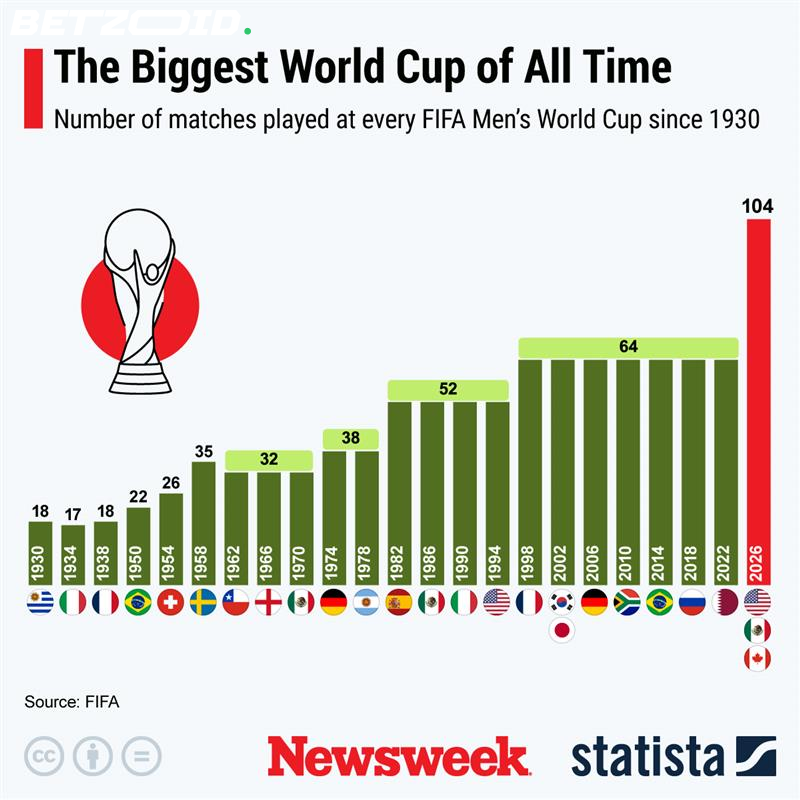
The 2026 FIFA World Cup is the largest in the competition's history — 48 teams, 104 matches, spread across the United States, Mexico, and Canada. That's more than double the 52 matches played at the 1982 Spain tournament, and a clean 40 more than the 64-match format that held steady from 1998 through Qatar 2022. FIFA didn't nudge this thing bigger. They rebuilt it from the ground up.
The money is the point
FIFA is projected to generate around $11 billion in total revenue from this tournament. Broadcasting rights alone should bring in approximately $3.9 billion — up roughly 30 percent over 2022, according to Emlyon Business School professor Simon Chadwick. More teams means more matches. More matches means more broadcast windows. More windows means more sponsorship slots. The math isn't complicated.
The three-host model amplifies this further. Dozens of cities, dozens of stadiums, each generating its own ticket revenue and tourism economy. FIFA President Gianni Infantino frames it through the nonprofit lens — revenue reinvested across the organization's 211 member associations. Whether you buy that framing or not, the financial architecture of this tournament is unlike anything the sport has seen.
There is a "supporter entry tier" at around $60, in the spirit of accessibility. It accounts for roughly 10 percent of each participating nation's ticket allocation. The other 90 percent prices most ordinary fans out.
Quality questions and what comes next
The expansion critics aren't wrong on the football side. A 48-team group stage inevitably produces mismatches — top-ranked nations against newcomers who qualified largely because the field got wider. Player workload is a legitimate concern too, particularly for those whose club seasons already run nearly year-round. UEFA President Aleksander Čeferin has called a potential 64-team World Cup "a bad idea," which is notable given it's already being formally proposed.
CONMEBOL has put a 64-team 2030 World Cup on the table — first raised by Uruguayan Football Association president Ignacio Alonso at a FIFA council meeting, then taken to Infantino directly by CONMEBOL leaders in New York. If it passes, the 2030 centennial tournament would feature 128 matches across six host countries on three continents.
- 1930: 13 teams, 18 matches
- 1982: 24 teams, 52 matches
- 1998: 32 teams, 64 matches
- 2026: 48 teams, 104 matches
- 2030 (proposed): 64 teams, 128 matches
The jump from 64 to 104 matches is the single largest expansion in the tournament's history. If the 2030 proposal clears, it would double that total in the space of one cycle. The sport's showpiece event is moving faster than it ever has — and the question of whether the football can keep pace with the business model is one nobody at FIFA seems particularly interested in answering.