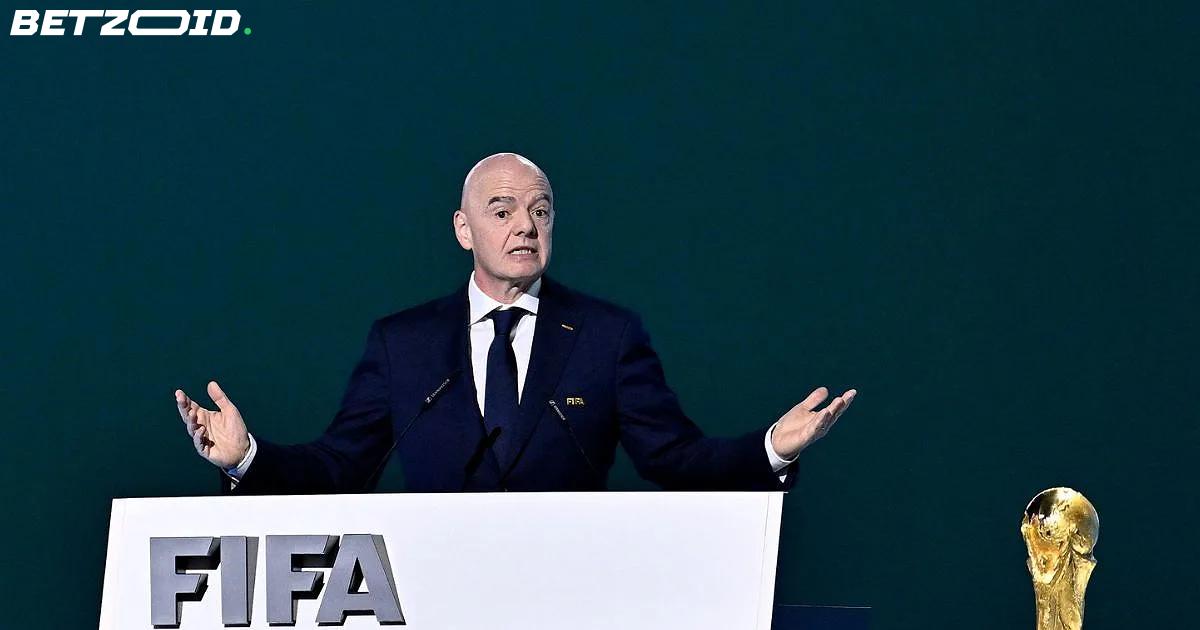
"I don't think it's a good idea for the World Cup itself, and it's not a good idea for our qualifiers either." That was UEFA President Aleksander Ceferin last year. His position hasn't shifted. Neither has Asian Football Confederation President Sheikh Salman's, who publicly questioned where any of this ends. They're both right — and Gianni Infantino knows it, which is exactly why he keeps floating the idea anyway.
Infantino has acknowledged, mid-tournament, that a 64-team World Cup is "among the ideas" worth examining once the 48-team edition wraps. The 48-team format only just debuted in 2026. The ink is barely dry and we're already talking about stacking another 16 nations on top.
The maths are alarming
Run the numbers. A 64-team tournament, keeping the same four-team group structure followed by a 32-team knockout, produces 128 matches. That's 24 more than 2026 and double what the old 32-team format delivered. Unless FIFA starts staging games simultaneously at a breakneck pace, you're looking at a tournament that runs well beyond five weeks — which is already a stretch by any reasonable measure.
Saudi Arabia is set to host in 2034, alone, with 15 proposed venues. Ramadan is expected to begin in mid-November that year, which essentially rules out the Qatar 2022 window. Adding 16 more teams to that puzzle — more stadiums, more hotels, more transport, more training facilities — in a country still building its tourism infrastructure isn't ambitious planning. It's chaos dressed up in a press release.
The 2030 edition is spread across Spain, Portugal, Morocco, Uruguay, Argentina, and Paraguay. Six host nations, 64 teams. Think about the coordination that actually requires for a moment.
What this is really about
The competitive balance argument is a fig leaf. Yes, smaller nations get a shot at the biggest stage. That's genuinely valuable. But the deeper consequence of a 64-team tournament is what it does to qualifying.
If qualification becomes easier — more automatic berths, less at stake in regional campaigns — the commercial value of those qualifying competitions drops. Broadcasters pay less. Regional confederations lose revenue. They become more dependent on FIFA's own distributions. Which means more financial leverage, more influence, and more structural power flowing toward Zurich.
Infantino framed it as fairness: "If you don't give smaller countries a chance to participate in the World Cup, they'll lack the incentive to keep improving." That's not wrong on its face. But it conveniently sidesteps the fact that the AFC and UEFA — the confederations representing football's most developed markets — are both opposed. The confederations most likely to lose power are the ones saying no.
- 128 matches in a 64-team format, up from 104 in 2026
- Tournament length could extend beyond five weeks, already a strain on club schedules
- France's federation budgeted €24.5 million for 2026 — a longer tournament pushes those costs higher for every nation
- Japan's J-League and MLS are both switching to August-May seasons, meaning a winter World Cup disrupts far more competitions than it did in 2022
- Player welfare concerns mount with each additional match week added to an already congested calendar
Whether any of this progresses likely hinges on how the 48-team version is judged commercially and competitively. If broadcasters love it and the group stages deliver drama rather than dead rubbers, Infantino has his argument. If the early rounds feel bloated and the knockout stage exhausted, the case collapses.
France's federation president Philippe Diallo went to April's FIFA Congress in Vancouver specifically to ask for greater financial support for participating nations, noting Les Bleus would probably need a semi-final run just to break even. A 64-team event only makes that math worse — for everyone except FIFA.