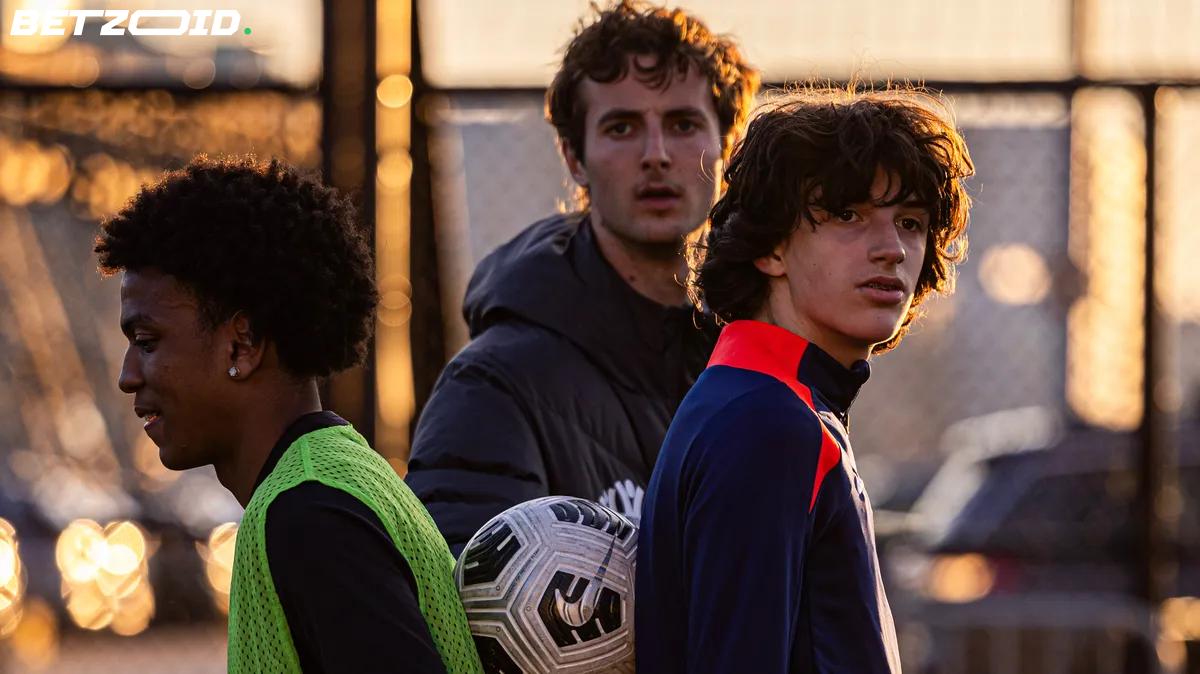
"It's like, 'Wow, this went from 0 to 100 really quick.'" Keanu Stingone said that about being a 12-year-old in a US professional academy. He quit shortly after. Not because he lacked talent — because the environment was designed for pressure, not development.
Stingone grew up playing grass-roots soccer in Austria before his family moved back to the States. The contrast was jarring. In Europe, youth soccer at that age is about enjoying the game, building technique, and staying curious. In America, 8-year-olds are already playing cutthroat. Scouts are sorting winners from losers before kids have finished primary school.
After quitting club soccer, Stingone drifted to pickup basketball during COVID, found his love for movement again, returned to high school soccer — no academy, just his friends — and eventually earned a spot at Manhattanville University. A Division III scout came to one of his games to watch someone else. Stingone played well enough to get noticed anyway.
The system filters out money problems, not talent problems
Landon Donovan made this point bluntly after Team USA's World Cup exit. His 8-year-old son played for a large San Diego club whose coaches eventually pushed him down to the B team — away from the friends he'd built the sport around. "I was crying in bed with my son and my wife," Donovan said. "He just said to me, 'I just wanna play with my friends.' And it broke my heart."
That's not a one-family story. That's a systemic one. The American club model doesn't find the most talented kids. It finds the ones whose families can afford thousands of dollars per season in fees. Spain, France, England, and Argentina all reached this World Cup's semifinals. The US went out in the round of 16. The gap isn't physical. It's structural.
Brando Babini, 21, founded Youth 4 Youth FC at 16 precisely because he saw that gap up close. Raised in New York City by a European and an American parent, recruited as a collegiate soccer player before realising that life wasn't for him, he built an organisation that trains players aged 10 to 18 — and crucially, helps families navigate a system most parents have no framework for understanding.
"Why should you be the one who has to understand the intricacies between GA and ECNL or between MLS and MLS2?" Babini says. "That's our job."
What Norway's system tells us — and what we should actually steal from it
The Wall Street Journal recently profiled Norway's youth soccer model. Low cost, high participation, equal playing time, minimal pressure. Erling Haaland came through it. The principle is simple: let kids fall in love with the game before you ask them to sacrifice for it. When Norway reached the World Cup quarterfinals this cycle, it wasn't a surprise to anyone who understood how deep that pipeline runs.
Babini and Stingone aren't saying American kids shouldn't work hard. They're saying the sequence is wrong. Build love first. Build competitiveness later. Stingone's view is that ninth grade — not age 8, not age 10 — is the point at which real commitment starts to make sense.
- Before high school: develop passion, stay with your friends, get touches in pickup as much as formal training
- High school onwards: commit to improvement, think seriously about the next level — but only if the drive is internal
- At any age: environment shapes progress; kids won't develop in places where they feel uncomfortable or expendable
Youth 4 Youth has grown to around 1,000 players and 50 coaches and ambassadors across New York and the Northeast, with programming reaching Dallas and virtual mentorship beyond that. Babini also runs a free college showcase in partnership with Nike, specifically to surface players who can't access high-end clubs. That's the direct structural answer to what Donovan identified — talent discovery that doesn't start with a credit card.
"There are millions of kids that are falling out of love with the sport, quitting at 13, 14, because they don't want to deal with their parents yelling, or the coaches, or the pressure," Donovan said. "If my kids are falling out of love with it, imagine what the rest of the country's dealing with."
For anyone watching the US underperform at another World Cup and wondering why the talent pipeline keeps stalling — that quote is as close to a root cause as you'll find.