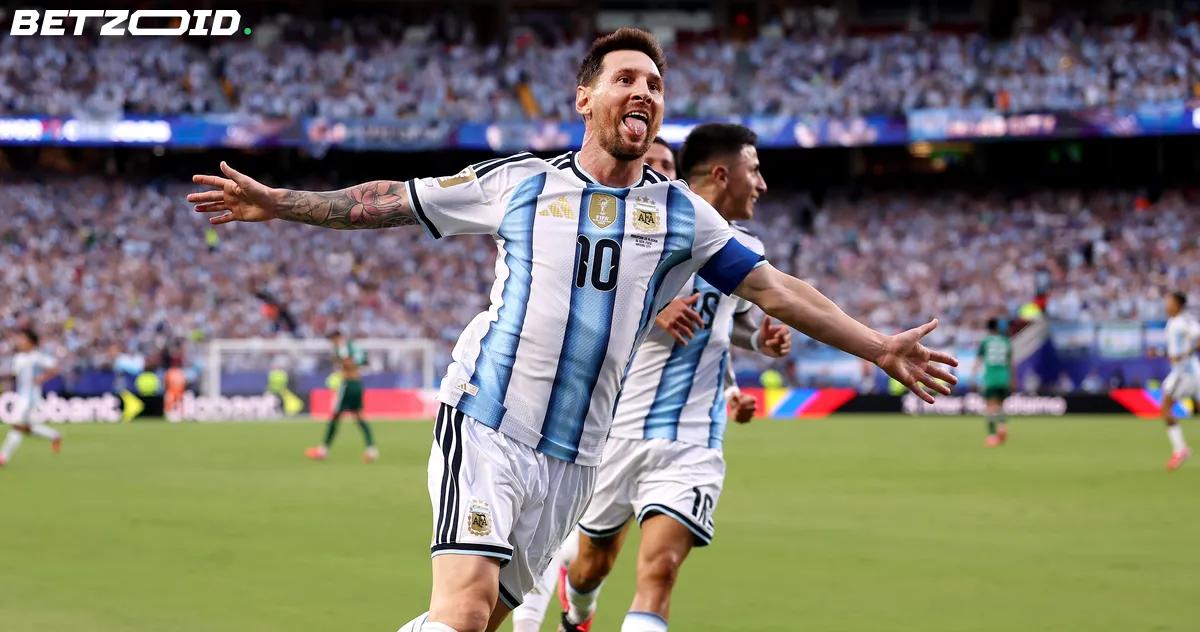
"The emotion was so overwhelming, an American woman who had never been to a game before started crying because she was so moved by the near-religious ecstasy we were witnessing." That's Roger Bennett, founder of Men in Blazers, describing what it felt like to be inside the Argentina-Egypt match. On television, watching the same game, millions of people were furious.
That gap — between the stadium and the screen — is the Argentina problem in a single sentence.
Lionel Messi is playing his final World Cup. He's scored more goals than anyone else in the tournament. On pure football terms, this should be the send-off story of a generation. But Argentina's round of 16 match against Egypt turned the whole narrative sideways, and it hasn't straightened back out since.
What actually happened against Egypt
Egypt scored a legitimate counterattacking goal — possibly the best of the tournament — to go ahead in the second half. Then Messi flagged down a sideline official, demanding the referee review a foul from before the move even developed. The referee, who had already waved play on, reversed his decision and disallowed the goal. The announcers were stunned. Egypt were incensed. Argentina eventually won 3-2, with the same referee denying Egypt a clear penalty late on and refusing to use VAR to review it. Egypt filed a formal complaint. FIFA said nothing meaningful.
Argentina's comeback, including Messi's equalizer, was real. The football was thrilling. But so was the controversy, and pretending one cancels out the other is exactly the kind of reasoning that makes neutral fans switch off.
There's also a broader context that's hard to ignore. FIFA president Gianni Infantino personally invited Messi's Inter Miami to the Club World Cup last year despite the club not qualifying through any sporting merit. Messi is the commercial centerpiece of this entire tournament. FIFA is projecting $8.9 billion in revenue. The incentives to keep Argentina — and specifically Messi — alive in this competition are not subtle.
The pibe paradox
Argentina's football identity has always carried this tension built in. British journalist Jonathan Wilson, who wrote a book on Argentine football called Angels with Dirty Faces, put it plainly: "Argentinian football is of the streets. It's the mass games on the vacant lots of the city, where it's all about technical skill, and there's not a teacher there with a whistle ready to stop things if somebody steps out of line. You've got to look after yourself."
The cultural archetype is the pibe — the street-smart kid who wins through skill and cunning, who beats a system stacked against him. Maradona was its purest expression: the Hand of God handball and the 60-yard solo Goal of the Century, both in the same quarterfinal against England in 1986. Shameless and transcendent, sometimes within minutes of each other.
Messi, ironically, was never a natural pibe. Raised in Spain, shy, commercially spotless, relatively straightforward. For years, Argentina fans didn't fully trust him for that reason. The 2022 World Cup changed everything — though it also came with a bad-tempered quarter-final against the Netherlands and players and fans hurling racist abuse at France's predominantly Black squad for months afterward. The crown was real. The baggage was real too.
The problem now is structural. El pibe is supposed to be the underdog beating a corrupt system. What happens when the corrupt system is actively helping him? That's not a pibe story anymore. That's just favoritism with better footwork.
Argentina face Switzerland in the quarterfinals on Saturday. Switzerland are one of this tournament's most uncontroversial teams — organized, clean, nobody's enemy. If Argentina get another refereeing gift, the backlash won't stay confined to social media. And if they win clean, on quality alone — the way Messi can still win games when he chooses to be absolutely decisive — the narrative resets completely.
That's the tight rope Argentina are walking. They're entirely capable of making this a football story again. Whether the officials, and FIFA, let them try that on their own is the question nobody should have to be asking at this stage of the tournament.