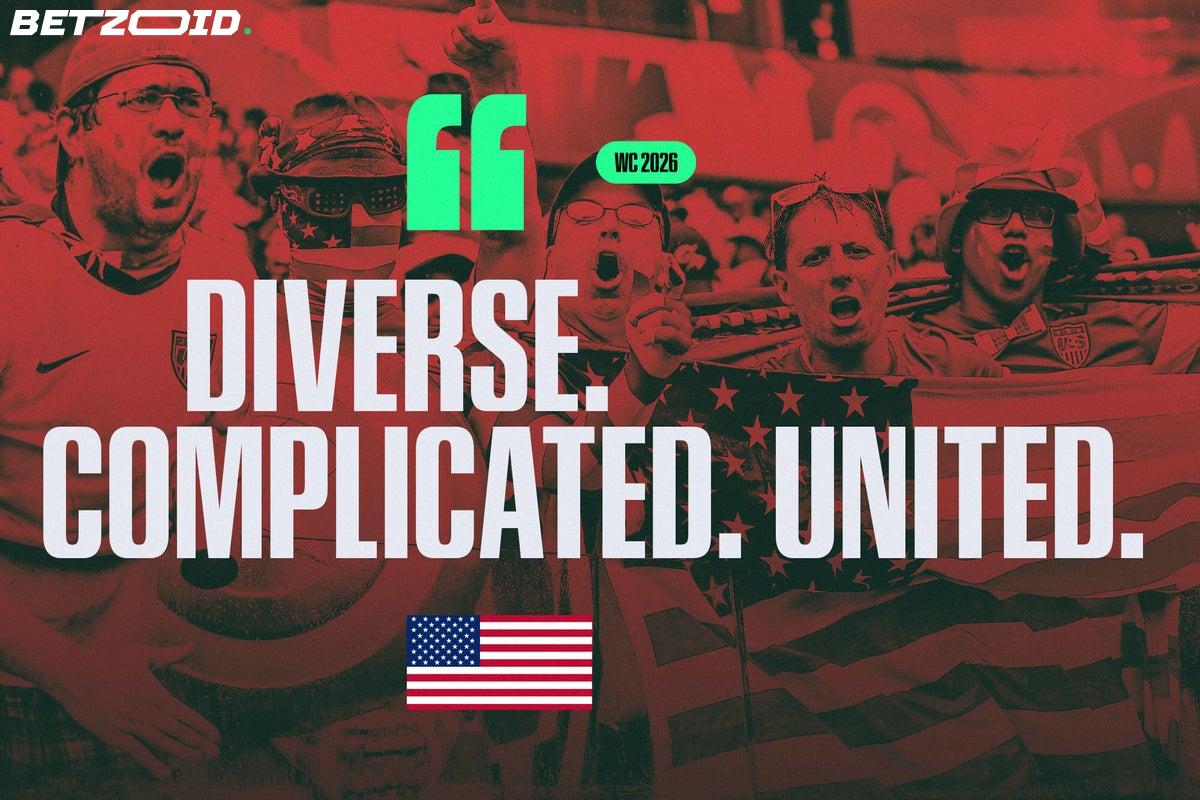
"It's a relentless optimism." That's how Antonio Borjon, a U.S. fan in Southern California, sums it up — and honestly, no three words better capture what it means to follow the USMNT.
American soccer fandom isn't one thing. It's the hardcore travellers who follow the team coast to coast. It's the casual fan who watches Barcelona all season and then wraps themselves in a Stars and Stripes jersey come June. It's the kids of immigrants who grew up singing a different national anthem. And once every four years, all of it collapses into a single, briefly unified mass.
A fanbase that starts from scratch every cycle
The generational loyalty that makes someone a Packers fan from birth, or a Liverpool supporter by bloodline, doesn't really exist in American soccer yet. The USMNT operates without a home stadium, rotating around the country like a travelling circus — and that fractured geography makes it genuinely hard to build a consistent supporter culture. Elliott Montalvan, president of Barra 76, puts it plainly: "We have everybody's culture. It's like creating the ideal superhuman."
His story is worth hearing. Raised in an Ecuadorian household in New York, he grew up wearing Ecuador jerseys. Now he runs a U.S. national team supporters' group. When the two countries face off, he and his father watch together, sing both anthems, and celebrate every goal. That kind of layered identity — immigrant roots and American belonging existing side by side — is specifically American. You won't find it in England or Uruguay.
But it comes with friction. U.S. fans have spent recent years outnumbered at home games by supporters from Morocco, Colombia, Turkey, Guatemala, South Korea, and Mexico. Monty Rodrigues, a longtime U.S. fan who emigrated from India, calls it "heartbreaking." It's a direct consequence of the country's diversity, which is also supposedly one of the team's greatest long-term strengths. Both things are true.
The underdog angle that actually works
Here's what makes 2026 different from the Olympics. When the U.S. basketball team takes the floor, everyone expects a demolition. When the U.S. men's soccer team kicks off, nobody does. That inversion matters. It's the rare moment when the most powerful country on earth gets to root for an underdog — and people feel it.
"It's the opposite of frontrunning," says Boston-area fan Jon Strauss, who's been following the team since the 1990s. "Get in on the ground floor and work your way up." That ethos is exactly why the bandwagon fills every four years, and why this summer's tournament — played on home soil — stands to pull in numbers the USMNT has never seen.
The hardcore base is small by any honest measure. Craig Hahn, a member of the Sammers supporters' group, acknowledges it directly: the travelling faithful who go to qualifiers and friendlies is "quite small." But come a World Cup on American soil, those diehards become the core of something much larger. Whether that bigger audience sticks around post-tournament is the question U.S. Soccer has been trying to answer for thirty years.
Montalvan and others are using 2026 as a construction project — deliberately blending supporter cultures from Latin America, Eastern Europe, Africa, and beyond into something that feels authentically American rather than derivative. "We don't want to copy; we want to be authentic," says Randy Hernandez, another Barra 76 member. "We mix together to make something new."
They're building it in real time. Whether it holds together after the final whistle is another matter entirely.