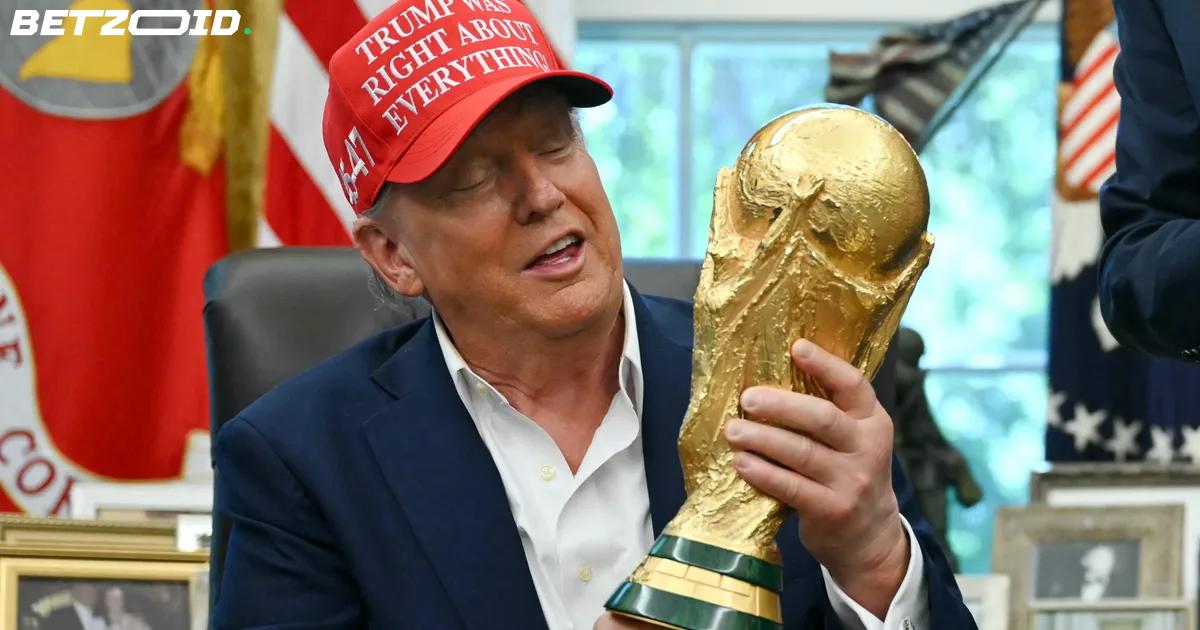
"The worse that Donald Trump's approval ratings get," says Jules Boykoff, the more incentive he has to "cling to sports as a sort of political life raft." With the FIFA World Cup less than a month away, Boykoff — a professor at Pacific University, former U.S. under-23 international, and author of the new book Red Card — argues that Trump isn't just enjoying the spectacle. He's using it.
The comparison Boykoff reaches for is pointed. Benito Mussolini hosted the 1934 World Cup and manufactured a trophy of his own — the Coppa del Duce — larger than the Jules Rimet itself, just to underline who was really running the show. He surrounded himself with athletes. He made the tournament a vehicle for fascist image-making. "If you look at the way Mussolini cozied up to the athletes at the World Cup in 1934, he just wanted to be around these kinds of macho guys," Boykoff told HuffPost. "Well, you can see the same kind of thing that Trump does all the time."
The FIFA Peace Prize says everything
The most glaring exhibit is the FIFA Peace Prize, awarded to Trump by FIFA president Gianni Infantino months before U.S. military action in Iran and Venezuela — citing Trump's "unwavering commitment to advancing peace and unity." Boykoff isn't mincing words about what that was: the most blatant example of sportswashing via the World Cup he's seen. "As ludicrous as the prize might sound to a lot of people, to him, he looks important."
It fits a pattern that goes well beyond soccer. This year alone, Trump invited Lionel Messi to the White House, attended UFC events, started building a UFC arena on the South Lawn, and is eyeing the NBA Finals. The 2028 Los Angeles Olympics sits on the horizon as another potential halo. Each appearance feeds what Boykoff calls the "sportswashing" machine — using popular sport to launder a damaged political brand.
Historically, the playbook has been consistent. Hitler's 1936 Berlin Olympics. The 1978 World Cup under Argentina's military junta. Russia in 2018. Qatar in 2022. The tenets don't change much. What changes is the scale of the audience and the sophistication of the spin.
Real consequences for real fans
This isn't purely abstract politics. Fans from Haiti, Iran, and other nations covered by Trump's travel ban are barred from entering the U.S. to watch their teams play. FIFA, which markets the tournament as a place where "football unites the world," has said little of substance about it. Boykoff cuts through the slogan: "Trump is obviously putting lie to that by not allowing many people from countries that have qualified into the United States to even watch matches."
Human rights groups have flagged the World Cup as a potential sportswashing "bonanza," with ICE presence at matches an additional concern as millions of foreign fans descend on U.S. cities. The tournament carries special event security ratings that give federal law enforcement broad latitude at stadiums. That's not a hypothetical — it's a structural reality that existed before a single ball is kicked.
For a tournament whose betting markets will be among the most traded in history — billions in handle across outright winner, group stage, and player prop markets — the political atmosphere around this edition is unusually charged. Whether that affects turnout, atmosphere, or the commercial ecosystem around the event is a live question with no clean answer yet.
Boykoff still believes in the game. But his closing line lands without sentimentality: FIFA, Infantino, and Trump are stealing the people's game "right out from under us."