"You can just see that it's not a normal game for them. There's a certain amount of desperation in the way they play. They have to be successful, and you can sense it." That's Colin Bell, former South Korean women's national team manager, watching North Korea play. And he's onto something that goes well beyond tactics.
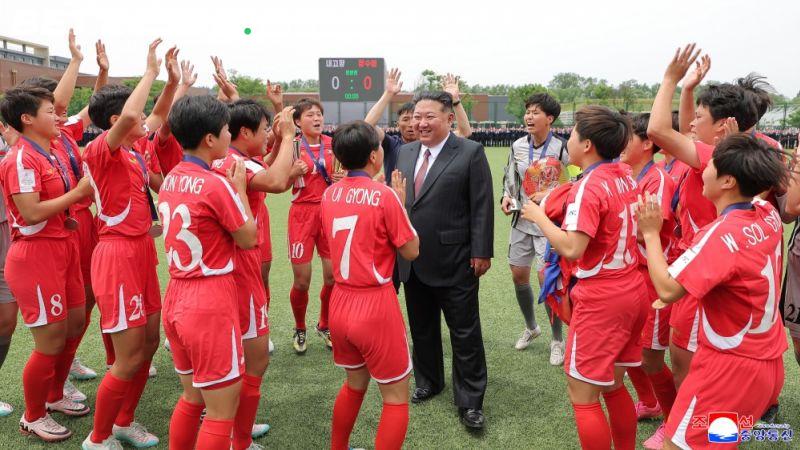
Pyongyang-based Naegohyang Women's FC lifted the AFC Women's Champions League trophy last month — on South Korean soil, of all places — while the national youth sides hold both U-17 and U-20 world titles. The U-17s just added an Asian Cup, beating Japan 5-1 in the final. Kim Jong Un was courtside for the celebratory exhibition match. Players wept. The supreme leader shook hands.
This is not a football story that fits neatly into the usual template.
The machine behind the results
It starts early. The Pyongyang International Football School, founded in 2013, takes girls and boys from age seven through to 17. Champions League MVP Kim Kyong Yong — now 24, the match-winner in the final against Tokyo Verdy — started playing at ten and has been through every level of the system. She's a blueprint, not an exception.
What that system produces, according to coaches who've faced these teams, is something difficult to replicate. British coach Stephen Constantine, who ran FIFA coaching sessions in the country in 2018, described watching players sprint the length of the pitch while carrying someone on their back. "It was insane," he said — and he meant it as a compliment, mostly.
American defender Rielly Chesna, whose Ho Chi Minh City side lost to Naegohyang in the Champions League quarter-finals, put it more plainly: "You could tell they know exactly where they're supposed to go, and they just flowed. Their passing on the ground and movement was perfect. It was definitely hard to track them."
Bell, who studied the U-20s at the recent Asian Cup, was blunter still: "I watched every player run. They all run with the same style. Honestly. It's drill, drill, drill from a very early age, and you just cannot compete with them at youth level."
Can it translate to the senior Women's World Cup?
That's the question that actually matters now. North Korea's senior women's team returns to the global stage at next year's Women's World Cup in Brazil — their first appearance since withdrawing from the 2023 edition, citing Covid-19. Their record at this year's Women's Asian Cup was strong enough that Australia's coach Joe Montemurro called them "the best team in the tournament" after edging them out in the quarter-finals.
There's a complicated history here. Five players failed doping tests at the 2011 World Cup — blamed on traditional Chinese medicine involving deer musk glands and lightning strikes, in what remains one of the stranger episodes in tournament history. They were banned from the following World Cup cycle. Then came years of self-imposed isolation.
Now they're back, with a new head coach and nearly half the squad refreshed with youth graduates. The bookmakers haven't fully priced in what this team might do, which is worth watching. A side that conceded a tight quarter-final loss to Australia — who are, by any measure, a top-10 women's team — isn't arriving in Brazil to make up the numbers.
Freelance Asian football journalist Gina Bagnulo thinks they'll win matches. Bell is more cautious: "Youth football has been a big advantage so it will be very interesting to see how they fare. Are they able at some stage to dominate senior national football? I'm not sure if they can."
The gap between youth dominance and senior success is real. But a squad built on a decade of the same drills, the same coaching philosophy, and — if Bell is right — the same existential drive to perform? That's not nothing.
"If you're a champion, Kim Jong Un will meet you at the airport," said FIFA educator Kwok Ka-ming, who trained coaches in North Korea four times between 2013 and 2019. "This is critical."
In women's football, most nations are still figuring out how to invest. North Korea built a machine. Brazil will show us what it's actually worth.