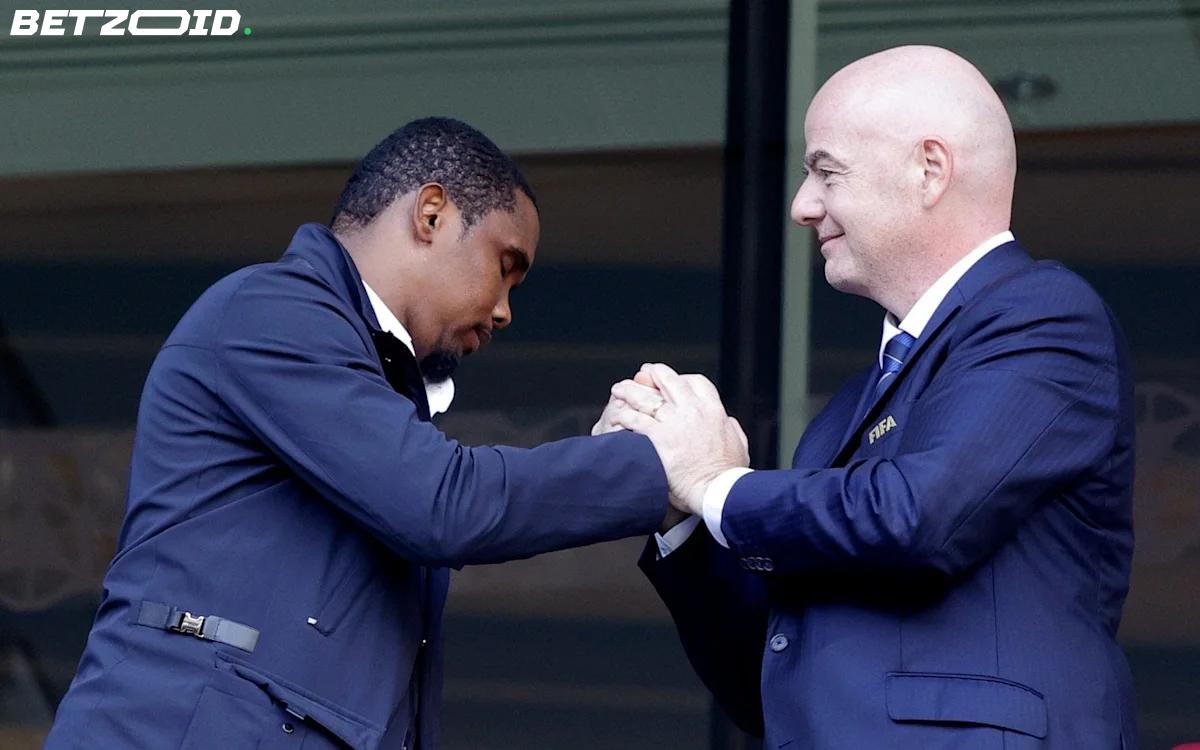
"When accusations as serious and documented as these result in no visible investigation, while the official concerned continues to be publicly promoted by FIFA, it becomes legitimate to speak of protection." That's not a conspiracy theory from a bitter rival. That's a former member of Fecafoot's executive committee, speaking on the record.
The allegation at the centre of it: €567,570 — roughly £487,000 — paid by the Russian football federation into Samuel Eto'o's personal bank account in Qatar, with no evidence the money ever reached Fecafoot's official accounts. Former executives say they filed formal complaints with FIFA's ethics committee more than a year ago. They're still waiting.
The money trail FIFA won't follow
The Times obtained what it says is an invoice for €455,056 — representing 80 per cent of appearance fees for the Russia vs Cameroon friendly played in Moscow in October 2023 — directed to Eto'o's account at Qatar National Bank in Doha. Fecafoot's own statutes state that all federation funds must be held in accounts opened in the federation's name. Not a president's personal account in a Gulf state.
Guibai Gatama, former Fecafoot executive committee member, put it plainly: "Neither Fecafoot nor Samuel Eto'o has denied the existence or authenticity of these transactions, as the documents are damning."
No denial. No investigation. And Eto'o keeps getting publicly backed by Gianni Infantino on social media.
This isn't the only financial question mark hanging over Eto'o's tenure. A Los Angeles law firm representing his opponents in Cameroonian football reportedly asked the FBI to look into the disappearance of a $600,000 match fee from a Cameroon vs Mexico friendly in San Diego in June 2023. The Russia money and the US money are separate cases — but together they paint a picture of a federation president whose financial management has attracted attention on two continents.
The political arithmetic is obvious
Eto'o's accusers aren't shy about naming the dynamic. Former vice-president Henry Njalla Quan — who filed his own complaint in 2024 alleging match-fixing and abuse of power — asked directly whether "an element of political reciprocity" exists between Eto'o's vocal support for Infantino and the protection he appears to receive in return.
It's a fair question. Eto'o has publicly called for Infantino's controversial FIFA Forward Enterprise sell-off plan to be revived. FIFA's legal team cited Eto'o by name — "one of the greatest African soccer players in history" — in US court filings defending the scheme against a UEFA lawsuit. Infantino has posted on social media congratulating Eto'o on his re-election as Fecafoot president despite a tenure that includes a 22-month suspended prison sentence for tax fraud, a $200,000 CAF fine for signing a deal as a paid ambassador for a Russian betting company that sponsored Cameroonian football, and a ban from national team matches for abusing officials at the Under-20 Women's World Cup.
FIFA's spokesman insisted the president "has no influence over FIFA's judicial bodies" and called the scrutiny an attempt to "amplify unsubstantiated allegations." But that defence gets harder to sustain the longer the ethics committee stays silent on documented complaints about a man Infantino keeps publicly championing.
Morocco, the World Cup final, and more governance chaos
Meanwhile, the head of Morocco's football federation, Fouzi Lekjaa, told a political event that Benslimane — home of the proposed 115,000-seat Hassan II Stadium — "will have the honour of hosting the 2030 World Cup final." FIFA immediately denied any such decision had been made. Spain's football chief Rafael Louzán has said the same thing in the opposite direction, insisting the final belongs in Spain.
No final venue decision has been made. The FIFA council meets next month. But the fact that national federation heads are making these declarations publicly — in political settings, not sporting ones — tells you everything about how the 2030 tournament is being negotiated.
Morocco was among the first nations to publicly back Infantino after the FFE collapse. FIFA's African headquarters is there. Infantino has chosen Rabat for March's congress, where he's set to stand for a fourth presidential term.
Also on the same day Lekjaa made his final claim: the French Football Federation withdrew its endorsement of Infantino's re-election by unanimous vote, saying "a series of events directly involving FIFA's governance and its president" had "seriously damaged the image and unity of football."
The French aren't alone in that view. They're just the latest to say it out loud.