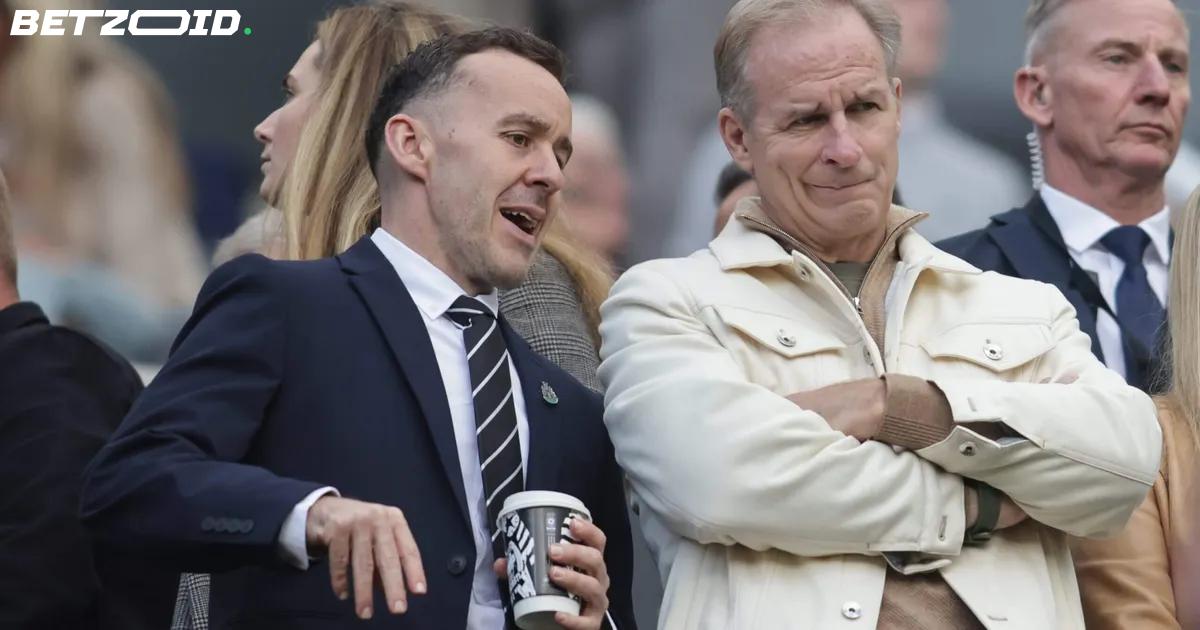
In October 2021, Newcastle United had one executive. One. Lee Charnley, managing director, running the whole operation under Mike Ashley, who wasn't even on the board. Five years on, the club has a six-person board, a CEO, a sporting director, a performance director, ten C-suite members, and specialists fanned out across every department. That's not growth — that's a different club wearing the same shirt.
The Saudi-backed takeover didn't just change who owned Newcastle. It changed what Newcastle is, structurally and commercially. PIF's 85 per cent majority stake — increased following Amanda Staveley's exit in 2024 — means chairman Yasir Al-Rumayyan sits at the apex of everything, even if the 56-year-old rarely sets foot in the northeast. He usually attends a match or two a season. The real weight of daily influence flows through Jacobo Solis, PIF's head of international direct investments, who joined the board in January 2025 and has been quietly central throughout.
Hopkinson Is Running the Show
The CEO slot was chaotic before David Hopkinson arrived. Darren Eales resigned after a cancer diagnosis in late 2024. Newcastle went more than a year without an active chief executive. When Hopkinson — previously a senior figure at Real Madrid, Madison Square Garden Sports, and Maple Leaf Sports — took the job 13 months ago, he wasted little time reordering things.
His 100-day review doubled the size of the senior executive team. He introduced "The Newcastle Code" as the club's cultural framework. He sold Sandro Tonali to Tottenham for up to £100m. He secured the club's first training-ground and training-kit sponsors in KNOX and SumUp. And in August, he announced a £190m training ground at Woolsington near Newcastle Airport, while the club also acquired the Grade I-listed Leazes Terrace buildings behind the East Stand.
The target is £500m in annual revenue by 2030. That's an ambitious number for a club that, under Ashley, wasn't exactly known for commercial aggression. A new chief revenue officer, chief marketing officer, chief creative officer, chief strategy officer, and chief people officer have all been brought in. The crest you saw unveiled last week? That was Kenny McIver, the new CCO — former global design director for Nike Football, designer of kits for Barcelona and England, and a lifelong Newcastle season-ticket holder.
The Football Structure Is Still Settling
Ross Wilson is the sporting director, Newcastle's third since 2022 after Dan Ashworth and Paul Mitchell. He and Hopkinson operate as partners rather than a strict hierarchy — Wilson reports directly to the board on footballing matters, which gives him real independence. That's a meaningful detail. It means the football side has its own lane.
Wilson's first transfer window was defined by necessity: Anthony Gordon sold for compliance, then Tonali's exit freed funds. Bruno Guimaraes went to Arsenal. Every incoming signing was 24 or under. The wage bill is being trimmed. Wilson frames this as a deliberate "trading model" — buying young, developing, selling, reinvesting. Newcastle's Premier League and European odds will live or die by how well that cycle actually works in practice.
Then there's the head coach situation. Eddie Howe — who won the Carabao Cup in March 2025, the club's first major trophy since 1969, and twice qualified for the Champions League — asked to leave before pre-season. His successor is Matthias Jaissle, 38, a product of the Red Bull coaching system who won back-to-back Asian Champions League titles at Al Ahli. He cost £8.5m in compensation. Hopkinson called him a "rock star." Whether the Tyneside crowd comes to see him that way depends entirely on results.
Jaissle believes in high-press, vertical football and working with young squads — which is exactly what Wilson has built for him. Unlike Howe, who had board-level access built through years of trust, Jaissle reports into Wilson and the executive team. That's a tighter leash by design.
- Technical director: Sudarshan Gopaladesikan ("Suds"), 34, recruited from Atalanta in July 2025 — leads data operations across departments
- Assistant sporting director: Jack Ross, formerly head of football strategy, covers talent management, the women's team, and academy
- Academy director: Steve Harper, Newcastle's longest-serving player, running the full youth operation
- Women's football: Newcastle top of WSL2 after five wins from five under new head coach Tanya Oxtoby
- Recruitment: Currently short-staffed — Steve Nickson left for Wrexham in July, Andy Howe departed last month. A head of first-team recruitment is expected before January.
The recruitment gap is the most pressing vulnerability right now. A January window with no permanent head of first-team recruitment, while the squad is mid-rebuild, is the kind of structural hole that can unravel a carefully laid plan. Newcastle say a preferred candidate has been identified. They need to move.
Five years ago, one man ran this club. Now it takes twenty to keep the lights on — and that's before you factor in the coaches, scouts, and analysts underneath them. Whether all that structure translates into trophies is the only question that actually matters on Tyneside.