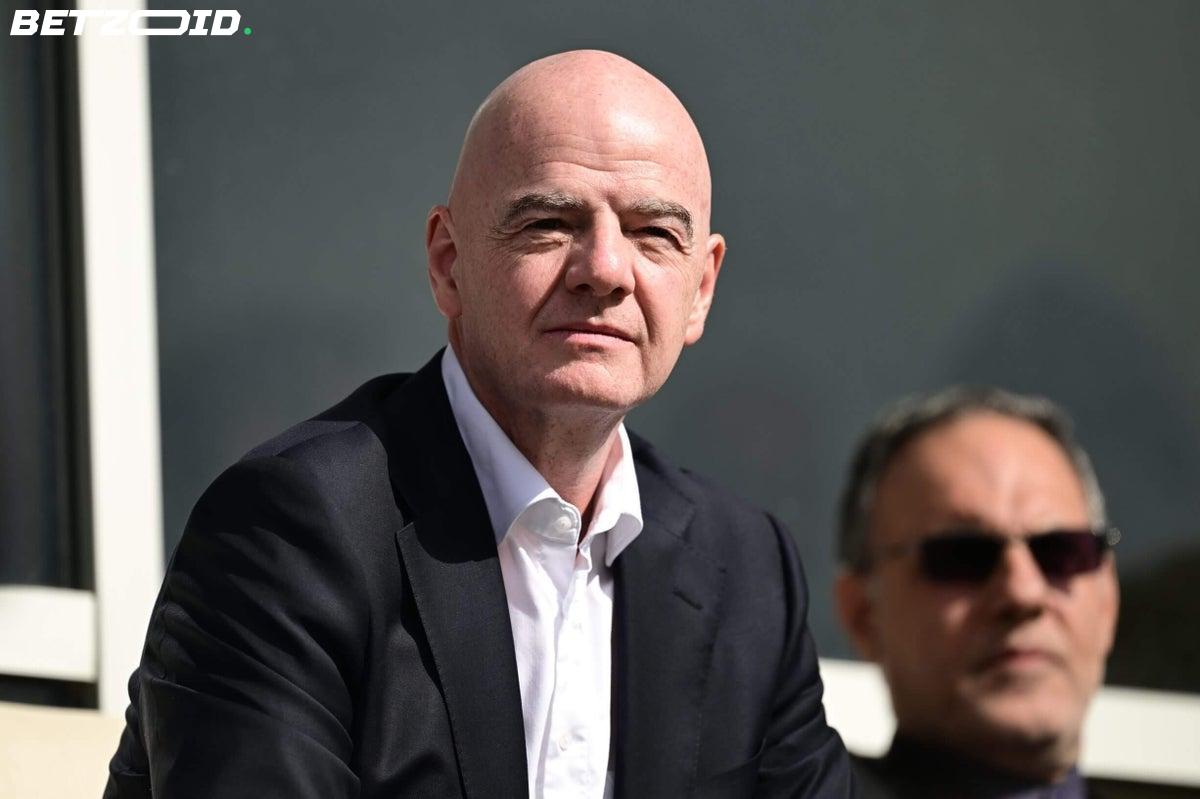
"Without FIFA, there would be no football in 150 countries." That's Gianni Infantino's line, delivered at the World Sports Summit in Dubai in late December — and it's the kind of sweeping claim that sounds authoritative until you think about it for ten seconds.
England and Scotland played their first international in 1872. FIFA was founded in 1904. Thirty-two years of football existed just fine before the governing body showed up. The idea that kicking a ball would simply cease in half the world without FIFA's administrative umbrella is, as one academic put it to The Athletic, getting things precisely backwards.
"FIFA needs football more than football needs FIFA," says Alan Tomlinson, Emeritus Professor of Leisure Studies at the University of Brighton and author of What is FIFA For? That's not a contrarian take — it's just historically accurate.
The money is real, even if the rhetoric isn't
Here's what's actually true: FIFA's Forward development programme does funnel significant cash to member associations. Under the current 2023-2026 cycle, each of the 211 members is entitled to up to $8 million over four years. The total pot across this cycle sits at $2.25 billion, rising to $2.7 billion for 2027-2030. The six confederations — AFC, CAF, Concacaf, CONMEBOL, OFC and UEFA — each receive $60 million per cycle on top of that.
Break it down annually since FIFA Forward launched in 2016 and you get roughly $500 million a year split across 200-plus associations. That's just over $2 million per association. Useful. Not exactly existential.
The $8 million per association breaks into operational costs (up to $1.25 million annually), tailored infrastructure projects (up to $3 million over the cycle), and travel and equipment support for smaller federations. A FIFA spokesperson told The Athletic that without this support, "more than 50 per cent of FIFA's member associations could not operate." That's a more defensible claim than Infantino's version — organised tournament football would look very different, particularly women's, youth and disability football that often depends entirely on third-party grants to function.
Context for why Infantino chose Dubai to make this argument: the 2026 World Cup ticket prices had just been announced to a storm of criticism. General admission prices drew immediate backlash before FIFA scrambled to introduce a "supporter entry tier" of around 1,000 tickets per game at $60. Generating revenue from a bloated World Cup and then pointing to development spending as justification is a reliable FIFA playbook move.
The transparency problem nobody wants to discuss
The auditing process FIFA cites as its safeguard has real gaps. Annual financial audits from member associations are required — but they're not made publicly available. FairSquare, the non-profit advocacy group, called this out bluntly in an October 2024 report: "There is a critical lack of transparency over how member associations spend FIFA's development funds." FIFA promised independent external audits of all member associations back in 2019. There's no public repository of those audits anywhere.
Sanctions do happen. In May 2024, five Bangladesh Football Federation officials were sanctioned after funds were found to involve "false and/or falsified documentation." Officials from Panama, Venezuela, Equatorial Guinea and the Maldives have faced similar action. The system catches some misconduct — but Tomlinson's concern cuts deeper: "I don't think most of us really understand what would be done if there was a big problem."
What FIFA Forward actually does well is fund infrastructure in places that genuinely couldn't afford it otherwise. Comoros, the archipelago off Africa's east coast, has received over $17.5 million — more than $3.5 million of which went to stadia and a technical centre. The FA Wildcats programme for girls aged five to eleven got off the ground partly on FIFA funding. U.S. Soccer received $3 million in October 2024 to expand grassroots participation. These are real outcomes.
Tomlinson's sharper concern is structural: as these payments have scaled up spectacularly over the past decade, they've created a patronage system. Member associations vote for the FIFA president. The FIFA president controls the grants. "We will give you our vote if you give us that money" isn't an accusation — it's just an observable dynamic baked into the one-member-one-vote structure that keeps Infantino in power.
Football wouldn't disappear from 150 countries without FIFA. But organised international competition, women's football development, and grassroots infrastructure in smaller federations would take a serious hit. Infantino chose the more dramatic version of that sentence — because he was deflecting from ticket prices, not delivering a governance lecture.