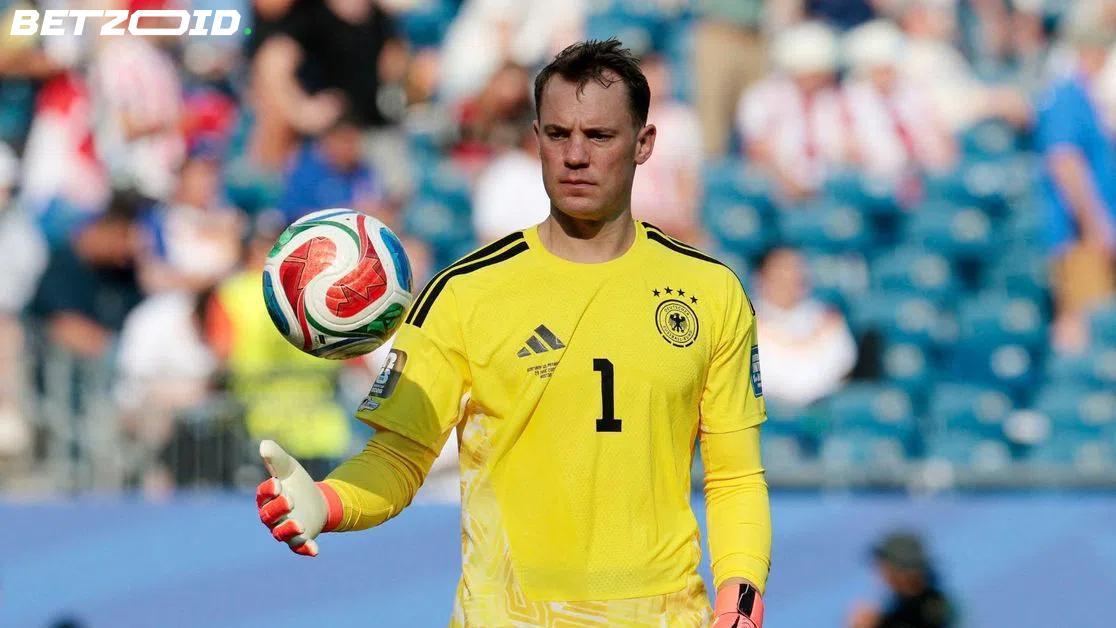
Germany went out to Paraguay on penalties at the 2026 World Cup, and Manuel Neuer walked away from international football. Again. For good this time.
The 40-year-old had come out of retirement weeks before the tournament at Julian Nagelsmann's request — a bet on experience that didn't pay off. Germany crashed out in the Round of 32, and Neuer confirmed what most had suspected: there would be no third act.
The goalkeeper who broke the position's job description
The résumé is extraordinary on its own terms. 128 caps. A World Cup winner's medal. The 2014 Golden Glove. A third-place Ballon d'Or finish in a year when Messi and Ronaldo were still at their peaks — which, for a goalkeeper, borders on absurd.
But the trophy count isn't the legacy. The legacy is that every top-level goalkeeper in 2025 is expected to do things Neuer spent a decade normalising: receive passes under pressure, step outside the box to sweep danger, initiate attacks with precision rather than punts. That wasn't standard before him. Now it's a baseline requirement.
The clearest proof came in Germany's round of 16 clash against Algeria at the 2014 World Cup. With Germany's defensive line pushed almost to the halfway line, Neuer repeatedly sprinted out of his area to kill through balls before they became chances — acting less like a goalkeeper and more like a libero. Germany won 2-1 in extra time, and a tactical concept went mainstream. The sweeper-keeper stopped being a curiosity and became the blueprint.
Coaches responded. Recruiters responded. The metrics clubs use to evaluate goalkeepers now include progressive passes, actions outside the penalty area, and press resistance — data points that barely existed as recruitment tools before Neuer made them relevant. Ederson, Alisson, ter Stegen, Maignan, Diogo Costa — they all carry elements of what Neuer built, even if none has fully replicated the complete package.
A club career that still isn't finished
At club level, Neuer's Bayern Munich record is staggering: 13 Bundesliga titles, two Champions League crowns, a Bundesliga record for clean sheets, and a decade as the cornerstone of the most dominant side in German football history. He arrived from Schalke in 2011 in what was then a landmark goalkeeper transfer and immediately changed how Bayern's entire defensive structure was built.
Crucially, that chapter isn't closed. Neuer signed a one-year extension at Bayern earlier this year, keeping him at the club until 2027. Jonas Urbig is the heir apparent for the national team, and Bayern's younger options are developing — but the club still wants Neuer in the building. That says something about the gap between what he offers and what exists behind him.
Germany's goalkeeping market just opened up, and whoever fills the shirt will be measured against standards that Neuer spent 15 years establishing. That's a complicated inheritance.