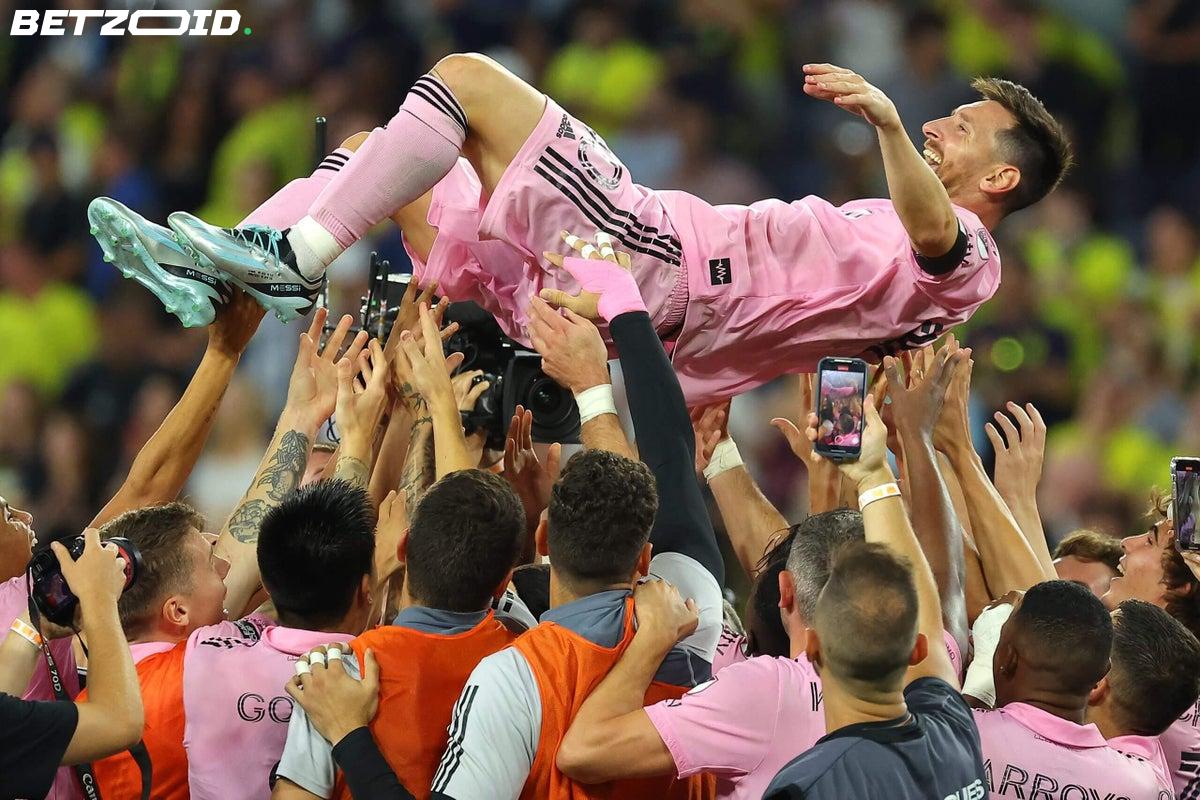
The first thing Lionel Messi said when he sat down with Inter Miami's sporting director to sign his contract wasn't about money, lifestyle, or the Florida weather. It was: "Tell me all the trophies I can win." That line alone tells you more about this chapter of his career than a thousand takes about MLS being a retirement league.
Those details come from The Messi Effect, a new book by journalist Tom Bogert out June 2, which traces how Messi's 2023 arrival reshaped American soccer — in boardrooms, locker rooms, and on the books of every team that suddenly had to compete for attention against the greatest player alive.
The initiation story everyone will be talking about
The book's most vivid scene involves a team dinner ritual. Career MLS midfielder Victor Ulloa — the guy who once had a Messi poster on his wall — was tasked with getting the new arrivals to sing in front of the squad. Sergio Busquets went first, which surprised everyone given his reputation for near-total silence. Jordi Alba followed with a reggaeton belter, "Pobre Diabla" by Don Omar, and the room ignited.
Then it was Messi's turn.
He stood on a chair. Said "Hola, soy Lionel Messi" — deadpan, no theatre — and launched into an Argentine chant about Diego Maradona. The man spent his entire career being measured against Maradona's ghost, and there he was, in a Fort Lauderdale restaurant, singing the Maradona song to his new teammates.
"There was so much noise," Ulloa recalled. "It was just like a huge party for thirty seconds until he stopped."
Five seconds in, the entire squad was on its feet. That moment mattered — not because it's charming, but because integration at that level is genuinely hard, and Messi clearly understood what was being asked of him.
MLS got the star — now what?
The book's sharper argument is about the league itself. Messi's arrival coincided with the most consequential stretch in American soccer history: the 2024 Copa América, the 2025 Club World Cup, and the 2026 World Cup all landing on U.S. soil. MLS, by most accounts, hasn't fully worked out how to capitalise on any of it.
Commissioner Don Garber is quoted saying the league doesn't need to "tear up the playbook and start again." Others in the room disagree sharply. Roster rules — the decision that will define whether MLS can actually compete for top-end talent in a post-Messi world — remain unresolved. The calendar flip is done. The competition structure is changing. But the hardest call keeps getting deferred.
Messi himself has noticed. Inter Miami owner Jorge Mas describes a contract extension meeting where Messi was visibly frustrated: "He's sitting there going, 'I'm filling every stadium... and they can't move fast. It's almost embarrassing.'"
That frustration matters beyond the anecdote. Messi is set to become a minority owner of Inter Miami when he stops playing, which means he has a financial stake in MLS getting its act together. His public comments to NBC earlier this year were diplomatic — "there are still big changes to be made" — but the private version, apparently, was blunter.
- MLS voted to shift to a summer-spring calendar to align with global transfer windows
- Competition structure changes are expected but not yet finalised
- Roster rules — the most consequential reform — remain undecided ahead of a CBA expiration in January 2028
- A new commissioner is expected to be appointed in the coming years
The Beckham comparison runs through the whole book, and it's instructive. Beckham arrived in 2007 when the league was still years removed from nearly filing for bankruptcy, and his signing triggered the designated player rule that shaped MLS for the next fifteen years. Messi's arrival promises equivalent structural change. The difference is Beckham leaned into being an MLS ambassador. Messi, who has given exactly one press conference since arriving, has not. He's letting the football do it — and quietly applying pressure behind closed doors.
Inter Miami's ownership group is determined that his legacy doesn't evaporate when the contract does. The Lionel Messi Stand at Nu Stadium. A youth tournament bearing his name. An ownership stake designed to keep him tied to the club permanently. "His impact has got to last forever," Jose Mas says, "and if it doesn't, then we failed."
Whether MLS can say the same when Messi eventually walks away is a much less settled question.