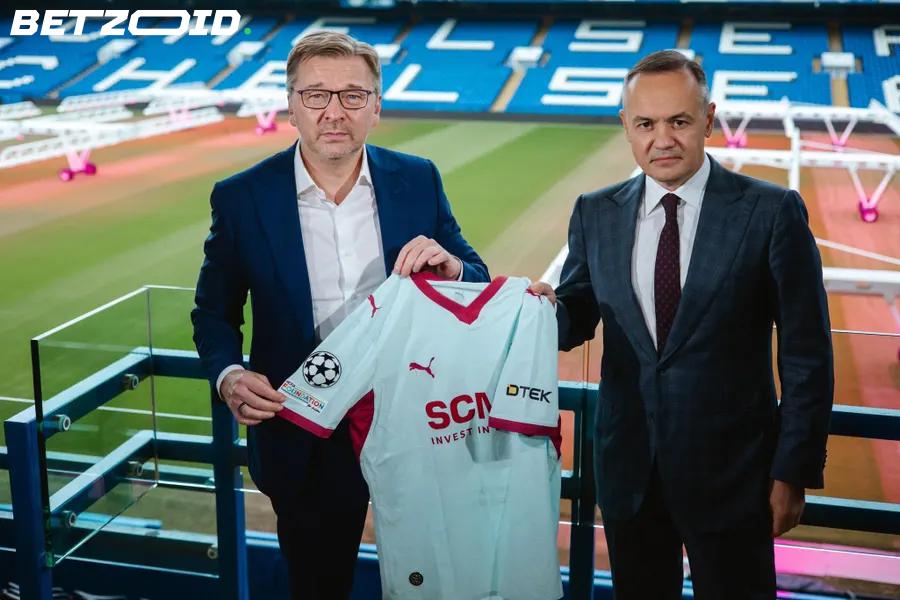
"It's difficult to live without a dream," Shakhtar Donetsk CEO Serhii Palkin says. "Having this kind of dream gives you the resources to survive, to develop, to compete and to be ready to return one day back to Donetsk." He's been running this club for 21 years. Twelve of them in exile. That quote isn't inspirational filler — it's a mission statement forged under genuine duress.
Shakhtar open their Champions League campaign at Stamford Bridge on October 14th against AEK Athens. They're there because Chelsea didn't qualify for Europe. Before London it was Gelsenkirchen, before that Hamburg, before that Warsaw. The $400 million Donbas Arena they left in 2014 sits in occupied territory. The home jersey supply got wiped out in August when a Russian ballistic missile destroyed PUMA's logistics warehouse near Kyiv.
The details keep piling up and each one would be a crisis at any normal club. At Shakhtar, they're Tuesday.
Two revenue streams, one strategy
Before the full-scale invasion in 2022, Shakhtar operated like a standard top-tier European club — ticketing, broadcast deals, sponsorships, commercial partnerships. All of that is essentially gone. Domestic matches run behind closed doors. Their European home profile depends on which borrowed stadium they can secure each season.
What's left: player sales and UEFA prize money. That's it. And yet Palkin says the club generated up to $400 million across the four seasons since the invasion. The economics are brutal but they're functioning.
The UEFA side is straightforward math. Champions League entry alone brings €18.62 million. Every win adds €2.1 million, every draw €700,000. After a season in the Conference League — where a win was worth €400,000 — this is a step-change in potential earnings. Shakhtar's final run to the Conference League semi-finals, where Crystal Palace eliminated them in May, was impressive. The money on offer this season is a different conversation entirely.
That financial reality shapes everything. Scouting, squad construction, even the coaching appointment of Arda Turan — a left-field pick whose Atlético Madrid and Barcelona playing days gave him name recognition across Europe — all of it feeds into the same goal: stay visible, develop talent, sell well.
The Mudryk blueprint
Mykhailo Mudryk is the clearest version of what Shakhtar are building toward. Three Champions League goals in the 2022/23 group stage. Chelsea and Arsenal in a bidding war by January. €70 million up front, up to €100 million total — the largest transfer in Ukrainian football history. Owner Rinat Akhmetov put $25 million of those proceeds directly into Heart of Azovstal, a fund supporting soldiers and their families.
The club knows how to run this pipeline. They built their reputation on Brazilian talents — Fernandinho, Willian, Fred — bought cheaply and sold at significant profit. The war disrupted that when FIFA ruled that foreign players in Ukraine could suspend their contracts, allowing most of the Brazilians to leave for nothing. Shakhtar pursued at least €50 million in compensation from FIFA, describing the ruling as "unfair." The case hasn't resolved their losses.
The pivot was toward homegrown Ukrainian talent, supplemented by a new wave of Brazilian imports. Current top scorers Luca Meirelles and Kauã Elias continue that thread. The sell-on structures have grown more sophisticated too — goalkeeper Anatoliy Trubin went to Benfica for €10 million with Shakhtar retaining 40% of any future sale; midfielder Heorhii Sudakov followed in 2025 on a deal worth up to €27 million with a 25% sell-on clause. These aren't headline fees but they're smart long-term positions.
Palkin says Shakhtar now have the youngest squad in the Champions League, built around players aged 19 and 20. For any club relying on the transfer market as a primary income stream, that's not a weakness — it's the point. Every scout in Europe will watch their Champions League matches. A standout performer becomes the next Mudryk. That's the entire commercial model playing out in real time.
Behind all of this sits Akhmetov, who has owned the club since 1996 and whose SCM Group lost the Azovstal steelworks in Mariupol to the war. His businesses have invested more than $4.3 billion in Ukraine since the full-scale invasion. DTEK, his energy company, appears on Shakhtar's Champions League shirt for the first time this season alongside an "Invest in Ukraine" message — a deliberate reframing of Ukraine's global image from aid recipient to investment opportunity. DTEK CEO Maxim Timchenko says his company has invested €2.4 billion since 2022, more than any other domestic or foreign firm, while absorbing the destruction of 80-90% of its thermal generation capacity over four consecutive winters and losing 484 employees.
"We need to move from words of support to real actions," Timchenko says. The shirt is the argument made visible to hundreds of millions of Champions League viewers.
When Mudryk joined Chelsea in January 2023, Akhmetov said Shakhtar would one day play a friendly against Chelsea at the Donbas Arena. They're now playing their home games at Chelsea's ground instead. That gap between the dream and the reality is exactly what Palkin is describing when he talks about uncertainty — unable to plan even a day ahead, let alone a year.
"We can even lose, but give our 100% on the pitch," Palkin says. "For people sitting in Ukraine and watching a Ukrainian club playing on this level, it's unbelievably important." That's not a performance target. It's the whole reason the club still exists.