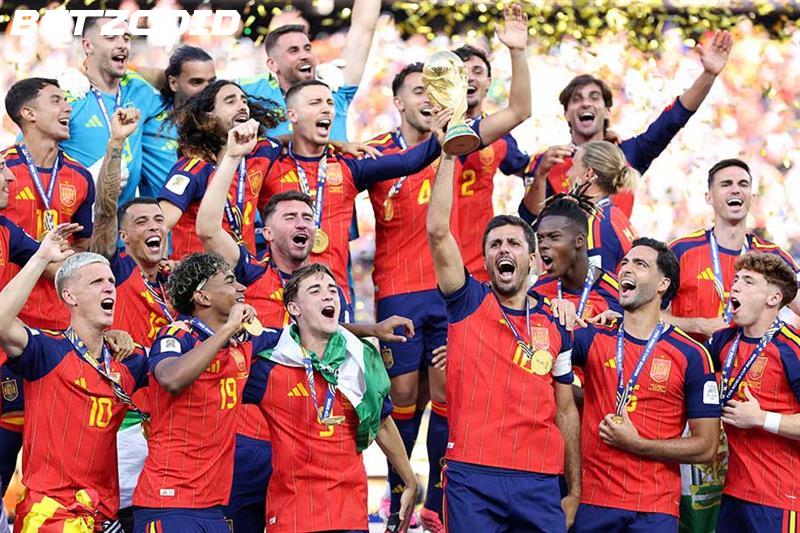
Gianni Infantino called it the best World Cup ever. He said the same after Russia 2018. And Qatar 2022. Donald Trump went further, declaring it "five times greater" than any tournament in history — no explanation for where the five came from. Standard procedure, then. But strip away the superlatives and the question still stands: was the 2026 World Cup, which ended with Spain edging Argentina 1-0 in extra time on Sunday, actually any good?
Honestly? More than expected. Less than advertised.
The numbers that actually matter
Start with what worked. Nearly seven million spectators attended — more than the combined crowds of 2018 and 2022. Six billion viewers worldwide. An estimated $15 billion in projected revenue for FIFA, nearly double the $7.6 billion generated in Qatar. And 308 goals at an average of 2.96 per game, the highest since Mexico 1970.
America's stadiums were packed. The fear of cavernous, half-empty venues never materialised. Fans who'd paid through the nose — flights, hotels, tickets priced at a level that bordered on extortion — showed up and made noise. They waved at the big screens. They had the time of their lives. The atmosphere delivered even when the football occasionally didn't.
The sport itself threw up genuine storylines. Cape Verde, appearing at their first ever World Cup, went 90 minutes without conceding against both finalists. Their goalkeeper Vozinha — 40 years old — kept a clean sheet against Spain and became an overnight global sensation. That's the kind of thing World Cups are supposed to produce.
The Golden Boot race was exactly what a tournament of this scale should be. Messi, Mbappé, Haaland, Kane, Bellingham — all present, all competing, all pushing each other. Mbappé won it with 10 goals, his second Golden Boot, while moving past Messi in the all-time World Cup scoring charts with 22 career goals. Hard to argue with that as a spectacle.
Betting markets reflected the scale of the event. An estimated $50 billion to $150 billion was wagered globally — roughly $500 million per match — making it the largest single gambling event in history. Spain's odds to lift the trophy, and the Golden Boot market in particular, moved dramatically throughout the tournament as the star players traded blows in the group stage.
Where the cracks showed
Now for the problems. Because there were several.
The group stage was essentially 72 games of administrative padding. With 12 groups and eight third-placed teams advancing, it was genuinely harder to get eliminated than to qualify for the knockouts. Top nations cruised. Jeopardy was in short supply. The format functioned less like a competition and more like a very expensive audition process for the round of 16.
At the opposite end, the latter stages were cramped. Argentina played their quarter-final, semi-final, and final inside nine days. A tournament that ran for nearly six weeks somehow couldn't find the space to give its finalists adequate recovery time. That's a scheduling failure, not a quirk.
VAR was a recurring disaster. The decision to disallow goals based on fouls deep in the attacking buildup infuriated coaches and fans alike throughout the tournament. Egypt's 3-2 loss to Argentina in the round of 16 — where a goal was chalked off in circumstances that sparked genuine outrage globally — became the defining VAR moment of the competition.
The hydration breaks, introduced because temperatures hit 38°C in some cities, shredded game rhythm. What started as a player welfare measure became a tactical tool — coaches using the pauses for team talks — and a commercial one, with broadcasters plugging in ad breaks. By the latter stages, the boos when the breaks were called were audible. Fans had had enough.
Politically, the tournament was combustible from the start. US travel bans and visa restrictions blocked fans from more than a quarter of the participating nations. The Iranian team, whose country was in an active conflict with the host nation, was permitted into the US for just 24 hours before each group game before being sent back to their base in Mexico. Trump personally phoned Infantino to reverse a red card shown to US player Folarin Balogun — and Balogun subsequently played the next match. Argentina's players posed with a banner claiming sovereignty over the Falkland Islands after their semi-final win over England, prompting the British government to demand a FIFA investigation.
Egypt coach Hossam Hassan, unprompted, waved a Palestinian flag at Dallas Stadium after his side reached the round of 16, then used two press conferences to speak about the Palestinian cause in terms that were direct and unambiguous. Whatever your politics, the man had a point to make and he made it, loudly, in the middle of the United States. That took nerve.
So: the best World Cup ever? The tournament earned a genuine success story label, not an unqualified one. It overcame the sceptics on atmosphere and goals, fell short on structure and integrity. Infantino is already floating the idea of expanding to 64 teams for the next edition. He'll call that one the best ever, too.