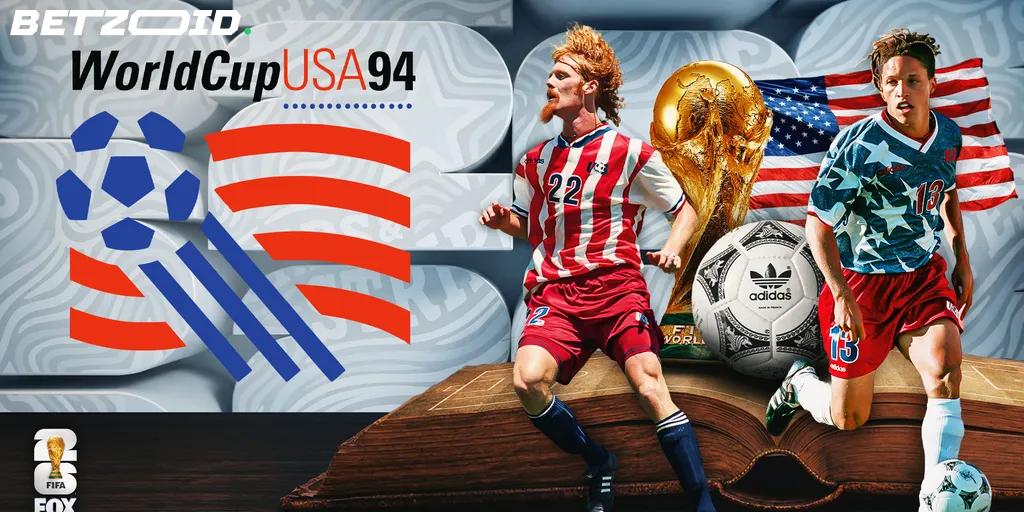
Roberto Baggio's penalty sailing over the crossbar at the Rose Bowl is the image most people carry from the 1994 World Cup. But the real story of that tournament isn't Italy's heartbreak — it's what happened across the entire United States that summer, in stadiums built for a different game, watched by crowds nobody predicted would show up.
Before a ball was kicked, the skeptics were loud. No top-tier professional league. A population that supposedly didn't care. Europe and South America questioned the whole thing. Then 3.6 million people walked through the turnstiles — still the all-time FIFA World Cup attendance record, more than 30 years later.
A tournament full of records nobody saw coming
The USA opened against Switzerland at the Pontiac Silverdome — the Detroit Lions' NFL home — on a temporary grass pitch. The first indoor World Cup match ever played, in a stadium with no air conditioning and temperatures that midfielder Thomas Dooley later described as "the worst place I have ever played at." Eric Wynalda's stunning goal gave the host nation a 1-1 draw and an early identity.
That identity held up. The Americans shocked a heavily favored Colombia side 2-1 at the Rose Bowl. A 1-0 loss to Romania followed, pushing the U.S. into a July 4 date with Brazil at Stanford Stadium. In front of a packed house, with Brazil reduced to ten men by a red card, the hosts couldn't find the breakthrough. Bebeto scored the only goal. Dream over.
Brazil went on to win it all — their fourth title, first since 1970 — built around Romario and Bebeto, who combined for eight goals. The final against Italy went 120 scoreless minutes before Baggio's miss handed the trophy to South America. First-ever World Cup final decided by penalties.
Oleg Salenko scored five goals in a single game against Cameroon. One match. Five goals. Nobody has done it since. Russia still went out in the group stage — which makes Salenko arguably the most statistically dominant player ever eliminated in the first round. He and Bulgaria's Hristo Stoichkov shared the Golden Boot on six goals each, the only time in tournament history that award has been split.
Stoichkov earned his half the hard way. A stunning free-kick helped knock out defending champions Germany. Bulgaria reached the semifinals. His two penalties against Greece and a goal against Mexico in the Round of 16 bookended a run that nobody in Eastern Europe has matched since.
Maradona's exit, MLS's birth, and what it all meant
Then there was Maradona. One last iconic goal against Greece. One wild-eyed sprint toward the camera. Then a positive drug test and a flight home in disgrace. The 1986 World Cup winner's tournament lasted two matches before FIFA ended it. The image of that celebration — pupils blown, teeth bared — became the defining before-and-after picture of his career's final chapter.
Belgium's Michel Preud'homme took home the inaugural Golden Glove (then called the Lev Yashin Award), keeping clean sheets against Morocco and the Netherlands before his side exited 3-2 to Germany in the Round of 16. Brazil's Romario claimed the Golden Ball after five goals and a role in virtually every key moment of the winning campaign.
The tournament's legacy in the United States is concrete: Major League Soccer launched in 1996, now 30 clubs across 28 cities in the US and Canada. The talent pool available to the national team today is a different animal entirely compared to the squad that played Alexi Lalas and Cobi Jones into the last 16.
The 2026 World Cup returns to the United States — this time co-hosted with Canada and Mexico — running June 11 through July 19, with the final at MetLife Stadium in East Rutherford, New Jersey. All 104 matches on FOX and FS1. The country hosting it is not the same country that hosted it in 1994, and the attendance record set that summer will almost certainly be the first thing in the crosshairs.