The 2026 World Cup is here. Forty-eight teams, 104 matches, three countries, and enough off-field chaos to fill a separate tournament. Mexico host South Africa at the Azteca Stadium on Thursday — the same ground that gave us Diego Maradona's Hand of God and the Goal of the Century — and football is supposed to take over from here. The problem is everything else won't let it.
FIFA president Gianni Infantino called this "the biggest, the most inclusive, the greatest World Cup ever." The first two claims are already in serious doubt.
Travel bans, war, and the Iran question
The Trump administration's immigration crackdown has hit the tournament before a ball has been kicked. Somali referee Omar Artan — an award-winner in his field — was barred from entering the United States and dropped from the officiating roster. The backlash was global and immediate. So much for inclusivity.
Iran's situation is even more complicated. The team relocated its training base from Tucson, Arizona to Tijuana, Mexico after visa problems and revoked tickets piled up. Players arrived wearing lapel pins commemorating victims of a missile strike on an elementary school — a direct reference to the US-Israeli military campaign against Iran that has been running since earlier this year. They're playing a football tournament while a war involving their country is actively ongoing. That's not context. That's the story.
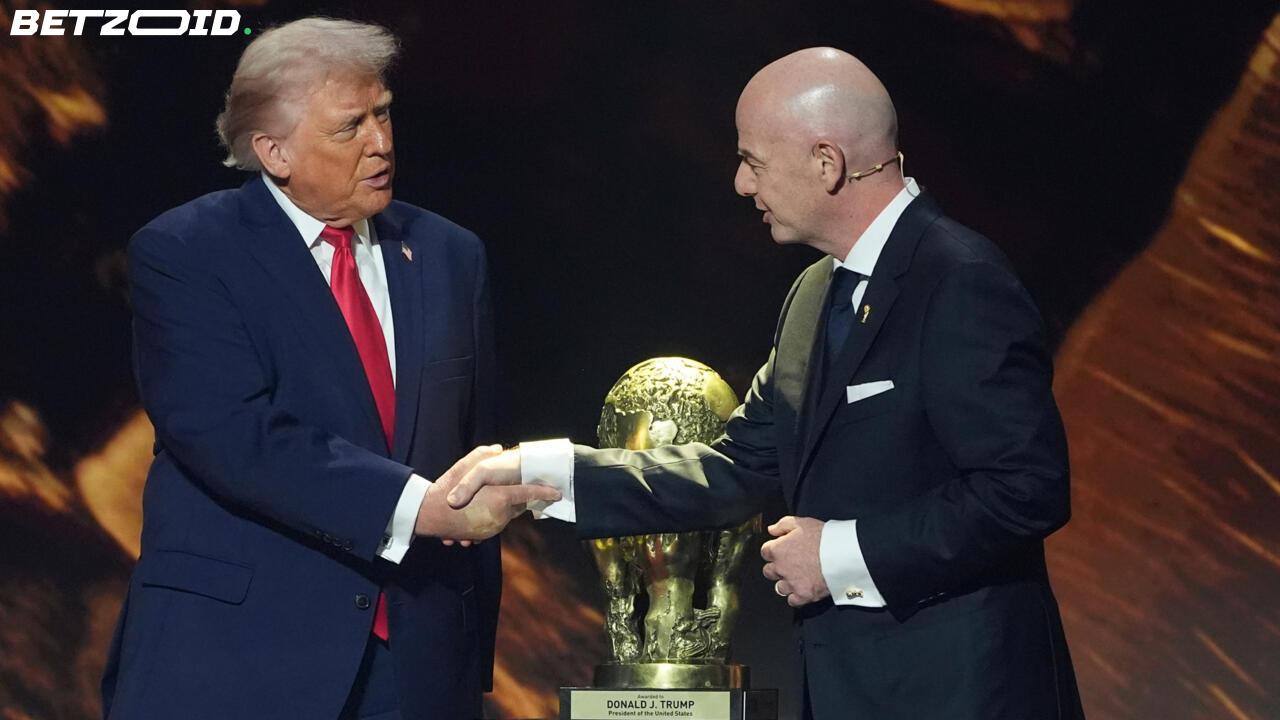
Meanwhile, Infantino awarded Donald Trump the inaugural FIFA Peace Prize last year. A golden Club World Cup trophy has been sitting in the Oval Office. The relationship between FIFA's leadership and the White House is, to put it diplomatically, cozy — which makes the travel ban situation all the more awkward for the governing body to explain away.
Tickets at $32,970 and a 26% excitement rate
The ticket pricing has been a separate scandal entirely. When general sale opened in January, prices ran from $140 to $8,680. The final at MetLife Stadium near New York now has tickets listed at $32,970 — and on FIFA's own resale marketplace, four seats to the final were listed at just under $2.3 million each in April. FIFA takes a 30% cut from every resale on that platform. Fans have called it a "monumental betrayal." That's not hyperbole — it's just accurate.
Add $175 parking fees and train fares that jumped from $12.90 to $98 in New Jersey, and you start to understand why hotel bookings across the 11 US host cities have been lighter than projected. A recent IPSOS poll found only 26% of Americans said they were "at least somewhat excited" about the tournament. Just 7% were "extremely or very excited." For a country hosting the world's biggest sporting event, that's a soft number — and it probably moves the needle on US-based group stage attendance odds if you're thinking about where value might lie in over/under markets.
Infantino's defence? Demand is equal to "1,000 years of World Cups at once." The hotel occupancy data suggests otherwise.
Messi, Ronaldo, and the football that still matters
Once the matches actually start, there are genuine storylines worth following. Lionel Messi, 37, in what is almost certainly his last World Cup. Cristiano Ronaldo, 41, chasing the one trophy his career is missing. Either outcome would be historic — but both of them making deep runs simultaneously seems increasingly unlikely given the sheer weight of competition in this expanded field.
Brazil haven't won a World Cup since 2002 and have brought in Carlo Ancelotti — yes, the Italian who just left Real Madrid — to end the drought. England are backing Thomas Tuchel, a German, to finally break 60 years of near-misses. The irony in both appointments is hard to miss.
The US, managed by Mauricio Pochettino, carry host nation expectations but almost no realistic pedigree. Captain Tim Ream framed it as simply as possible: "Why not us? Why can't we do it?" It's a fine attitude. Whether it survives contact with Brazil or France in the knockout rounds is a different question.
The expanded 48-team format means only 16 sides are eliminated in the group stage. Real knockout pressure doesn't arrive until the round of 32. For six weeks, this is what world football looks like — and it's opening in the shadow of a war, a travel ban, and tickets most fans in the world could never afford.