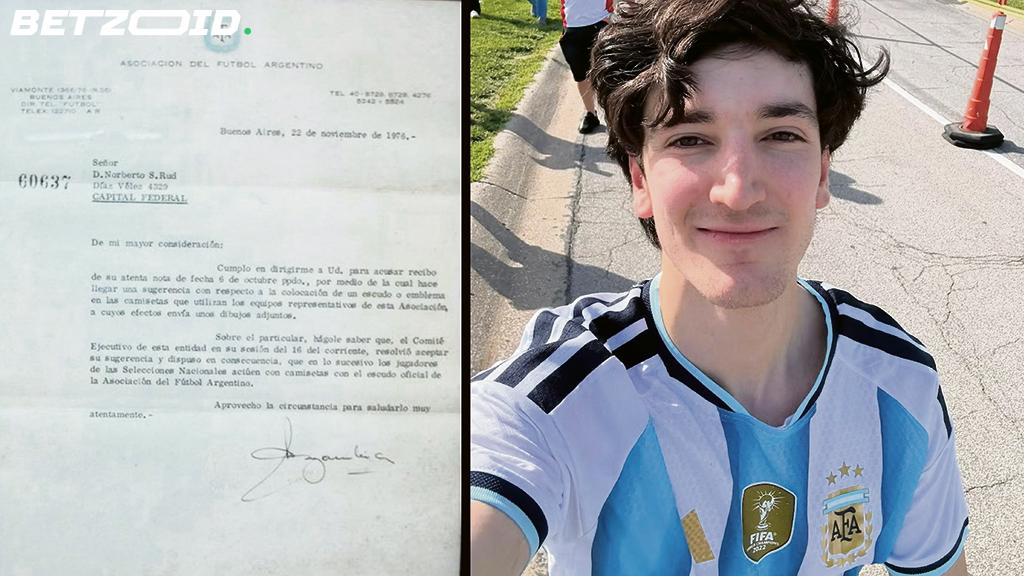
Every time Lionel Messi pulls on that famous blue-and-white shirt, he wears the work of a Jewish fan from Buenos Aires who submitted his design to the Argentine Football Association almost 50 years ago. Most people have never heard of Norberto 'Toto' Rud. They should.
Rud was in his late 20s, a member of Club Náutico Hacoaj — a Jewish sporting club in Buenos Aires — when he noticed something that now seems obvious: Argentina had no crest. While West Germany had its eagle and the Soviet Union its bold CCCP lettering, Argentina's jersey was distinguished only by its stripes. In the era of black-and-white television, that was a problem. Supporters watching abroad couldn't always tell who they were looking at.
Twenty designs and one winner
Rud didn't just grumble about it. He prepared around 20 design proposals and submitted them directly to the AFA's president and executive committee. His winning concept: a vertical shield, laurel branches at the base for victory and glory, and stars at the top to mark World Cup titles. Clean. Symbolic. Lasting.
The crest debuted on November 28, 1976, and has remained essentially unchanged since. It's been on the shirt through three World Cup triumphs — 1978, 1986, and 2022 — worn by everyone from Maradona to Messi. One of the most recognised football emblems on the planet, designed by a man most football fans couldn't name.
Rud died in 2010 at 61, buried at La Tablada in Buenos Aires — Latin America's largest Jewish cemetery. He saw two World Cup wins in his lifetime. The third came twelve years after he was gone.
A small piece of Hacoaj on every shirt
His son Oliver put it plainly: "Every time I see Argentina's national team crest, it still amazes me. Every time I see the crest, I feel a little piece of him in my heart."
Hacoaj club president Osvaldo Ofman framed it with deserved weight: "His design not only represents the jersey of the Argentina national team, the reigning World Cup champions, but also gives us the feeling that a small part of Hacoaj and the Jewish community lives on in an emblem recognised around the world."
It does. And now you know who put it there.