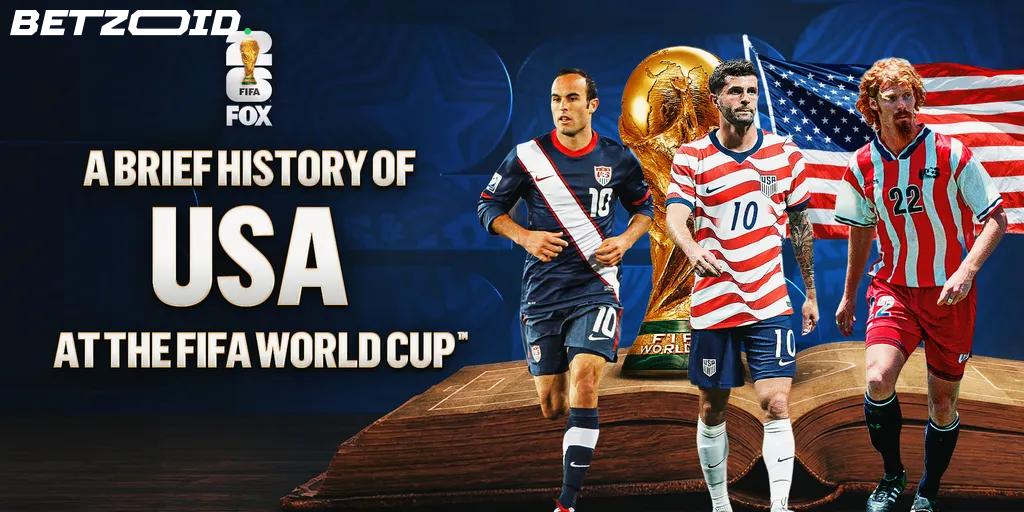
The United States didn't just show up at the first World Cup in 1930 — they finished third. That's where this story starts, and it gets stranger from there.
A patchwork squad of semi-pros, British immigrants, and a Belgian-born goalkeeper traveled to Uruguay and demolished Belgium 3-0, then Paraguay 3-0. Argentina ended the run with a 6-1 semifinal beating, but FIFA retroactively handed the U.S. bronze based on record. No third-place match was played. The Americans just went home with a medal and apparently forgot about it for four decades.
The 1950 upset that nobody believed
The defining moment of the early USMNT era came in Belo Horizonte in 1950. Joe Gaetjens — a Haitian-born dishwasher living in New York who wasn't even a U.S. citizen yet — headed in the only goal of a 1-0 win over England. England, in their World Cup debut, had professional players. The Americans had a grave digger, a postman, and Gaetjens washing dishes between matches.
The game became known as "The Miracle Match." It got a book. It got a 2005 movie. It also didn't stop the U.S. from going out in the group stage — and then not qualifying for another World Cup for 40 years.
Four decades. From 1950 to 1990, American soccer was background noise while the NFL, NBA, NHL, and MLB carved up the sporting landscape. The North American Soccer League briefly imported legends — Pelé, Beckenbauer, Cruyff — but none of that translated into better American players. The NASL folded in 1984. U.S. Soccer was essentially starting from scratch.
The team returned to the World Cup stage in Italy in 1990, young and overmatched: 5-1 to Czechoslovakia, 1-0 to Italy, 2-1 to Austria. But they were back. And four years later, they were hosting.
1994 changed everything — literally
FIFA awarding the 1994 World Cup to the United States was controversial at the time. A country that didn't have a top professional league hosting football's biggest tournament felt like a gamble. Then 3.5 million people showed up. That's still the all-time World Cup attendance record.
On the pitch, the U.S. advanced past the group stage for the first time since 1930 before losing 1-0 to Brazil in the Round of 16. Brazil went on to win the whole thing. Alexi Lalas became a poster boy. Cobi Jones — who would go on to earn 164 caps, still the national record for appearances — was everywhere.
That tournament directly produced Major League Soccer, which launched in 1996 and gave the country both a domestic league and a genuine youth development pipeline.
From there, the results have been uneven. A quarterfinalist in 2002 — where Gregg Berhalter's shot hit Torsten Frings on the arm and the referee waved play on, sending Germany through — and then irrelevant in 2006. A last-minute Landon Donovan goal against Algeria in 2010 kept them alive. Tim Howard made a World Cup record number of saves in a 2-1 extra-time loss to Belgium in 2014 and still couldn't keep them in it.
Then 2018: no qualification at all. The first time the U.S. missed the tournament since 1986. A low point that forced genuine soul-searching about the player pathway and coaching structure.
The recovery came through a generation built differently. Christian Pulisic developed at Borussia Dortmund. Weston McKennie at Juventus. Players forged in European football rather than domestic comfort. Qatar 2022 brought a Round of 16 appearance before a loss to the Netherlands — progress, but not enough to satisfy anyone serious about where this program should be.
2026: the home crowd factor is real
Now the U.S. co-hosts again, alongside Mexico and Canada, and the pressure to perform in front of home crowds is not subtle. Pulisic and McKennie return as part of 13 holdovers from the Qatar squad. The group stage opens June 12 against Uruguay in Los Angeles, followed by Panama in Seattle on June 19, and then the finale against Bolivia in Los Angeles on June 25.
On paper, that's a navigable group. But the USMNT has proven it can stumble against opposition it should handle — 1998 in France, where it lost all three group games and scored once, is the cautionary tale that never quite goes away.
- USMNT top scorers: Clint Dempsey and Landon Donovan — 57 goals each
- Most capped player: Cobi Jones — 164 appearances (1992–2004)
- Winningest coach: Bruce Arena — 81 wins across two stints (1998–2006, 2017)
The tournament runs June 11 to July 19, 2026, with the final at MetLife Stadium in East Rutherford, New Jersey. Ninety-six years after finishing third in Uruguay, the United States will try to prove that home advantage and a new generation of European-tested players can finally push them past the quarterfinal stage they last reached in 2002.
The history is patchy, the expectations are high, and the group stage is no guarantee. That's American soccer in a sentence.