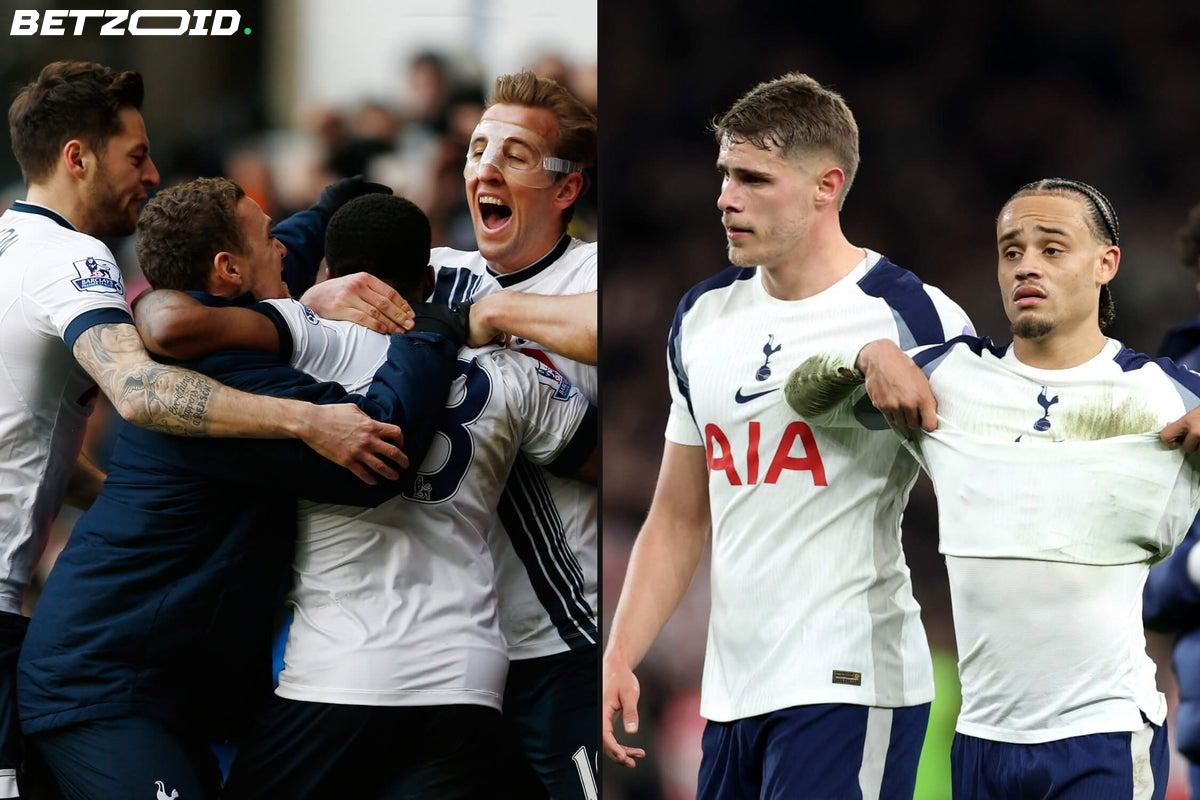
Remember February 28, 2016? Tottenham Hotspur were sitting pretty at the top of the Premier League table. Fast forward 10 years, and they're genuinely battling relegation. It's one of the most dramatic falls from grace in Premier League history.
Let's rewind to that magical night. Mauricio Pochettino's Spurs came from behind to beat Swansea City 2-1 at White Hart Lane. Nacer Chadli equalized, then Danny Rose scored the winner with 13 minutes left. The celebrations were so wild that Pochettino nearly jumped into the crowd.
Then came the announcement that sent the stadium into raptures: Arsenal had lost 3-2 at Manchester United. Spurs were now three points clear of their rivals and just two behind Leicester City. With only 11 games left, the bookmakers made them title favourites for the first time ever.
The path seemed clear when Leicester drew 2-2 with West Brom that Tuesday. But Spurs bottled it. They lost 1-0 at West Ham when a win would've put them top. Then they drew 2-2 with Arsenal after briefly leading. They never caught Leicester again.
That was the peak. Since then, it's been mostly downhill. Sure, there were highlights – that incredible Champions League run to the final in 2019, brief success under Antonio Conte, and last year's Europa League triumph. But the overall trend has been clear: decline.
Where Did It All Go Wrong?
The biggest mistake? Not selling players when they should have. Pochettino built a brilliant team on a budget, but every team has a shelf life. Players get bored, lose their edge, and need moving on to keep things fresh.
Kyle Walker left for Manchester City in 2017, but he was the exception. Danny Rose nearly joined Chelsea but the deal collapsed. Dele Alli never got his big move even when his form dipped. Toby Alderweireld fell out of favour but stayed. Christian Eriksen eventually left for Inter with just six months on his contract, bringing in peanuts.
Chairman Daniel Levy didn't want Spurs to look like a selling club. But holding onto players too long made the whole project go stale. It's like keeping the same water in a swimming pool – eventually it gets murky.
Because they weren't selling, Spurs couldn't bring in fresh talent either. The new stadium construction meant cash was tight. Lucas Moura arrived in January 2018 and scored that incredible Champions League hat-trick against Ajax. But then? Nothing. Not a single signing until summer 2019.
The summer 2018 Jack Grealish saga perfectly illustrated the problem. Villa needed to sell, and Spurs knew it. But Levy started bidding at just £3million plus Josh Onomah. He tried playing it slow, gradually increasing offers. Then Villa got new owners and Grealish stayed. Spurs ended the window empty-handed.
That 18-month recruitment gap haunted them for years. While rivals kept refreshing their squads, Spurs were stuck playing catch-up. They needed young players coming through in the late 2010s who'd hit their peak in the mid-2020s. Instead, they had a gap generation.
Managerial Mistakes and Lost Identity
By November 2019, the Pochettino magic was gone. Losing the Champions League final to Liverpool crushed everyone. The next season, Pochettino couldn't find the energy to lift his team. So Levy replaced him with Jose Mourinho.
On paper, hiring a 'proven winner' made sense. But Mourinho's football was the complete opposite of everything Pochettino built. It felt like Levy cared more about looking like a big club than actually being one. That thinking dominated the post-Pochettino years and cost them their identity.
In summer 2021, Levy gave Fabio Paratici from Juventus more power than any executive before. Paratici brought in some good players like Cristian Romero and Dejan Kulusevski. But there were plenty of misses too, leaving the squad inconsistent and unreliable.
The spending strategy shifted dramatically. After buying Tanguy Ndombele for £55million in 2019 from France, Spurs stopped shopping abroad for big signings. Instead, they paid Premier League prices for Premier League players. The results? Underwhelming.
Richarlison cost £50million and has 23 league goals in almost four years. Brennan Johnson cost £47.5million and scored 18 before being sold at a loss to Crystal Palace. Dominic Solanke cost £55million and has 11 league goals in nearly two years. Mohammed Kudus cost £55million and has just two league goals from 19 games.
None flopped completely, but none became stars either. Meanwhile, clubs shopping in Europe found gems with huge upside. Spurs' 'low-risk' approach became low-reward.
For much of this decade, Harry Kane and Son Heung-min papered over the cracks. They were world-class forwards who carried the team through mediocre spells. Kane came through the academy. Son cost just £20million from Leverkusen in 2015.
But Kane left for Bayern Munich in 2023. Son joined LAFC in MLS in 2025. Spurs never had a plan to replace them or develop the next generation. The fear is that Kane and Son were the last in a line going back through Gareth Bale and Luka Modric – with nobody to follow.
The lack of playing identity since Pochettino has been painful to watch. Spurs jumped from one idea to the next without commitment. Levy talked about 'Tottenham DNA' being 'free-flowing, attacking and entertaining' in 2021. Then he hired Nuno Espirito Santo the next month.
Antonio Conte brought tactical discipline but was never backed properly. Then came Ange Postecoglou with expansive, possession football. Levy said 'we've got our Tottenham back.' Two years later, he replaced him with Thomas Frank's set-piece efficiency. The strategy changed every time the manager did.
Money talks in football, and Spurs stopped keeping up with their rivals. They used to match Arsenal's wage bill. But last season, according to UEFA's report, Arsenal spent €95million more on salaries than Spurs. Chelsea spent €121million more. Liverpool spent €191million more.
Spurs' real wage competitors aren't the old 'Big Six' anymore – they're Aston Villa and Newcastle. The two teams that have leapfrogged them in the league. When it emerged last year that Spurs' wages-to-revenue ratio was just 42 percent, fans were furious. It looked like the club was unwilling to push the boat out.
The final blow came after last year's Europa League triumph. Winning their first trophy in ages should've been a springboard. Hundreds of thousands turned out for the parade. Instead, everything since has moved away from that moment.
Postecoglou got sacked despite delivering silverware. The club said they needed to 'compete on multiple fronts.' Thomas Frank replaced him with completely opposite football. Then Levy was suddenly dismissed and the club restructured mid-season.
One bookmaker now has Spurs at 9-2 to go down. The same bookie offered 7-2 on them winning the title 10 years ago. It's a staggering reversal of fortune and a cautionary tale about losing sight of what made you successful in the first place.