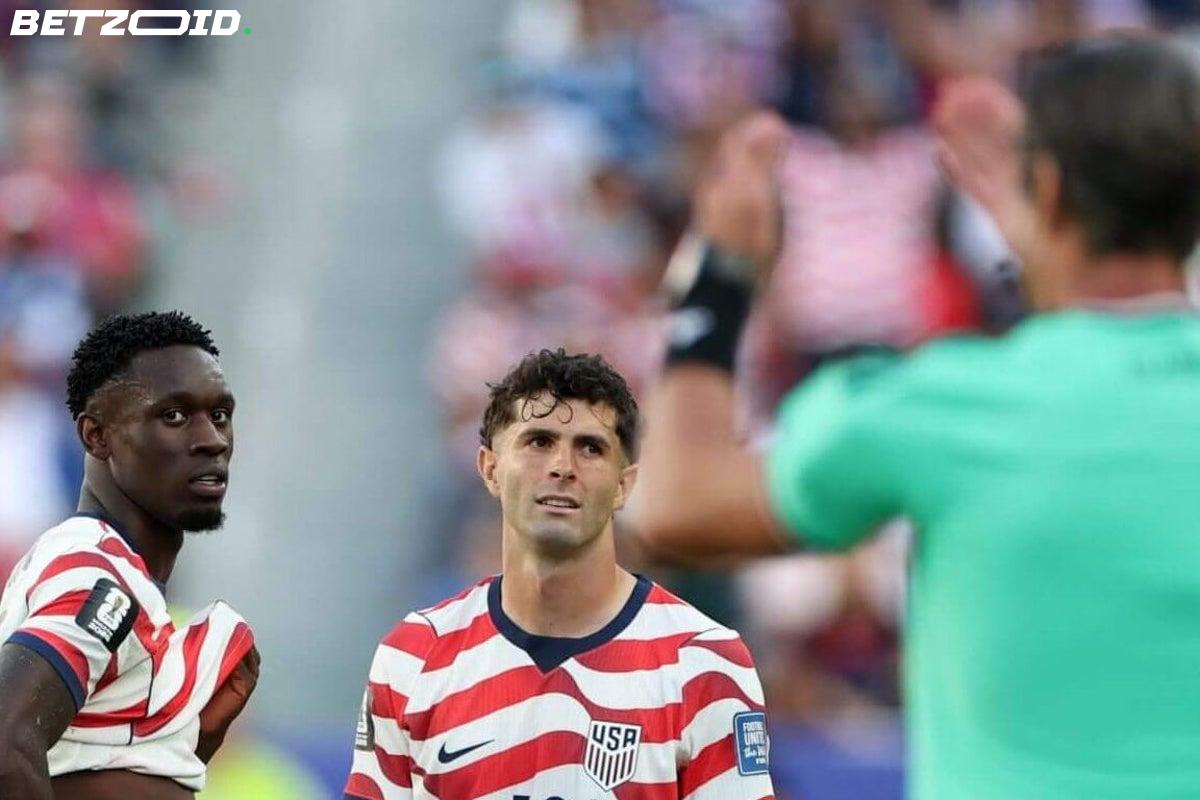
Folarin Balogun didn't commit serious foul play. VAR's camera operators made it look like he did, and a Brazilian referee in front of a monitor signed off on the illusion.
The incident itself was unremarkable by football standards. A ball played forward, two players jostling for position, an off-balance forward landing awkwardly on a defender's ankle. Nobody on the pitch thought it was a red card. The Bosnian players barely appealed. The on-field referee let it go. Then the studio got involved.
What followed was a masterclass in how to build a case against a player using camera angles and frame rates. The first image shown to referee Raphael Claus was a freeze frame — Balogun's foot apparently stamping down on Tarik Muharemović's ankle, presented at its most damning. Then came a slow-motion replay. Then the footage was frozen at point of contact again. Then more slow-motion. By the time the wider, normal-speed angles arrived — the ones that showed a routine physical contest — the verdict was already written.
The Protocol Says One Thing, VAR Does Another
IFAB, the body that writes football's laws, is clear on this. Slow-motion should be used for facts — point of contact, position of a player — while normal speed should determine the intensity of a challenge. That's not a minor technical detail. It's the entire point. Slow motion turns every awkward collision into a horror challenge. An accidental studs-up becomes a premeditated assault when played at a fraction of its real speed.
In the Balogun case, slow motion wasn't used to clarify facts. It was used — repeatedly — to exaggerate intensity. That's the opposite of what IFAB prescribes, and FIFA's refereeing hub apparently sees no contradiction in that.
The question that nobody in an official capacity wants to answer is this: is the on-field referee being sent to the monitor to make a decision, or to validate one that's already been made? The sequence in which footage is presented — most incriminating first, normal speed buried at the end — suggests the latter. That's not a review system. That's a prosecution.
The Cost Is Real
Balogun, the USMNT's most dangerous forward, missed the round of 16 against Belgium because of it. The punishment didn't fit the challenge — it barely fit a yellow card, let alone a ban that eliminates your team's best striker from a knockout game.
Football has fixed structural problems before when tournaments forced the issue. The backpass rule came after Italy 1990. Goal-line technology arrived after Lampard's ghost goal in 2010. Both required embarrassing, high-profile failures before anyone acted.
This is that moment for slow-motion VAR replays. FIFA has the incident, the tournament, and the player. The reform is straightforward: normal speed for intensity, slow motion only for positional facts, and never lead with the freeze frame.
Until that changes, the red card Balogun received isn't an outlier. It's the system working exactly as it's currently allowed to work.