The football hasn't even reached the knockout rounds, and the 2026 World Cup has already generated enough off-pitch drama to fill a documentary. Visa denials, a referee accused of flashing a hate symbol, a national team coach calling his players "the most oppressed in the World Cup" — and that's before we get to the empty seats FIFA is trying to explain away.
Two players locked out of Canada
The most legally consequential story involves two players denied entry into Canada. Ghana midfielder Thomas Partey — charged with seven counts of rape and one count of sexual assault in the UK, to which he has pleaded not guilty — was barred after a Canadian federal judge rejected Ghana's appeal on public interest grounds. He missed Ghana's 1-0 opening win against Panama in Toronto but remains eligible to play in the team's two US-based fixtures: June 23 against England in Foxboro and June 27 against Croatia in Philadelphia.
Ivory Coast forward Elye Wahi is also stuck. Canada denied him entry following his arrest by French police on May 29 over alleged spot-fixing — specifically, suspiciously timed bets on him receiving a yellow card in a Ligue 1 match. He did receive the card. The match ended in a draw. He hasn't been formally charged, but the investigation is active, and he'll miss Ivory Coast's game against Germany in Toronto on Saturday.
Two players at the same tournament denied entry to a host nation for entirely different legal reasons. That's not bad luck — that's a FIFA vetting process that has serious questions to answer. Anyone who had Ivory Coast deep in the tournament is now reconsidering their position with Wahi sidelined.
A goalkeeper's tears, and the visa that followed
Not every visa story ends badly. Cape Verde goalkeeper Vozinha — 40 years old, playing in his nation's first-ever men's World Cup — made seven saves in a 0-0 draw against Spain on Monday in Atlanta. Then he broke down on the pitch. Not just from the emotion of the result, but because his mother couldn't be there.
"My mom, she didn't manage to be here because of the money you have to pay for the visa," he told reporters, still in tears. "I would like her to be here."
By Wednesday, House Minority Leader Hakeem Jeffries had worked with Secretary of State Marco Rubio to waive her visa fees and arrange travel. She'll be in Miami on Sunday to watch Cape Verde face Uruguay. "No mother should miss the chance to see her child make history," Jeffries said. It's one of the few genuinely warm moments this tournament has produced so far.
The rest of the chaos, in brief
- Iranian team ordered out immediately after their match: Coach Amir Ghalenoei said his squad was put on a plane to Tijuana minutes after their 2-2 draw with New Zealand, with no recovery time. The Department of Homeland Security confirmed Iran agreed to terms allowing entry only from the day before a match to the evening of the match itself. Ghalenoei called his team "the most oppressed in the World Cup." Iran's base camp was already relocated from Arizona to Mexico before the tournament began due to visa uncertainty following the US-Iran conflict that started in February.
- Somali referee denied entry at Miami airport: Omar Artan was turned away by US Customs and Border Protection over what officials described as "association with suspected members of terror organizations." Artan had a valid visa. He returned to Mogadishu, was greeted by thousands of supporters, and says he'll be at the 2030 World Cup in Spain, Portugal and Morocco.
- Australian VAR referee denies white power gesture: Shaun Evans formed a circle with his thumb and index finger during a broadcast shot at the Dallas VAR center during Germany vs. Curaçao. Anti-discrimination group Fare called it an intentional neo-Nazi symbol and demanded FIFA act. FIFA investigated and found no breach of its Disciplinary Code. Evans said it was "an involuntary, subconscious twitch" and that camera footage showed him repeating the movement while holding a pen throughout the match.
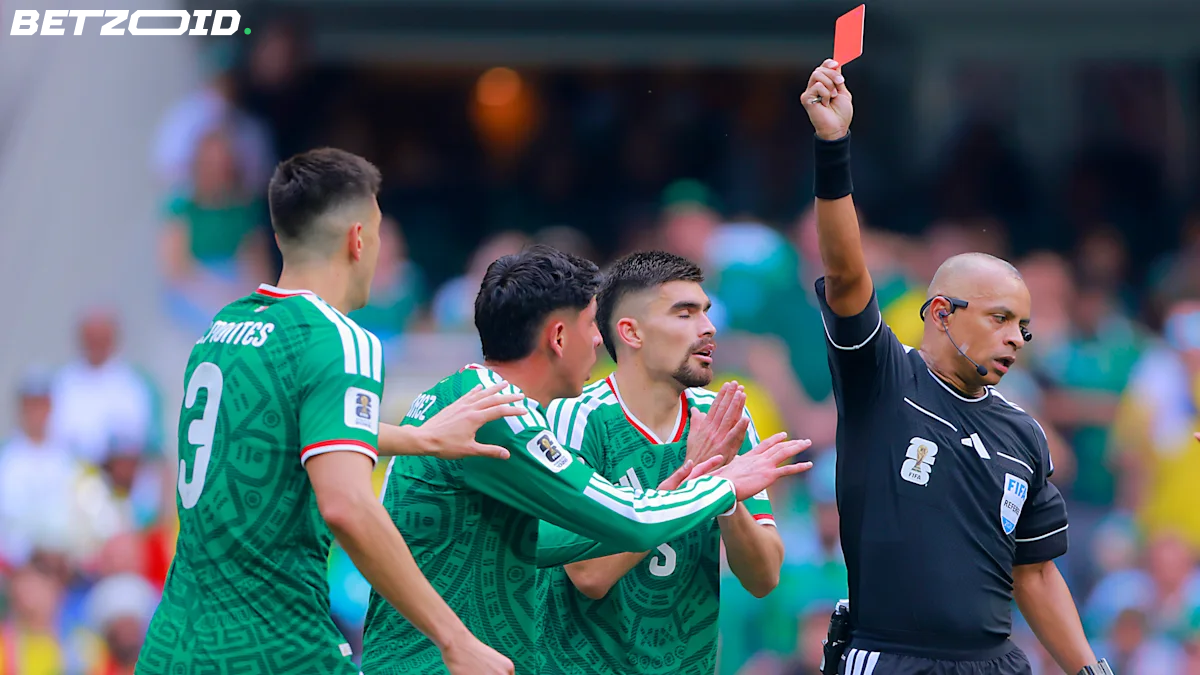
- Opening match red card carnage: Three players were sent off in the South Africa vs. Mexico opener — the most in a World Cup match since the 2006 "Battle of Nuremberg," when four were ejected. For context, the entire 2022 Qatar World Cup produced only four red cards total.
- Empty seats FIFA can't quite explain: Viral images from South Korea vs. Czech Republic in Guadalajara showed large empty sections in what FIFA insisted was a near-sellout. Their explanation: fans were "standing in concourses." Similar scenes appeared at Switzerland vs. Qatar and Japan vs. Netherlands. Meanwhile, World Cup Final tickets — originally listed at up to $8,680 — have since climbed to $32,970. The cheapest group-stage seat costs $140, more than double the $69 entry point at Qatar 2022.
Six million tickets sold, geopolitics bleeding into team logistics, legal proceedings following players across borders — the 2026 World Cup is three countries trying to run one tournament while the world's complications follow every squad through the door. Or in some cases, stop them at it entirely.