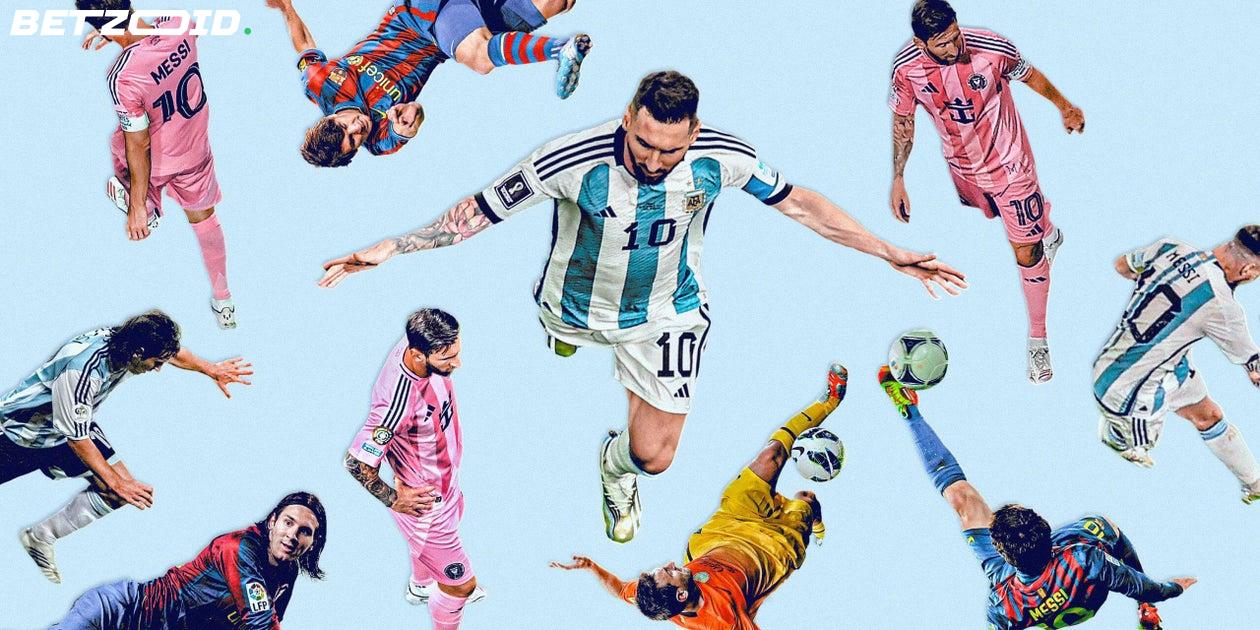
"I don't know," William Gallas told France's coaching staff when they asked how he planned to stop an 18-year-old Lionel Messi in the 2006 Champions League. He wasn't being modest. He was being honest — and nothing that followed over the next two decades made that answer look any less accurate.
The Athletic spoke to a group of players who faced Messi across different eras, different formations, and different versions of the man. Goalkeepers, centre-backs, midfielders. Some who held him once. Some who faced him dozens of times. The verdict, roughly, is unanimous: nothing worked.
"Even when you know which direction he'll go, you have no chance"
Ivan Ergic played against Messi on the day he made his World Cup debut — Serbia and Montenegro versus Argentina in Gelsenkirchen, June 2006 — and twice more for Basel against Barcelona. He's now a playwright. Which is fitting, because the way he describes Messi sounds less like a scouting report and more like someone trying to explain theatre to a person who's never seen a stage.
"He's one of those players who, even when you know which direction he'll dribble, you have no chance," Ergic says. "If you commit half a second too early to one side, he shifts to the other. And when you think you're about to win the ball, he manages to touch it just enough to keep it in front of him and under control, even in the middle of a crowd."
Gorka Iraizoz, the former Athletic Club goalkeeper, faced Messi 27 times and conceded 18 goals. His technical breakdown of why is worth reading slowly. "His physique helped him hide the ball until the last moment, without much leg swing, without having to show or give any clue about where he was going to shoot. That allowed him to wait, opening his body with a subtle touch to the far post or adding power to the near post." You had covered the space. You thought you knew. Then something else happened.
Andres Guardado had 20 photos of himself and Messi together on the pitch. "I do not have the ball in any of them," the Mexican said. Carlos Sanchez, who successfully man-marked Messi to a goalless draw in a 2011 Copa America match, described it as "constant, relentless attention" — and still said that in half a second, everything he'd done could mean nothing.
Walking as a weapon
The thing that unnerved opponents most wasn't when Messi ran at them. It was when he didn't.
Raphael Varane, who played against Messi 21 times for Real Madrid and France, puts it better than most coaches ever have: "Messi's speciality was walking in areas where you don't know who should defend. Is it the midfielder? Is it the full-back? Is it the centre-back? You get the impression that he's not running, so you defend less. But it's the opposite — he puts himself in a situation where he can attack well."
Gallas confirms it from the other side: "Even if he was walking, what you wouldn't want as a defender is for him to receive the ball. So you'd think about getting close to him. But if you get close to him, he has already won that battle — because if he doesn't get the ball, you've allowed space behind you to be created. And that's exactly what he wants."
Celtic's Jozo Simunovic put it most memorably. Every time he turned his head during their 2016 Champions League group-stage match against Barcelona, Messi was staring at him. Not at the ball. At him. Watching his positioning. Mapping the spaces. Manager Brendan Rodgers relayed it at a press conference a year later, barely suppressing a smile. "He was looking at me, and it unnerved me."
David Sumpter, a professor of applied mathematics who worked with Barcelona analysing patterns of play, described what Messi was doing in those moments: finding pockets of space that didn't yet exist. "In that respect, yes, these players could see two seconds into the future, five seconds into the future. With Messi, it seemed almost like he could see 10 minutes into the future."
The version Qatar saw was different — and still good enough
By the 2022 World Cup, Messi was 35 and spending the majority of his time walking. Rene Meulensteen, Australia's assistant coach at that tournament, had studied it carefully. "He spent 80 per cent of his time just wandering and comes to life in the final third where he knows he can do something that matters."
Australia actually built a game plan around it — pressing from behind Messi, playing out from the back precisely because they knew he wouldn't press. It half-worked. Until it didn't, and Argentina went through.
Against Croatia in the semi-final, Messi went up against Josko Gvardiol — 15 years younger, six inches taller, and physically superior in almost every measurable way. It didn't matter. Stop-starting Gvardiol into hesitation, faking one way, going the other, Messi manufactured space where none existed and set up Julian Alvarez for Argentina's third. At 35.
Tristan Muyumba, who plays for Atlanta United and has faced Messi several times in MLS since his move to Inter Miami, cuts to something simpler: "He's very intelligent and knows how to position his body at every moment. His lower body is very athletic. You often hear that Messi is small, but he's solid and he stands firm."
He also adds, almost as an aside: "He's not very talkative — but he'll flash you a little smile or slap your hand. He doesn't seem to have a lofty opinion of himself."
Which is the strangest part of all of this. The player who made world-class defenders look ordinary, who beat Boateng so badly the German's Twitter Q&A became a public roasting, who made Gvardiol look like he'd never defended before — he seems, by all accounts, completely unbothered by any of it.
Boateng's response to the online mockery, years after the fact, is probably the most honest thing anyone has said about this whole subject: "I would love to see each one of you defending against Messi."