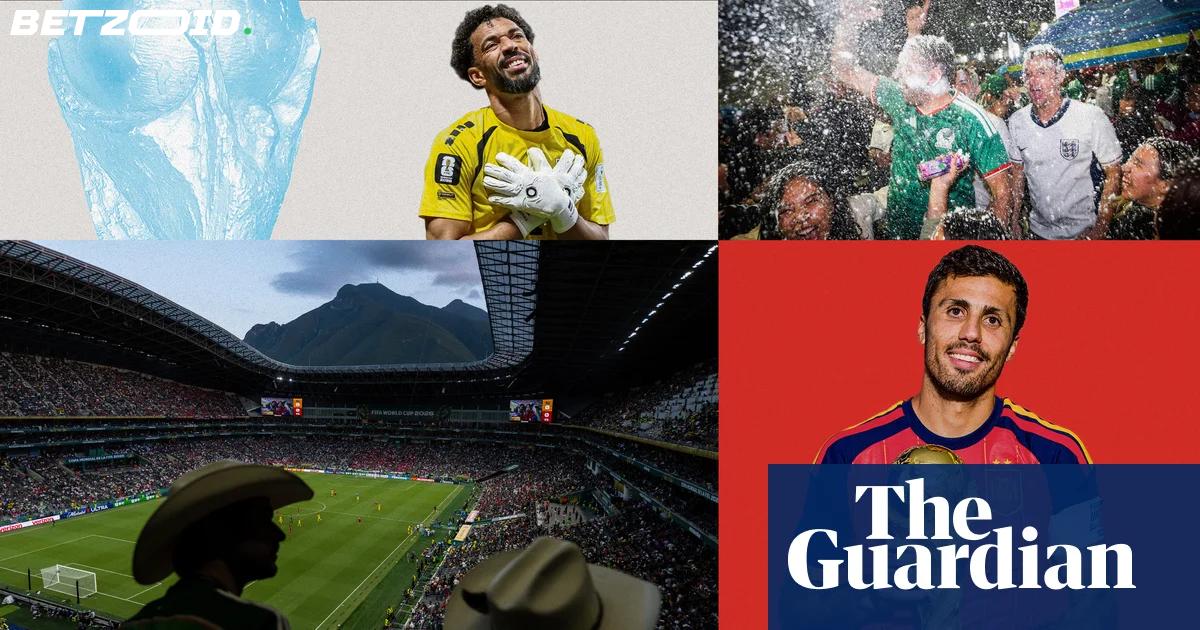
The World Cup is done. The pitches are being rolled up, the journalists are flying home, and the verdicts are in. Rodri won the Golden Ball. Sidny Lopes Cabral scored the goal of the tournament. And somehow, a 40-year-old goalkeeper without a club became the most talked-about player in the world.
The Guardian's team of reporters — spread across 14 venues, six weeks, and what sounds like several memorable deli breakfasts — have delivered their final tournament awards. Here's what they made of it.
Game of the tournament: the Azteca wins, but Cape Verde keeps stealing votes
Mexico 2-3 England at the Azteca collected the most individual votes, and it's not hard to see why. A thunderstorm delayed kick-off. Bellingham was brilliant. A genuinely iconic stadium delivered a genuinely iconic night. Nick Ames called it "a high point for England that should cut through despite later disappointments." Paul MacInnes went further: "like drinking cortisol neat."
But Argentina 3-2 Cape Verde and Argentina 3-2 Egypt both picked up significant backing too. The Argentina-Egypt match had the Messi comeback, refereeing controversy, and a two-goal deficit overturned in normal time — Jonathan Wilson's pick. Argentina-Cape Verde had Sidny Lopes Cabral's goal and one of the tournament's great upsets narrowly averted.
The strangest honourable mention goes to Algeria 3-3 Austria — described by Alexander Abnos as "a completely strange fever dream" that was supposed to be a biscotto. It wasn't. France 4-6 England also gets a mention, with Ben Fisher calling it "borderline hilarious."
Player of the tournament: Rodri, almost unanimously
Rodri. Full stop. The Spain captain won more individual votes than any other player and picked up the official Golden Ball for good reason — he was the engine of the best team in the tournament, and he looked fully back to his best. Jack Snape put it plainly: "in those moments where a contest teeters... no player has shown his quality more consistently."
The Spain midfield question — Rodri's availability, his injury record — had been a genuine betting concern heading into this tournament. Anyone who backed Spain when those doubts kept their odds inflated will be quietly satisfied.
Kylian Mbappé took votes despite France's semi-final exit to Spain. Haaland leaves with a quarter-final, a credible Golden Boot run, and — per Jeff Rueter — "perhaps the biggest boost in star appeal in the lucrative North American market." That last point matters more than it sounds for his commercial trajectory.
The wildcard pick: Vozinha, Cape Verde's 40-year-old goalkeeper. He doesn't have a club. He showed up to a World Cup and shut down team after team. Paul MacInnes voted for him and called it "an actual fairytale that didn't need to be spun by any marketing department." His mother flew from Cape Verde to watch him play. The detail that keeps appearing in every journalist's highlights is that — and it's not hard to understand why.
Goal of the tournament: Sidny Lopes Cabral, and it's not a debate
Sidny Lopes Cabral's equaliser for Cape Verde against Argentina won this category as decisively as Rodri won his. A long-range curler that bent between Emi Martínez and the far post in a knockout match, in extra time, against the defending champions. Jeff Rueter described the noise that left his body when it went in. Jacob Steinberg simply wrote: "Argentina 3-2 Cape Verde. It's not a debate."
Wilson Isidor's long-range strike for Haiti against Morocco also collected votes — Barry Glendenning called it "as good a goal as any scored in the World Cup. Ever." Julián Alvarez's swerving long-ranger against Switzerland in Kansas City and Kerim Alajbegovic's off-balance finish for Bosnia against Qatar were also flagged.
There was also a disallowed goal from Uzbekistan — likely Eldor Shomurodov — that Abnos described as "an instinctive, oddly satisfying lob from a tight angle." Max Rushden remembered it as someone walloping one into the top left-hand corner that didn't count. Either way, the goal that didn't count apparently haunted several reporters for weeks.
The hosts: warm people, dreadful public transport
The verdict on the three co-hosts was broadly positive on atmosphere and people, more complicated on logistics. Mexico delivered the cultural experience — the Azteca, the Messi pilgrimages in Dallas, mariachi bands trying to follow group-stage tiebreaker rules. Canada were praised for their passion and the electric atmosphere in Vancouver and Toronto. The US showed genuine World Cup fever that surprised several reporters.
The sour notes were consistent: the Folarin Balogun eligibility reprieve — described by Ewan Murray as impossible to ignore — drew pointed criticism as Fifa and the US administration bending tournament rules. And public transport in Florida, in particular, came in for a beating. Jonathan Wilson's personal highlight was "standing knee-deep in raging floods in Monterrey waiting for a bus" after losing a tablet he subsequently lost again in Houston anyway.
As World Cups go, the scale was unprecedented and the chaos was proportional. The football, at its best — an Azteca thriller, a 40-year-old keeper defying everything, a full-back curling one past Argentina in extra time — was everything the game can be.