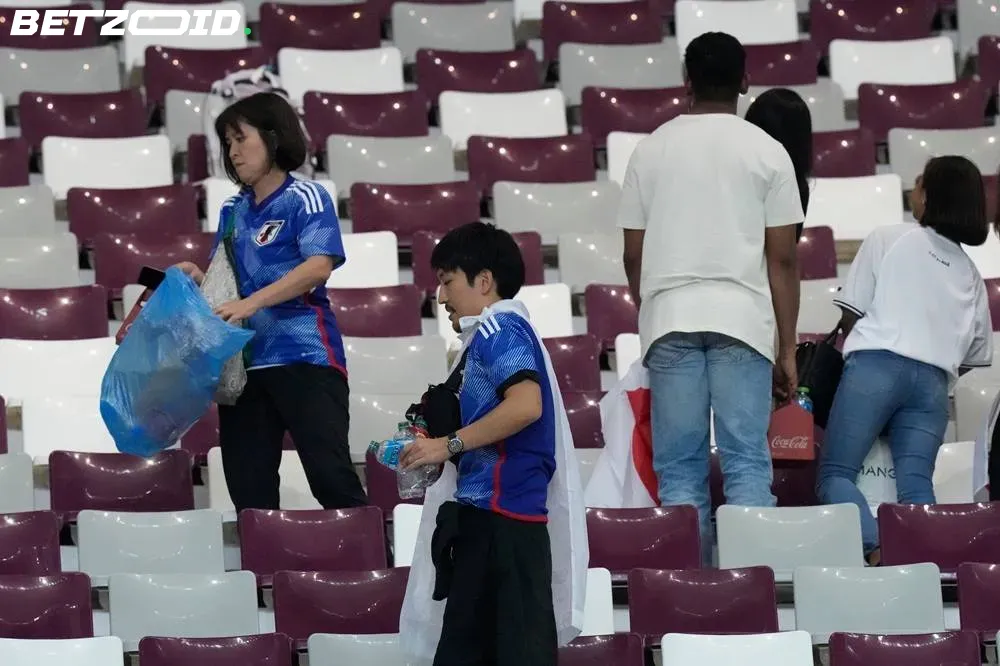
"A bird leaves nothing behind." That Japanese proverb is the cleanest explanation for why, at every World Cup since 1998, Japanese supporters have stayed behind after the final whistle to sweep up litter — including after losses — while everyone else files out.
It's happening again at World Cup 2026. Japan open their campaign in Arlington, Texas, and Monterrey, Mexico this June, and you can already set your watch by what follows each match.
This isn't politeness — it's socialization
The behaviour isn't a PR stunt or a spontaneous act of sportsmanship. It's baked in from elementary school, where many Japanese classrooms don't have janitors. Students clean the rooms themselves. They clean the corridors. They clean the yard. By the time they're standing in a World Cup stadium at 10pm, picking up someone else's plastic cup is just... normal.
"Japanese sports fans at world events who clean up the stadium are behaving much the same way they did when they learned how to enjoy sports as school boys and girls," said Koichi Nakano, professor of politics and history at Sophia University.
The concept underpinning all of it is meiwaku — the idea that leaving a mess is an imposition on other people. In a country where greater Tokyo alone holds around 35 million people, not inconveniencing those around you isn't optional. It's survival.
In Qatar in 2022, fans left thank-you notes on rubbish bags written in Arabic, English, and Japanese. In Russia four years earlier, the players cleaned their own dressing room after being knocked out and left a note in Russian. The cleanup isn't just for the cameras.
Football specifically — not just a Japanese thing
Anthropologist William Kelly of Yale points out that the tradition is more attached to football than other sports in Japan, and links it to the founding of the J-League over 30 years ago. The league built its identity around community connection — deliberately distancing itself from baseball — and that sense of ownership over a stadium and its condition stuck.
The media attention has reinforced it further. "Now that the media has latched onto the story and lavished praise on Japanese fans, they have made it a point of pride to display those values and norms," wrote Jeff Kingston of Temple University Japan.
It's spread beyond the World Cup too. The same scenes played out at the Under-20 World Cup in Chile and at Wembley last month after Japan beat England 1-0 in a friendly.
"It's one of our traditions," said Toshi Yoshizawa, who led the cleanup in Chile. "We grew up with the teaching that we should leave a place cleaner than when we arrived."
Twenty-seven years of World Cups. Same result every time.