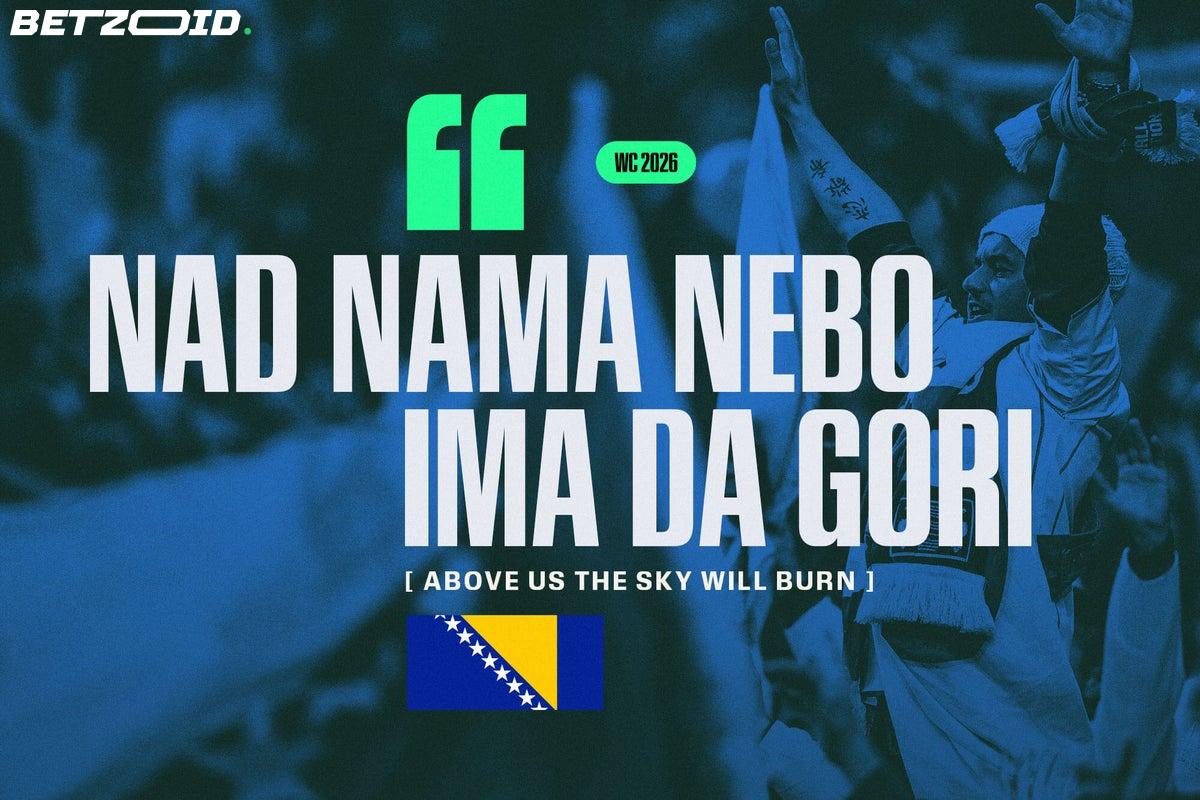
"Our fire is love, not anger." That line, from Bosnian broadcast journalist Ika Ferrer Gotic, tells you more about Bosnia and Herzegovina's football culture than any formation or fixture list ever could.
Bosnia are heading to the 2026 World Cup — their second ever — as a nation of three million people with a diaspora in the millions more. Their squad reflects that spread. Their fanbase amplifies it. And anyone who has stood near a Bosnian end at an away fixture will tell you: the atmosphere is unlike most things in international football.
A fanbase forged by something heavier than sport
The context matters here. The Bosnian War ran from 1992 to 1995. Around 100,000 people died. What followed was a global diaspora — roughly 350,000 Bosnians in the US alone, around 400,000 of Bosnian descent across North America when you include Canada. These aren't fans who travelled for the football. Football came to them as a way of staying connected to something they'd lost or left behind.
"You don't support Bosnia because it is easy or successful," says Amila Sirco, who has worked on logistics for the national team. "You support it because it is yours."
That distinction is worth sitting with. Most international fan cultures are built on success, geography, or habit. Bosnia's is built on survival and identity. It makes for a different kind of noise.
The BHFanaticos, Bosnia's largest organised supporter group, have been following the national team across football, basketball and handball since 2000. Flares, chanting, non-stop presence. Member Benjo puts it simply: "Many people underestimate Bosnia due to its size, but fans consistently show up in huge numbers abroad." For any sportsbook pricing up atmosphere-as-home-advantage scenarios, the Bosnian sections at 2026 venues in Canada and the US are going to be significant. This is not a neutral crowd situation.
Unity is the team's actual story
Bosnia is a country with a three-member rotating presidency — one Bosniak, one Croat, one Serb — and two autonomous entities operating under a federal structure. It is, to put it plainly, a nation that runs on carefully managed division. Not every citizen supports the national team. Some identify with Serbia or Croatia instead. That tension doesn't disappear when a match kicks off.
Which is exactly what makes the national team's role so pointed. Head coach Sergej Barbarez — a man whose mother came from a Croat-Bosniak background and whose father was a Serb — said this year that "religion and nationality never played a major role" in his family. He now leads a squad that reflects that same mix.
PSV winger Esmir Bajraktarevic was born in Wisconsin, made one senior appearance for the USMNT, and then declared for Bosnia in 2024. His family is from Srebrenica. His presence in the squad carries weight that goes well beyond his output on the right wing.
Semir Mustafic of TV N1 frames the team's World Cup qualification as something with a social function: it "helps erase everyday problems" and showed that "unity brings more success than division." That's not empty rhetoric in a country with Bosnia's recent history. It's a genuine argument being made through results.
"Football is like therapy here," Gotic says. "It gives us hope and it is our national glue."
Above the stadium, the sky will burn. They've been waiting a long time for this.