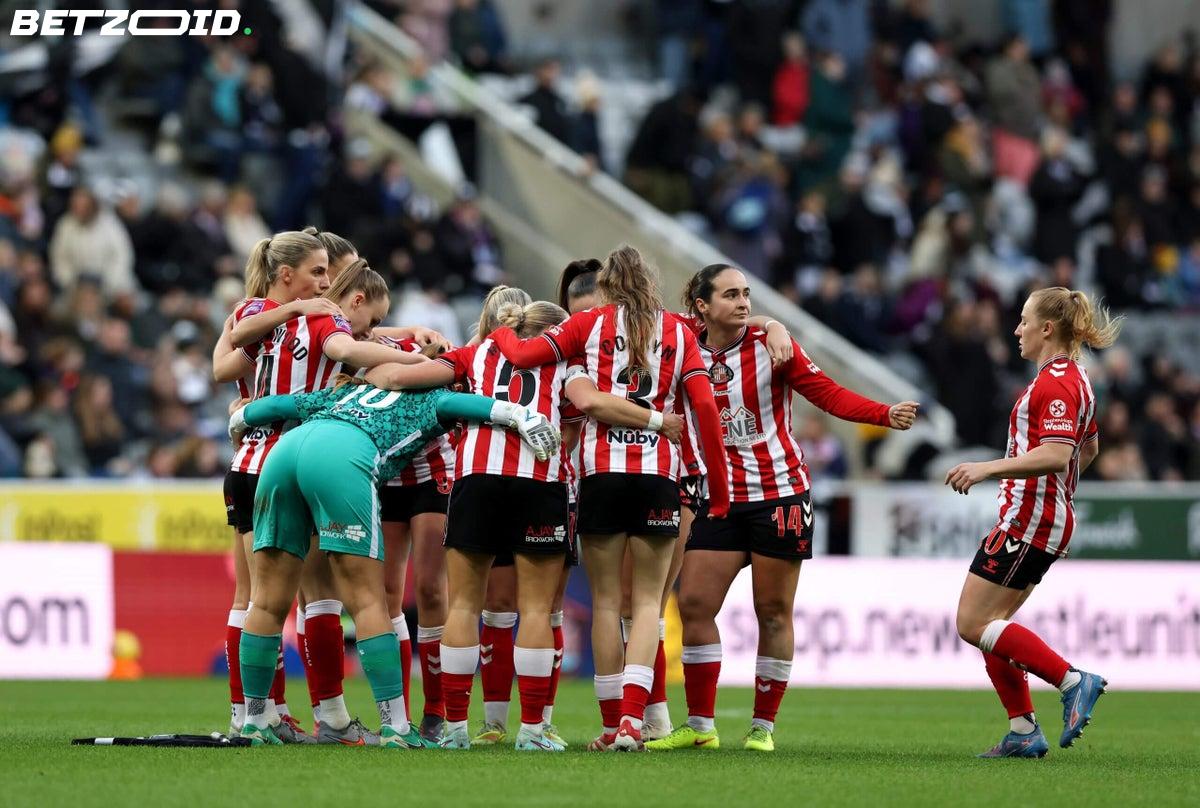
"I'd love to be sitting there one day and the Stadium of Light is sold out and everyone's coming to watch the women play." That's Kay Cossington, the new head of Bay Collective, and she means it — but she's also been very deliberate about what this takeover is not.
Bay Collective, the multi-club ownership group backed by U.S. private equity firm Sixth Street, has completed its majority takeover of Sunderland Women, with WSL approval now granted. The group holds 80 per cent; Sunderland retain a minority stake and, crucially, a genuine say in how the club is run.
Sixth Street are not small players. They paid a then-record $53 million expansion fee to put Bay FC into the NWSL in 2023, and hold revenue-sharing agreements with both Barcelona and Real Madrid. The financial firepower is real. What Cossington is selling, though, is patience.
Sustainable build, not a quick fix
"Will we see a high volume into player salaries in year one? No," Cossington said plainly. "But we'll see a difference, and a difference in all of the other components as well."
That's a measured line from someone who knows women's football deeply. Cossington spent 20 years at the FA — she oversaw the appointment of Sarina Wiegman, coached a 2009 under-19 European Championship-winning side that included Lucy Bronze and Jordan Nobbs (both Sunderland academy products at the time), and was awarded an MBE in 2024. This isn't a private equity firm parachuting in someone to read spreadsheets. She knows the ecosystem.
Sunderland haven't been in the WSL since 2017. Their budget in the Championship has been among the lowest across both WSL tiers. The previous ownership group under former chairman Stewart Donald let spending collapse to near-zero. Kyril Louis-Dreyfus reversed that decline when he took over the men's club in 2021, but the women's team never fully caught the wave.
That changes now — gradually. The immediate hires signal intent: Hannah Forshaw, former Everton Women CEO and ex-Liverpool vice-president of club operations, has joined as a senior adviser. Commercial and football operations teams are being built out. Five commercial contracts between Bay Collective and Sunderland have been agreed, covering everything from intellectual property rights to revenue splits.
The academy angle is the real story
Sunderland's women's development history is extraordinary. Lucy Bronze, Jordan Nobbs, Jill Scott, Demi Stokes, Lucy Staniforth, Poppy Pattinson, Carly Telford — Lionesses, all of them, all came through the club's academy. That pipeline has survived partly because the Foundation of Light charity plugged funding gaps when the club couldn't. Over 800 girls currently take part in weekly Foundation training programmes. A single private donation from a supporter, secured after girls' teams were showcased at half-time of a men's game, has funded the academy for three years.
That arrangement was always fragile. Bay Collective want to bring the entire pathway under one roof at the Academy of Light, giving the girls' programme the same infrastructure the boys' teams have long had. "You want the girls to have the same opportunities the boys have had," said Jamie Wright, the Foundation's deputy CEO — acknowledging what everyone in women's football already knows: parity in access has never been guaranteed.
Cossington called Sunderland's academy "unique" and a key factor in attracting Bay Collective to the club. Bay FC are already building a state-of-the-art performance centre in San Francisco, due to open in 2027. No equivalent blueprint exists for Wearside yet, but it gives you a sense of the group's ceiling.
On matchdays, Sunderland Women currently play at Eppleton Colliery Welfare Ground — 2,500 capacity, 250 seats, eight miles from the city centre. A groundshare agreement with the men's club means that if promotion to the WSL is secured, all league home games move to the Stadium of Light. That's the carrot. Promotion is the goal, "as early as is feasibly possible" in Cossington's words.
As for the takeover price, both parties are keeping that locked down. Sunderland CEO Tom Burwell described it only as "a revenue multiple we're very proud of" — with Women's revenue for 2024-25 sitting at £872,000, the maths on what 80 per cent cost is left to imagination. What's clear is the proceeds aren't ring-fenced for anything specific, and Burwell flatly denied they'd be used to service the £19.8 million interest-free debt the club's owners are owed.
Sunderland are the fourth Premier League club to sell a share in their women's team to an external investor in two years, following Chelsea, Aston Villa, and Everton. Unlike those three, they didn't restructure the women's team internally first. They just sold — because the expertise to negotiate a private equity deal didn't exist inside the club, and they knew it.
"There wasn't an investment professional," Burwell acknowledged. "The expertise to actually complete a transaction with a private equity firm like Sixth Street needed to be from outside the club." That kind of honesty is either refreshing or damning depending on your view of how Sunderland Women were managed before this moment.