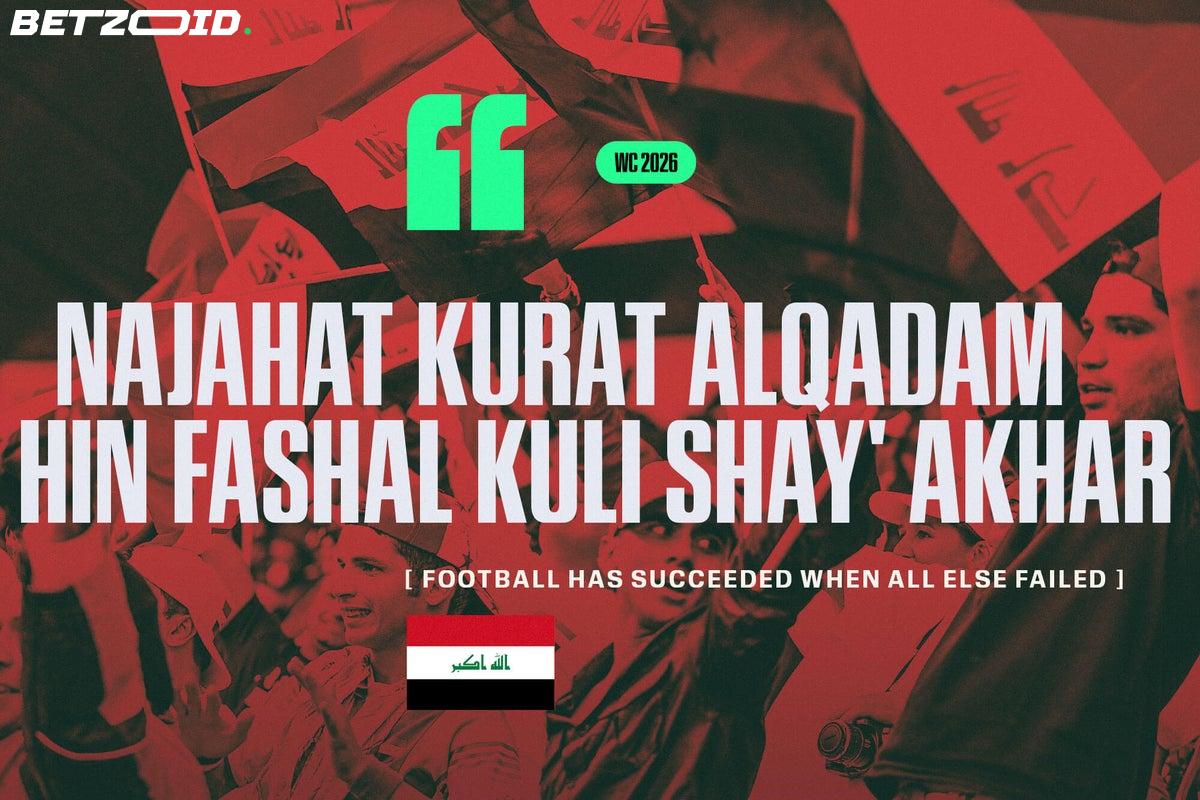
"The national team is the one thing where you'll have Sunnis, Shias, Kurds, Christians all working together." That line, from Iraq Football Podcast host Hassanane Balal, tells you everything about why this World Cup qualification means something that goes well beyond sport.
Iraq beat Bolivia 2-1 in a Monterrey play-off at the end of March to reach their first World Cup since 1986. Forty years. Two wars. The fall of a dictator. Waves of displacement that scattered a generation across four continents. And yet, here they are — in Group I against Norway, France and Senegal, with thousands of Iraqi diaspora supporters ready to fill American stadiums.
Prime Minister Mohammed Shia al-Sudani declared a two-day public holiday after Aymen Hussein's winning goal. That's the scale of it.
A squad shaped by conflict
Graham Arnold's squad for the Bolivia game included 10 players based in Europe. Ali Al-Hamadi grew up in Liverpool and is back in the Premier League with Ipswich Town. Zidane Iqbal came through Manchester United's academy and now plays in the Netherlands with Utrecht. These aren't just transfers — they're the direct product of families who fled Iraq during the worst years of the conflict.
Assistant manager Rene Meulensteen has spent years tracking Iraqis scattered across the globe. The team is, as Balal puts it, "a visual representation of what Iraq has gone through in the past two decades." That's not poetic license. It's literally true.
The bombs falling across the eastern border with Iran this year meant the squad had to travel by bus through Jordan just to reach their qualifying final in Mexico. They still won. The 21st game of a marathon campaign, and they delivered.
What this means on the pitch — and off it
Iraq enter Group I as heavy outsiders. France are favourites to top it, and Norway are no pushover. But the competitive picture almost misses the point. Arnold has spoken about this moment changing global perceptions of Iraq — giving a watching world a different image of the country than the one conflict has projected for decades.
Lana Al-Namee, an Iraqi now living in Chicago who will attend the opening game against Norway in Foxboro with her mother and two sisters, put it simply: "No matter your social status, your religion, your ethnic background, your politics, those things disappear when you've got that shared heartbeat."
Over 150,000 Iraqis live in the United States, according to the 2023 census. Many of them will be in those stadiums. The scenes at Monterrey airport after the Bolivia win — a hundred fans drumming and chanting through the departure hall at dawn, flags raised — are coming to New England and beyond.
In Arabic, the phrase that captures it all is this: "Najahat kurat alqadam hin fashal kuli shay' akhar." Football has succeeded when all else failed. For Iraq, that's not a slogan. It's a forty-year story.