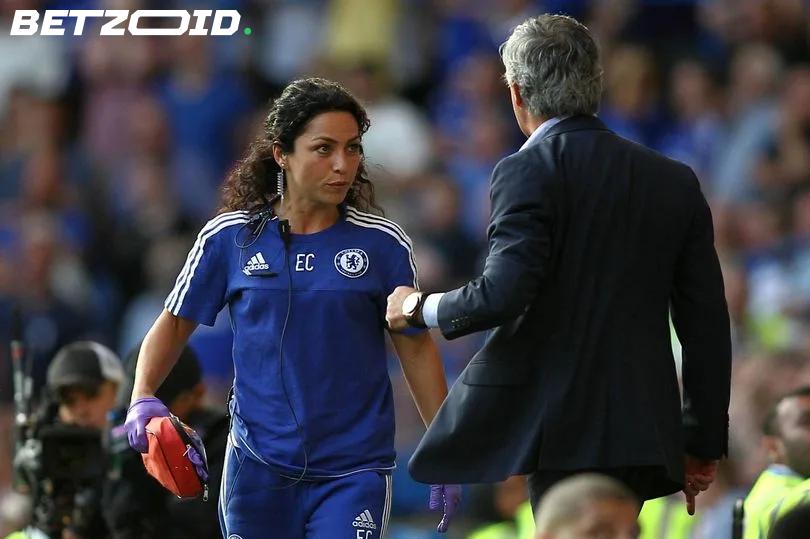
Eleven years later, and Eva Carneiro is still having to explain her job to people who should know better.
The former Chelsea team physician took to X this week after Jose Mourinho used his new self-titled Netflix documentary to relitigate one of the Premier League's more uncomfortable episodes — the August 2015 incident in which Carneiro ran onto the pitch to treat Eden Hazard during a match against Swansea. Mourinho was furious. Her doing her job, he argued, left Chelsea with nine men at a critical moment. She was stripped of matchday responsibilities and left the club shortly after. Carneiro later secured a settlement at a tribunal following legal proceedings for constructive and unfair dismissal, plus a personal claim against Mourinho.
Now Mourinho has revisited it on camera, describing the situation as "very, very simple" — Hazard wasn't really hurt, Carneiro was wrong to go on, end of story. John Terry backs him up in the documentary, claiming there was an "understanding" among players and medical staff that they'd only come on for genuinely serious injuries.
"Genuinely it would be healthy for John Terry to learn the rules of the game"
Carneiro didn't let that stand quietly. "11 years on and here we are reliving the worst. Hope they made some money," she posted, alongside a photo from her Chelsea days. The follow-up was sharper: "We are bound by a medico-legal code of conduct. Genuinely it would be healthy for John Terry to learn the rules of the game. It's been long enough mate."
She then shared a formal statement from the British Association of Sport and Exercise Medicine, which makes the legal position unambiguous: when a referee calls the medical team onto the pitch, attending the player is "their absolute duty of care." GMC standards govern it. The stage of the game is irrelevant. A club official — including the manager — has no say in the matter.
Carneiro added her own account of the specific sequence: referee Michael Oliver called them on twice, Hazard himself made eye contact from the sideline and confirmed he needed assistance — twice. "At that point my hands are bound as a medical professional," she wrote.
Mourinho's version, unchanged after a decade
Mourinho, now managing Real Madrid, is unmoved. "I'm not a doctor but my eyes know when a player is injured and when a player is not injured," he says in the film. He also frames his criticism of Carneiro at the time as no different to how he'd have spoken to a male doctor — a defence that didn't land particularly well in 2015 and hasn't aged better since.
Terry's contribution — that there was a shared "understanding" with the medical staff — is perhaps the most revealing part. An informal agreement, apparently accepted by "everyone," that effectively asked medics to override their professional obligations based on a manager's read of whether a player looked hurt enough. That's not football culture. That's a liability waiting to happen.
The BASEM statement Carneiro shared puts it plainly: "To discourage a doctor's duty of care to an athlete shows a disregard for player welfare and good medical practice."
Mourinho called the situation "very, very simple." On the medical and legal evidence, it is — just not in the way he means.