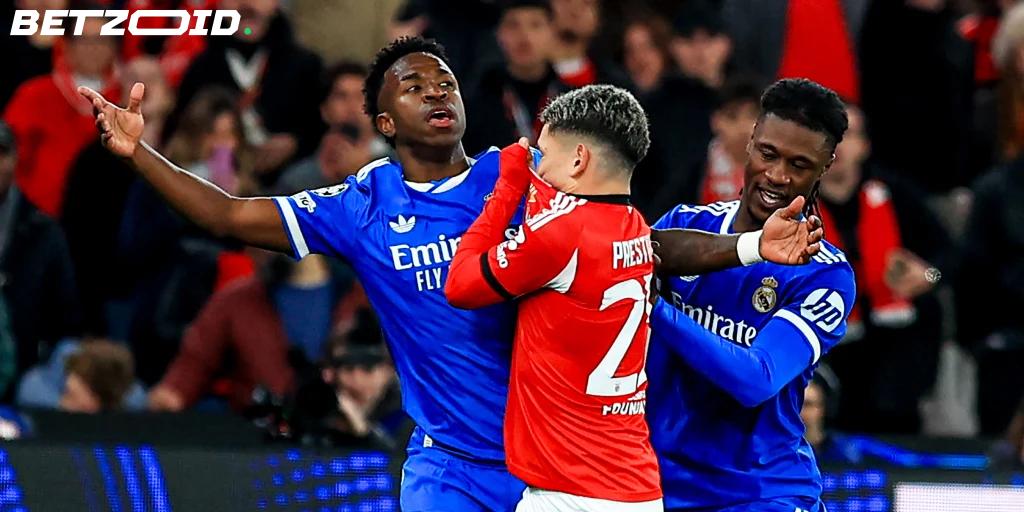
"There must be a presumption that he has said something he shouldn't have said, otherwise he wouldn't have had to cover his mouth." That was FIFA president Gianni Infantino, and he's not wrong — and now it's law.
The International Football Association Board unanimously agreed this week to issue red cards to any player who covers their mouth during a confrontation with an opponent. A second rule change goes alongside it: players who leave the field in protest of a referee's decision will also be shown straight red. Both changes land ahead of the FIFA World Cup.
The trigger was February's Champions League playoff between Real Madrid and Benfica. Around the 50-minute mark, Vinícius Júnior scored and celebrated with his trademark dancing — never popular with opposition fans. Benfica winger Gianluca Prestianni approached him with his jersey pulled over his mouth. Vinícius walked away visibly upset and immediately reported it to the referee, who activated the anti-racist abuse protocol, halting play for investigation.
What Prestianni actually said — and why it matters
No action was taken that night for lack of in-the-moment evidence. Vinícius told reporters after the game that Prestianni had directed a racial slur at him. Prestianni denied it on Instagram, saying Vinícius had "regrettably misunderstood" him. Then Kylian Mbappé stepped in: "He said it five times. I am speaking as clearly as possible. I am telling you what I think and what I heard, and I heard it very well."
Prestianni's defence to UEFA officials was that he used a homophobic slur, not a racist one — a distinction that carries real weight in the rulebook. UEFA handed him a six-game ban for homophobic discrimination. The equivalent punishment for racist abuse is ten games.
That gap in sanctions frustrated a lot of people. The mouth-covering rule is football's attempt to close the loophole entirely — if you can't prove what was said, the act of hiding it becomes the offence.
What this means on the pitch
In practice, this changes the temperature of every heated moment in a match. A player who pulls their shirt over their mouth to mutter something at an opponent doesn't just risk a fine or a later ban — they're off. Immediately. Their team plays with ten men for the rest of the game.
- Red card for covering mouth during a confrontation with an opponent
- Red card for leaving the field in protest of a referee's ruling
- Both rules approved unanimously by IFAB at a special meeting in Canada
- Changes take effect ahead of the FIFA World Cup
From a match-odds standpoint, this is worth tracking at the World Cup. High-pressure elimination games, star players with short fuses, and a rule that can swing a game in an instant — it's a real factor. Any team relying on a volatile forward or a player with a history of confrontations now carries a different kind of risk.
Mbappé said he heard it five times. The new rule means next time, one time is enough.