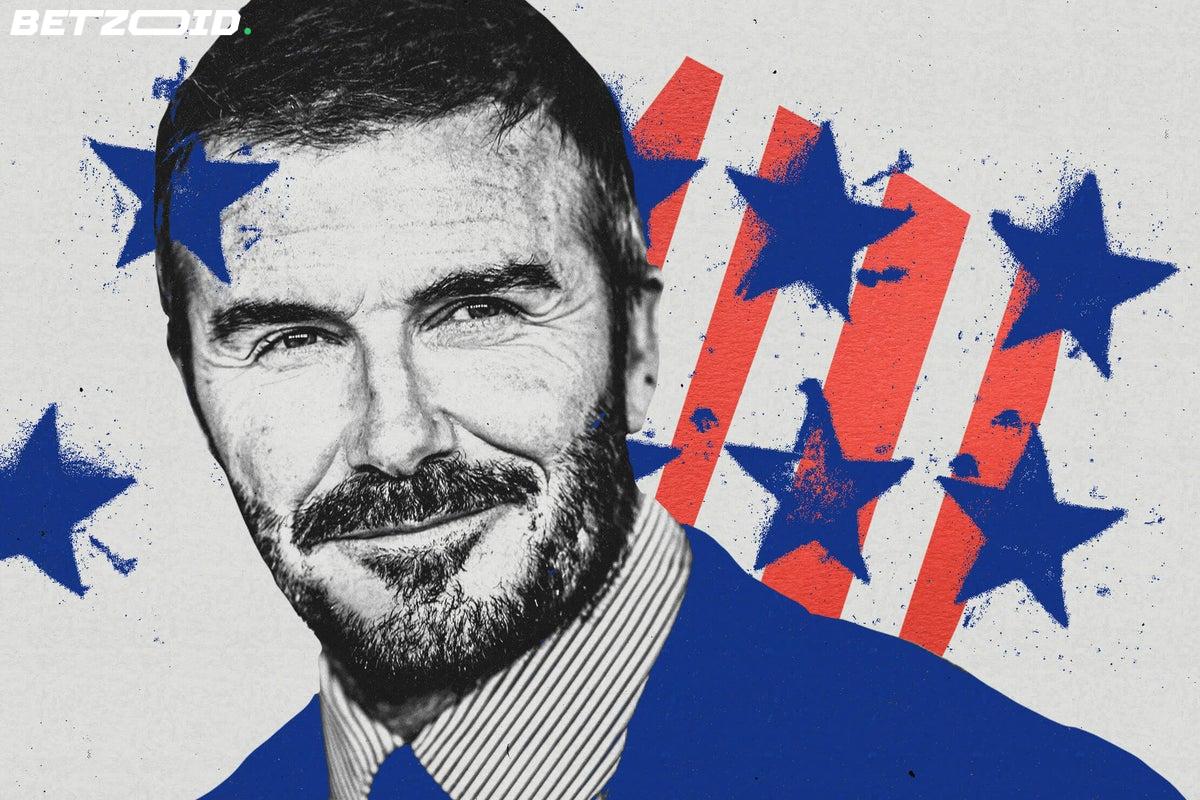
Tom Cruise introduced him. A star on the Hollywood Walk of Fame now bears his name. And somewhere in Miami, Lionel Messi is scoring World Cup goals for a club that wouldn't exist without him. Whatever Ramon Calderon thought was going to happen when David Beckham left Real Madrid for LA Galaxy in 2007, it wasn't this.
Calderon, Madrid's president at the time, dismissed the move with a line that has aged catastrophically: "David Beckham will be a B-list actor living in Hollywood." Nearly two decades later, Beckham has a Walk of Fame star, a $1.45 billion MLS franchise, and a commercial empire that turned a $45 million pre-tax profit last year on $92.3 million in revenue. The B-list is not exactly knocking.
The through-line nobody saw coming
At this World Cup — the first held across the United States, Canada and Mexico — Beckham is everywhere. USMNT games. England matches. Argentina fixtures in Miami. TV commercials during every break. It would feel like saturation if the substance wasn't there to back it up.
Because the ubiquity isn't accidental. It's the product of a 20-year strategic bet that almost everyone in European football thought was career suicide. When Beckham joined Galaxy as one of MLS's founding designated players — the rule itself was nicknamed after him — the league had 13 teams. It now has 30. He arrived as a galactico slumming it in a second-rate league. He left as the architect of something that pulled Messi across the Atlantic.
"There is no Messi in this league if not for David Beckham," Cruise said at the Walk of Fame ceremony. That's Hollywood, sure. But the mechanics back it up. Beckham negotiated an expansion team option when he signed with Galaxy — a fixed-price clause that looked eccentric in 2007 and looks like one of sport's great business moves now. That $25 million option became Inter Miami. Inter Miami became the most valuable club in MLS at $1.45 billion, per Sportico. And Inter Miami became Messi's home.
The chain of causation is real, not manufactured for a podium speech.
Brand Beckham, explained
The commercial dimension has reached a scale that prompted Harvard Business School to build a case study around it in 2023, centred on Beckham's deal with Authentic Brands Group — the company that manages the estates of Muhammad Ali, Marilyn Monroe and Elvis Presley. ABG CEO Jamie Salter's pitch was blunt: "David Beckham is effectively Mickey Mouse." ABG took 55 per cent of David Beckham Ventures; Beckham kept 45 per cent and his Inter Miami stake untouched.
At this World Cup, he appears in ads for Adidas, Pepsi, Lenovo, Bank of America and McDonald's — sitting alongside Lamine Yamal, Christian Pulisic and Ronaldinho in that last one. The broader ad market around this tournament has rebounded sharply from Qatar 2022, with the World Advertising Research Center projecting $10.5 billion injected into advertising. Beckham is positioned at the centre of it, not on the edges.
For anyone tracking Inter Miami's commercial trajectory or MLS expansion valuations, Beckham's visibility during this tournament isn't just personal brand maintenance — it's active leverage. The more America falls for this World Cup, the more his ownership stake appreciates.
He flew to New York by Concorde the day after his red card at France '98. He was backstage at a Spice Girls show at Madison Square Garden when Madonna walked in and said, "Oh, you're the soccer player, aren't you?" He named his first son Brooklyn. His wedding anniversary is July 4. The American motifs were always there, long before anyone treated them as a strategy.
"The more I saw, the more I became obsessed with America," he said. "I couldn't see why the greatest sporting nation wouldn't embrace the biggest sport on earth."
The UK tabloid The Mirror ran the headline "10 heroic lions, one stupid boy" after his red card in Saint-Etienne. The boy is now worth studying at Harvard. That's the whole story, really.