"Honestly? We can win it." That's Ricardo Carrasco, 26-year-old Ecuador fan, setting the floor somewhere around the quarter-finals and the ceiling at the whole thing. A decade ago, that sentence would have sounded like a punchline. Now it reads like a position paper.
Ecuador — La Tri — didn't qualify for a single World Cup between their first match in 1938 and the end of the 20th century. Zero. Their fans spent those decades picking a South American giant to borrow for a month, living vicariously through Brazil or Argentina, then returning to a national team that wasn't really on the map. The inferiority complex wasn't just cultural mythology. It was structurally accurate.
The moment everything shifted
March 28, 2001 is the date that changed the frame. Ecuador beat Brazil for the first time ever. Seven months later, they qualified for the 2002 World Cup — finishing second in CONMEBOL qualifying, above Brazil, Uruguay, and Colombia. From zero World Cups to outranking the continent's giants in the space of a year.
Progress since then hasn't been linear. They missed 2010 and 2018 entirely. But an entire generation has now grown up with the assumption that La Tri belong on the international stage — and the club game has caught up to reinforce that. Moisés Caicedo is running Chelsea's midfield. Piero Hincapié is at Arsenal. Premier League viewers who couldn't have placed Ecuador on a map five years ago now know the country by its footballers.
"People confused us with Colombia or Venezuela," says New York-based fan Danilo Carrion, who left Ecuador at 14. "Never being at the World Cup was the sadness of knowing we didn't have an identity in the world. Now you hear foreigners saying, 'Wow, look at Caicedo, look at Hincapié'. That never used to happen."
What Ecuador's odds actually reflect
The expanded 2026 format — 48 teams, a round of 32 before the last 16 — works in Ecuador's favour structurally. Carrasco calls the round of 32 "more than an obligation" and the round of 16 a "requirement." Given their CONMEBOL pedigree and the quality running through their current squad, that's not delusional. A team built around Caicedo's engine and Hincapié's defensive composure is genuinely capable of navigating a group and causing damage in the knockout rounds. Anyone pricing Ecuador as a soft touch in their group is doing lazy work.
The fanbase itself is still evolving. Hugo Erazo, part of supporter group La 593 — named after Ecuador's international calling code — admits the pre-match culture lags behind their South American neighbours. "In Ecuador, people just go to the stadium, sit down and that's it," he says. "We want to transform that spirit, start the party hours before kick-off." No deep-rooted carnival tradition, no ancient continental rivalries — Ecuador don't carry the baggage that weighs on Brazil or Argentina supporters.
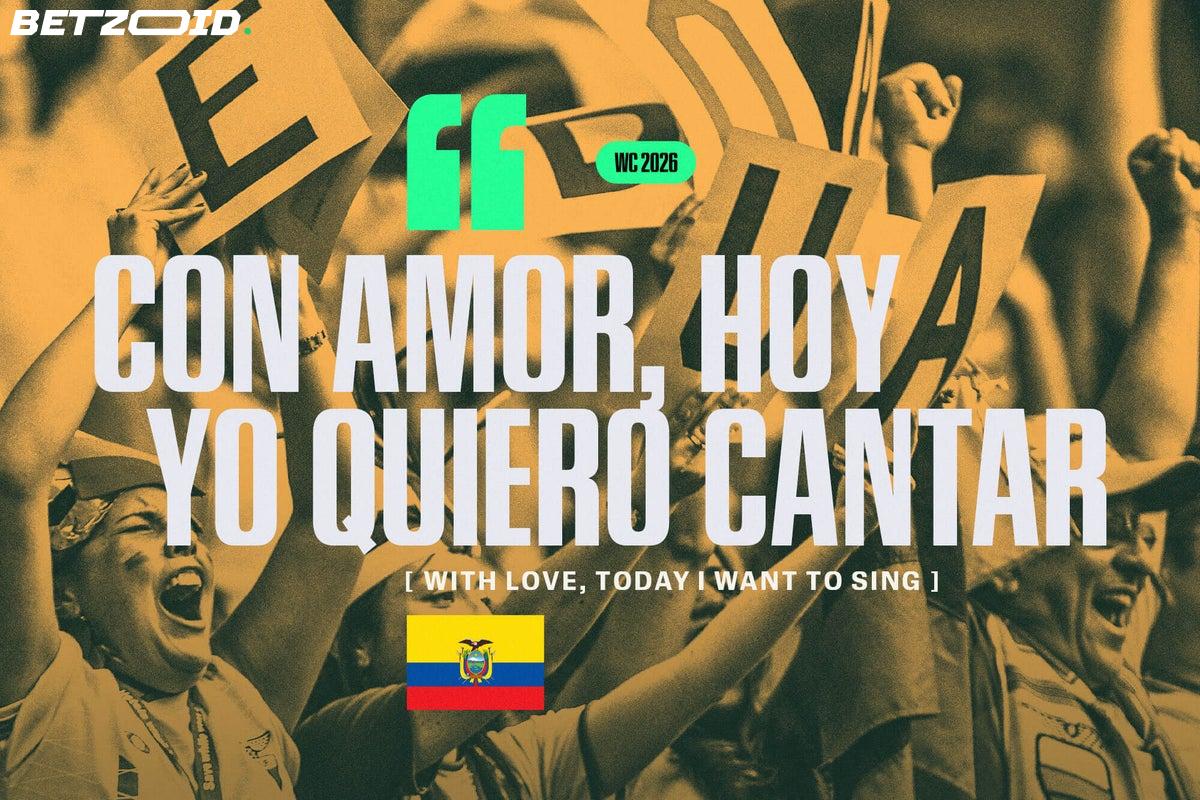
What they do carry is a fan song, A Mi Lindo Ecuador, a love letter to the country that opens: "With love, today I want to sing. Yes, sir, to my beautiful Ecuador." After six decades of watching from the sidelines, the singing finally has something to back it up.
Quarter-finalists or champions, says Carrasco. Nothing less.