"The field was a disaster. It jumped up on you as you ran." Emiliano Martinez said that after Argentina's Copa América opener in Atlanta in June 2024 — and he wasn't wrong. The surface at Mercedes-Benz Stadium was patchy, inconsistent, and visibly temporary. Nearly two years later, the people responsible for that pitch have spent every day since trying to make sure nobody ever says that again.
They've gone well beyond a fresh roll of sod. The artificial turf used by the Atlanta Falcons and Atlanta United was ripped out entirely in January. Then the asphalt foundation underneath went too, along with several layers of rock. In its place: a permanent natural grass installation, planted from below ground, with a hybrid synthetic stitch woven through the backing for stability. It still plays like natural grass — cleats break the surface cleanly — but it holds together in a way the Copa América pitch never did.
What went wrong in 2024 — and what changed
Lionel Scaloni's complaint at the time was that the grass had been laid two days before the Argentina-Canada game. That wasn't accurate — it was five days — but his broader point stood. The process was flawed: not enough time for the grass to settle, inadequate drainage, and the wrong technology for a domed environment. Weston McKennie put it bluntly: "You're playing on a football field, with laid grass that's all patchy and it breaks up every step you take."
The sand base underneath the new pitch directly addresses the trampoline effect Martinez described. An upgraded irrigation system now delivers more even water distribution across the entire surface, which is what makes grass bind and hold. A vacuum ventilation system that existed pre-Copa América has been overhauled with better drainage. And grow lights — described by FIFA's head of pitch infrastructure Ewen Hodge as "the beating heart of a field" — are being used to sustain grass in a domed stadium where natural light doesn't reach.
The roof at Mercedes-Benz will stay closed from now through the World Cup. That's a deliberate call. Open it when Atlanta's summer heat hits, and the grass wouldn't survive the temperature shock. Keep it shut, run the air conditioning efficiently, and a lower-light grass variety can thrive — provided the lighting technology does its job.
Atlanta United as the test run
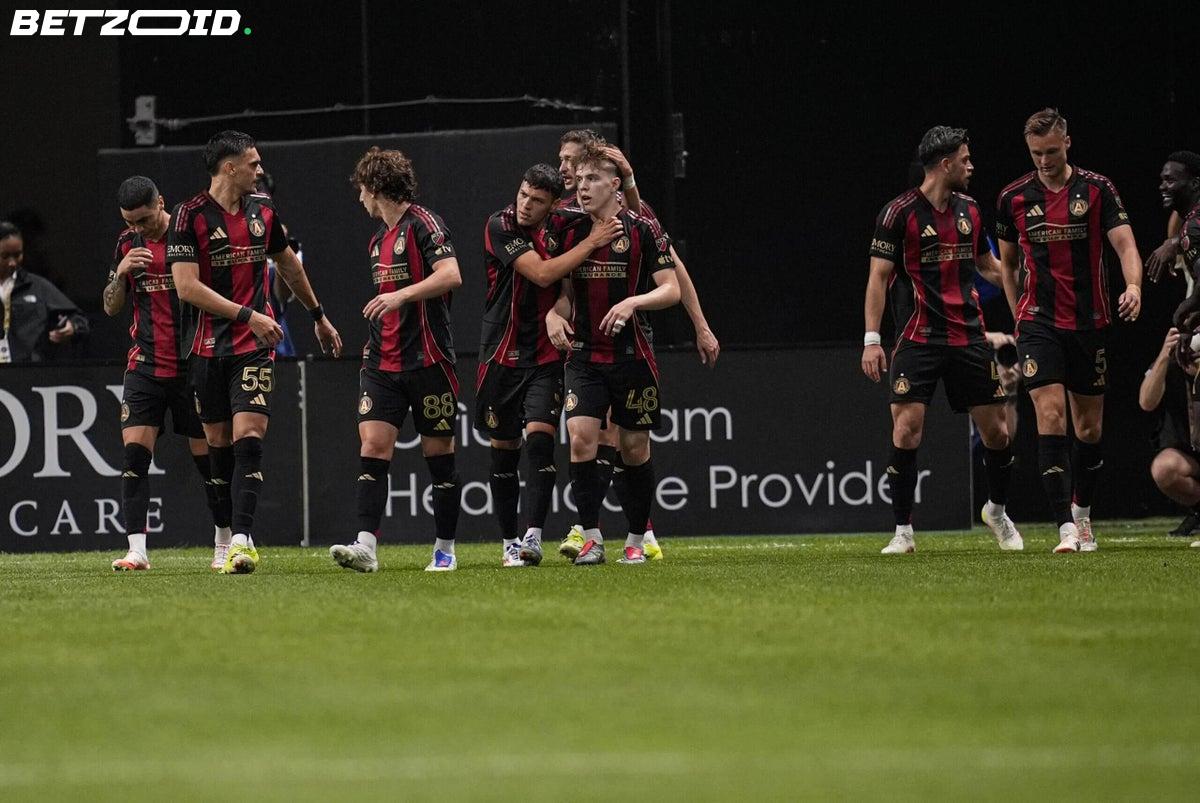
Mercedes-Benz has already hosted three Atlanta United MLS regular season matches on the new surface. That's not a soft launch — it's a live stress test before the USMNT faces Belgium on Saturday and Portugal three days later. Two senior international friendlies against European heavyweights will tell Adam Fullerton, the stadium's VP of operations, whether two years of work holds up under real match conditions.
- Atlanta will host eight World Cup matches, including a round-of-16 game and a semifinal
- FIFA will install its own grass field in Atlanta in May, as it will at other U.S. venues currently using artificial turf
- The 2025 Club World Cup — six matches hosted in Atlanta — passed without a single pitch complaint
That Club World Cup silence matters. "Sometimes no feedback is good," Fullerton said. "If people are talking about it in a negative way, you're going to hear about it right away." After Copa América, they heard about it immediately and loudly. After the Club World Cup, nothing.
Atlanta United's coaching staff have asked for the grass to be cut shorter to speed up play — a reasonable request that Fullerton is managing carefully, shaving it down gradually rather than scalping it. Head coach Tata Martino and his players are otherwise satisfied with how the surface plays.
For anyone with money on USMNT results this weekend, the pitch quality is no longer the variable it was in 2024. The bigger questions are whether Mauricio Pochettino's squad can handle Belgium's press and then back it up against Portugal — on a field that, for once, shouldn't be part of the conversation.
"The objective," Hodge said, "is that we don't hear anything about it." Given what Atlanta heard last time, that would be exactly the right outcome.