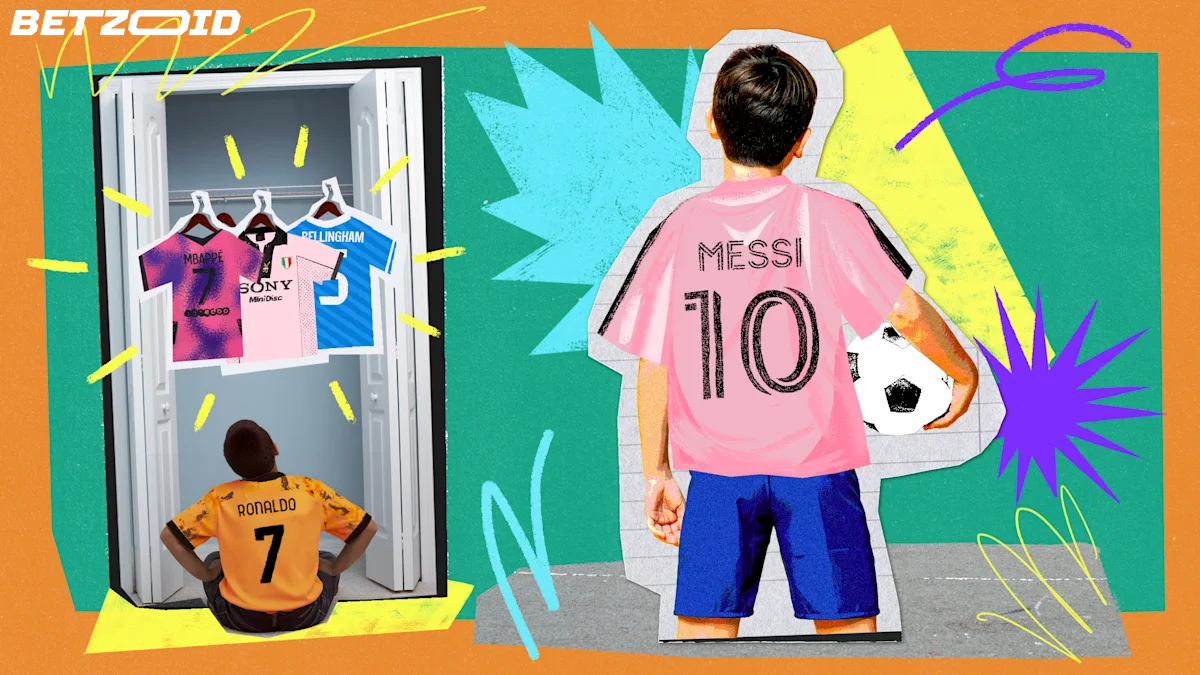
Nike sold two and a half times more national team jerseys before this World Cup than it did before Qatar 2022. USA kits were sold out for weeks. TikTok Shop recorded a 527% spike in U.S. soccer jersey orders in the tournament's opening week alone. The soccer shirt didn't just cross over into mainstream fashion this summer — it took the whole wardrobe over.
Adidas projected $570 million in World Cup gear sales in the first half of 2026. By May, its year-over-year sales were up roughly 70%. These aren't the numbers of a trend. They're the numbers of a shift.
The playground has already moved on
If you want to understand where American soccer culture actually stands right now, skip the punditry and go watch kids board a camp bus. One parent did exactly that — an informal parking-lot survey before his daughter left for sleepaway camp turned up Liverpool, Italy, USA, Argentina, and Messi's lifestyle collection within seconds. Not a single NFL, NBA, or MLB logo in sight.
His son's bag was packed almost exclusively with soccer kits. Arsenal, LAFC, Italy. That's just what the kid wears.
Another family he coaches has two boys running 12-shirt rotations each — and not just the obvious European clubs. Club América, Tigres, C.F. Monterrey. Their mom admits she went through a mourning phase when they stopped wearing the clothes she picked out. Now she scours discount stores for deals and buys sizes ahead. "I go a bit crazy shopping for them," she says. "It's fun, and it's addictive."
Authentic youth jerseys typically run over $100. The youth soccer jersey market was valued at $2.1 billion globally in 2019 and is projected to hit $4.1 billion over the next two World Cup cycles. North America already accounts for 18.9% of that market and growing.
More than fashion — it's the cultural gap closing in real time
The usual debate about why the U.S. men's team underperforms — best athletes going to other sports, expensive youth systems, poor development structures — resurfaced again after the Round of 16 exit to Belgium. All of it has some truth. But the deeper issue has always been cultural, not athletic.
For most of the world, kids grow up with soccer as background noise that becomes obsession. They hear it, watch it, play it in the street, and wear it before they're old enough to have a favourite formation. American kids, historically, didn't have that. Soccer was something you played on Saturday mornings, not something you lived inside.
That's changing — visibly, measurably. This generation can stream the Premier League on weekends and the Champions League midweek. They can attend MLS matches in their own cities. They follow club football year-round, not once every four years. And they wear the jerseys not as costumes, but as identity.
A closet full of kits won't produce the next great American midfielder. But a generation that experiences soccer as a way of life rather than a scheduled activity? That's a different pipeline entirely — and the betting market on U.S. men's soccer relevance by 2030 looks considerably more interesting because of it.
Olivia Rodrigo dropped a retro Barcelona kit earlier this year. NYC mayoral candidate Zohran Mamdani did one for New York. Designers from Miaou to Aimé Leon Dore have piled in. H&M, ASOS, Gap too. The soccer shirt's simple construction — pullover, short sleeves, no awkward padding — means it works with everything else in a wardrobe in a way a football or basketball jersey doesn't.
Style got it here. But what keeps it here is something bigger: for the first time, an entire generation of American kids thinks of soccer as theirs.