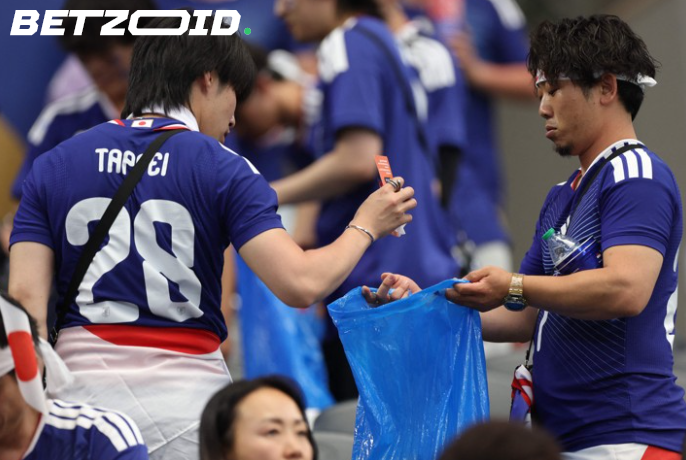
"A bird that has flown leaves no trace." That Japanese saying has become the most quoted line at the 2026 World Cup — and not because of anything that happened on the pitch.
After Japan's group stage match against the Netherlands at Dallas Stadium on June 15th, Japanese fans did what they always do: stayed behind, pulled out trash bags, and cleaned the stands themselves. The national team did the same in the locker room. FIFA posted the photo. The internet did the rest.
This isn't a PR stunt — it's a school curriculum
The cynics always show up. Every tournament, someone calls it performative, a bid for attention dressed up as civic virtue. Tsunoda Hirokazu, who has been traveling to Olympic and World Cup venues to clean stadiums since 2008, has a simple answer: "Just try it once yourself."
He's right that the logic holds up. The stadium gets cleaner. Cleaning staff go home earlier. Nobody loses. Tsunoda even carries spare bags for bystanders who want to join — and plenty of non-Japanese fans do.
The cultural roots go deeper than good manners. Japanese-American culture expert Nozomi Morgan points out that Japanese schoolchildren clean their own classrooms, stairs, and restrooms — every day, with rags labeled with their names. Tidying public space isn't a virtue signaled at international events. It's something drilled in from age six.
That's what makes this different from a marketing campaign. You can't manufacture something that's built into the school day.
The players carry the same instinct
It's not just the fans. At Russia 2018 and Qatar 2022, Japan's squad left spotless locker rooms complete with thank-you notes and origami paper cranes. They did it again here. Former captain Hasebe Makoto put it plainly during Russia 2018: "I am proud of the spirit that Japanese people and Japanese society possess. I feel pride as a Japanese citizen before I am a footballer."
That's a striking hierarchy of identity from a man who spent the bulk of his career at Eintracht Frankfurt and Arsenal.
CNN noted this week that Japan is "asserting another kind of presence" at this World Cup regardless of results. Which is a polite way of saying: the football has been complicated, but the behavior has been consistent.
Whether Japan advance past the group stage or not, they will leave Dallas Stadium — and every venue they visit — cleaner than they found it. At this point, that's as reliable a fact as the tournament bracket itself.