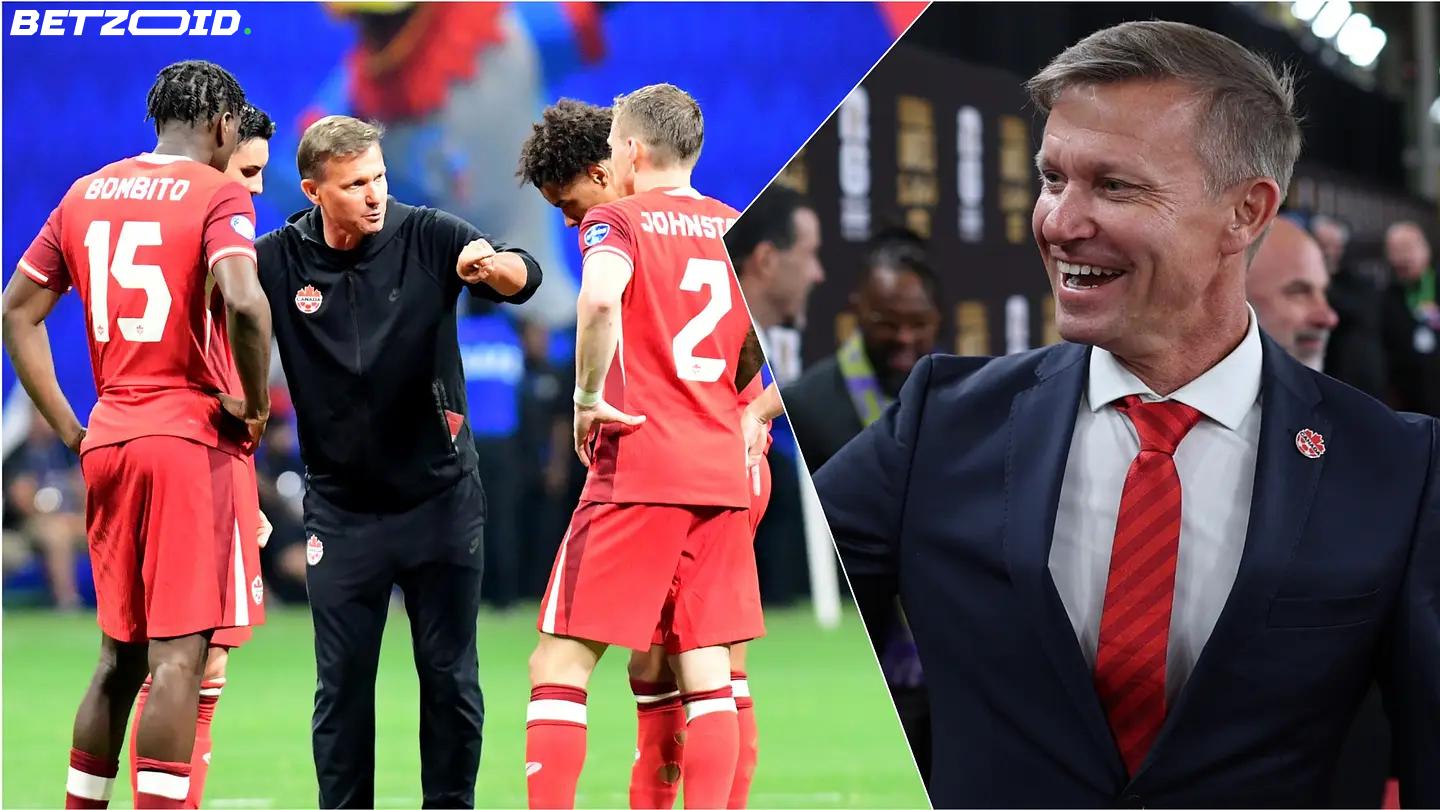
Canada didn't wait to see how the 2026 World Cup goes. Jesse Marsch has already signed a four-year extension, locking him in through the 2030 tournament — and given everything he's built, the decision is hard to argue with.
The 52-year-old Wisconsin native took over in 2024, and in that time he's pushed Canada to a 26th-place FIFA ranking — a program best — and to the Copa América semifinal, where only Lionel Messi's Argentina stood in the way. That's not a ceiling. That's a foundation.
More than a head coach
What makes Marsch genuinely difficult to replace isn't tactics — it's the role he plays beyond the whiteboard. He's called himself an "agent" for his players, and the evidence backs that up. Living in Italy, he's a regular presence at Sassuolo for Ismaël Koné and at Juventus for Jonathan David. When Koné was stuck in a toxic situation at Marseille under Roberto De Zerbi — Marsch's word for De Zerbi isn't printable — he helped engineer the exit. Koné is now a Serie A regular and a near-certain World Cup starter.
Then there's Liam Millar. The Hull City winger tore his ACL in 2024 and slid into depression during his recovery. Marsch flew him and his family out to Italy, put them up at his estate, and helped rebuild him mentally. Millar came back, had a stellar season, and earned a Premier League move. That's the kind of relationship that doesn't show up in any contract clause.
His 4-4-2, built on high pressing, transitional speed and two disciplined defensive blocks, fits this squad like it was designed for it. Because it was. With Alphonso Davies, David, Koné and several others still set to be in their 20s by 2030, the project has runway.
The money behind the deal
Canada Soccer isn't funding this alone — they can't. The new deal is majority-backed by Vancouver Whitecaps ownership and the Saputo Foundation (the same family that owns CF Montréal), with additional contributions from Boro and Jen Hamilton, the Adnani Family, and an anonymous donor. MLSE, which co-funded the original arrangement, has stepped back from this extension, though they remain involved with Canada Soccer in other capacities.
Marsch's previous deal was estimated at over $2 million per year. The exact figure for the extension hasn't been confirmed, but the funding structure suggests the stakeholders believe the investment is worth protecting — particularly with a home World Cup arriving in weeks and a lucrative club or international offer a strong tournament away.
For anyone looking at Canada's tournament odds this summer, one thing is clear: the continuity argument just got a lot stronger. A team that knows its coach is staying has no transition anxiety, no lame-duck dynamic, no players quietly auditioning for the next manager. Canada heads into 2026 with genuine belief — and now, a plan that extends well beyond it.
"With Canada," Marsch said in 2025, "I've found a place that embodies for me the ideals and morals of what not just football and a team is, but what life is — integrity, respect and the belief that good people can do great things together."
Four more years of that. Canada Soccer decided not to risk finding out what losing it would look like.