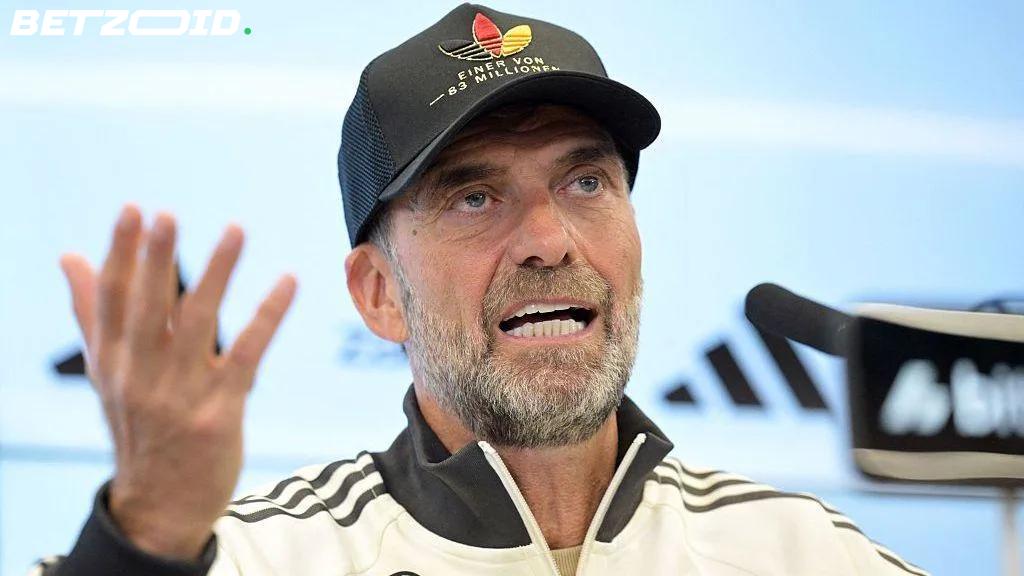
"I do not want to entrust national pride to the wrong people." That's how Jurgen Klopp chose to open his tenure as Germany manager — not with tactical philosophy or squad expectations, but with a direct response to the far-right Alternative for Germany (AfD) party winning 43.8% of the vote in Saxony-Anhalt, stopping just short of an absolute majority in the regional parliament.
He was careful to frame it as a sportsman's perspective rather than a politician's: "I can say that I would very much like to reclaim the flag for myself, for all of us. I want it so that when someone waves it, no one thinks: 'What is wrong with you?'" Whether you think football managers should wade into politics or stay in their lane, there's no question this sets a tone. Klopp's Germany is going to mean something beyond results.
The squad itself is a rebuild job
Klopp has named a 44-man pool for four Nations League fixtures across two weeks — a structure that splits into two groups of roughly 24 and 20 players for the different match windows. Against the Netherlands in Amsterdam on September 24 and Greece in Augsburg three days later, the first group takes charge. Then the second group joins for Serbia in Munich on October 1 and Greece in Thessaloniki on October 4.
Sixteen of those 44 players are uncapped. That's not a rotation decision — that's a generational statement. The squad includes Premier League names: Kai Havertz (Arsenal), Kevin Schade (Brentford), and Anton Stach, who has made the move to Leeds. Jamal Musiala is in despite two collapse incidents during Bayern's pre-season, which is the kind of selection that will attract scrutiny the moment anything goes wrong.
The second group features Brentford's Vitaly Janelt on his first call-up, Florian Wirtz (Liverpool), and Malick Thiaw (Newcastle). Depth across the Premier League, which at least gives Klopp a scouting advantage he's used to.
- Group 1 (vs Netherlands & Greece): Havertz, Schade, Stach, Musiala
- Group 2 (vs Serbia & Greece): Janelt, Wirtz, Thiaw
- Notable absences: Manuel Neuer and Antonio Rudiger, both retired after the World Cup second-round exit against Paraguay
What Klopp is actually inheriting
This job didn't come from nowhere. Germany went out in the last 16 at the World Cup, losing to Paraguay. Julian Nagelsmann was shown the door. Klopp, who had been serving as global head of soccer for Red Bull since leaving Liverpool, was brought in as the big name to steady the ship — and, apparently, the national identity.
The absence of Neuer and Rudiger removes two of Germany's most experienced international voices. The Nations League fixtures aren't glamour ties, but they matter — both for points and for Klopp to figure out who actually belongs in this squad when the games count. With 16 uncapped players in the pool, there are more questions than answers right now.
"Football can foster a sense of community," Klopp said. That's the soft sell. The harder reality is that he's taken over a national team in transition, with a political backdrop that few coaches have ever had to navigate at a press conference. The Netherlands away is a useful early test of whether the football can match the ambition.