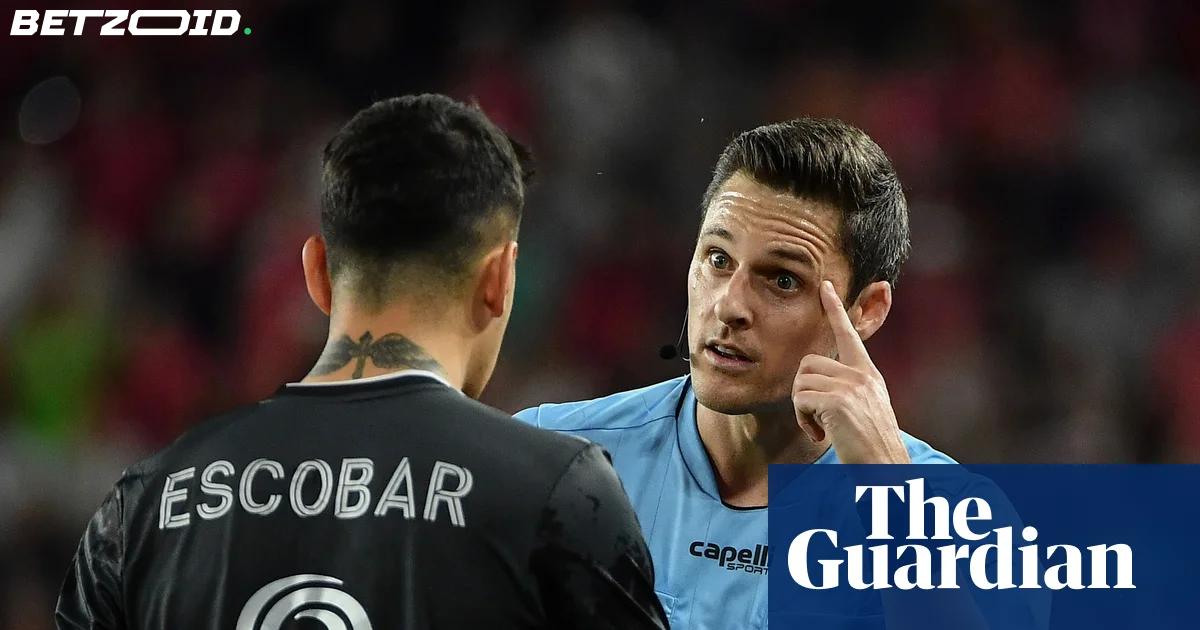
"I hate going to the monitor." That's the man who'll be operating VAR at this summer's World Cup talking — and it might be the most reassuring thing you've heard about the tournament's officiating setup.
Joe Dickerson, named US Soccer's male referee of the year in 2025, won't be in the center circle this summer. He'll be in the replay booth, a voice in the ear of the on-field official, calling up footage and flagging contentious decisions across stadiums throughout North America. And his personal distaste for over-relying on the monitor shapes exactly how he approaches the job.
What VAR actually looks like from the inside
The booth isn't one person staring at screens. Three officials work each match: the video assistant referee communicating live with the referee, a support VAR who keeps monitoring while the first is reviewing a call, and an assistant VAR handling notes. All three go through identical training — so when a decision needs a second look, there are genuinely three sets of eyes with the same reference points in the room.
Those reference points come from a 10-day pre-tournament seminar, the most recent held in Brazil, where officials work through clip after clip until the calls feel automatic. "We know that 90-something percent of the decisions we will see at the World Cup, we will consider almost black and white," Dickerson said, "even if the footballing public doesn't."
The remaining percentage — the handballs on bent arms, the soft contact in the box, the moments where an attacker goes down a split-second after winning the duel — those are the ones that will dominate the conversation regardless of what the booth decides.
Dickerson's philosophical take on the whole mess
Outside of refereeing, Dickerson is completing a master's at the University of Chicago, with a thesis on Machiavelli's political philosophy and a planned case study connecting it to officiating. That's not as strange a pairing as it sounds. His read on Machiavelli — empathy and leadership hidden beneath amoral pragmatism — maps fairly cleanly onto the VAR official's role: make the right call, understand the human cost of getting it wrong, and don't pretend the system is neutral.
"When you combine subjectivity with inherent bias and high emotions, you get a lot of strong opinions about things like VAR decisions," he said. He's not wrong. And at a World Cup, where every call lands in front of a global audience with a rooting interest, the pressure on that booth is unlike anything in club football.
Dickerson actually thinks the tournament format helps. In a league season, one bad call can fester across 38 games of context. A World Cup is a short, visible sprint — outliers are less likely to define the whole thing. Whether that logic survives contact with a knockout-stage handball call in the 89th minute is another question entirely.
The Premier League just voted against expanding VAR's scope to include corner kick checks. Fifa is going the other way, adding exactly that for this tournament. So the most-watched football event on earth is running an experiment the top club league in the world just rejected. Dickerson and his colleagues will be at the center of it.
"You can't eliminate the public's bias from any analysis of VAR," he said. "And that's not a bad thing."