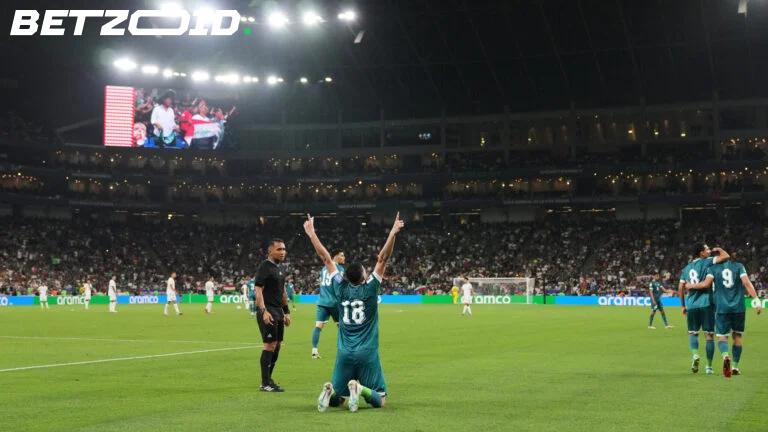
Forty years. A last-kick penalty. A 17-hour flight through grounded airspace. And a striker who buried the winner after losing his father and brother to war. That's what it took for Iraq to reach the 2026 World Cup.
Aymen Hussein scored the goal against Bolivia in Monterrey that secured the 48th and final spot in the tournament. It was the culmination of a 21-game qualifying campaign — a record — that nearly collapsed a dozen different ways before it ended.
His story alone would fill a book. His father, an Iraqi Army officer, was shot and killed in Hawija in 2008. Six years later, his brother was abducted by ISIS and presumed dead. The family home was destroyed. His mother and younger brother fled. Aymen was training with the youth team in Turkey when it happened.
A striker nobody believed in
For most of his international career, Aymen looked like exactly the wrong man for the big moments. Two goals in his first 32 appearances. At 6-foot-2, critics compared him to a motionless plank of wood. A political satirist took aim. His own coach once sprinted onto the pitch to physically stop him taking a penalty, that's how little confidence there was in him.
Then something shifted in this qualifying cycle. He started scoring. He became the team's top scorer and main talisman. After the winner against Bolivia, he said: "It was a dream I've lived since childhood." The country rewarded him with three cars, a villa, an apartment, a 21-karat gold iPhone, and a plot of land. He's now in Iraq's all-time top five scorers.
He isn't the only one carrying weight in this squad. Midfielder Zaid Ismail dedicated qualification to his father, a deputy intelligence officer killed in 2006 when Zaid was four years old. Ali Al-Hamadi — the first Iraqi international to play in the Premier League — scored the opening goal in Monterrey and was almost in tears celebrating. His father had been imprisoned for peacefully protesting against Saddam's government, eventually fleeing to Toxteth, Liverpool. Ali was reunited with him in England as a toddler after the 2003 invasion.
21 games, three routes, and one last-second VAR call
The qualification path was relentless. Iraq fell out of direct contention after a collapse in Amman — two late goals, a 2-1 loss to Palestine, the first time Iraq had ever lost to them. Coach Jesus Casas was sacked.
In came Graham Arnold, two years removed from stepping down with Australia after a poor start to their own World Cup campaign. He'd watched Iraq beat Australia 3-1 in the 2007 Asian Cup and never forgot what they were capable of when motivated.
The AFC playoffs brought a 0-0 draw with Saudi Arabia, who edged Iraq on goal difference by a single goal. Then came a two-legged tie against the UAE. Drawn in Abu Dhabi, level in Basra, a UAE goal ruled offside with minutes left, and then — in the last seconds of ten minutes of stoppage time — VAR spotted a handball. Penalty.
Amir Al-Ammari stepped up. Born in Sweden to parents who fled Kuwait after the 1991 Gulf War, he used breathing exercises he'd recently learned to slow himself down. He'd watched the goalkeeper dive early in previous kicks and waited. Put it to the right. Scored. Iraq erupted.
One game left. But war broke out in the Middle East in February, airspace closed, flights grounded. Arnold, stuck in a UAE hotel, demanded FIFA postpone the play-off. Eventually the squad got out — a 12-hour drive from Baghdad to Amman, then a 17-hour flight to Mexico. They arrived ten days before kick-off.
Bolivia equalised after Iraq's early goal. Then Aymen Hussein scored the winner.
Iraq are in Group of Death territory at the 2026 World Cup — France, Norway, and Senegal. Nobody expects them to advance. But Arnold wasn't interested in managing expectations after Monterrey: "We're going to play without fear, shock the world and enjoy it while we're doing it."
Iraq face Norway on June 16 in Boston. On paper, they're massive underdogs — their group betting odds reflect a team expected to exit at the first stage. Whether that changes between now and the summer is the question. What's already certain is that no team at this tournament fought harder just to be there.