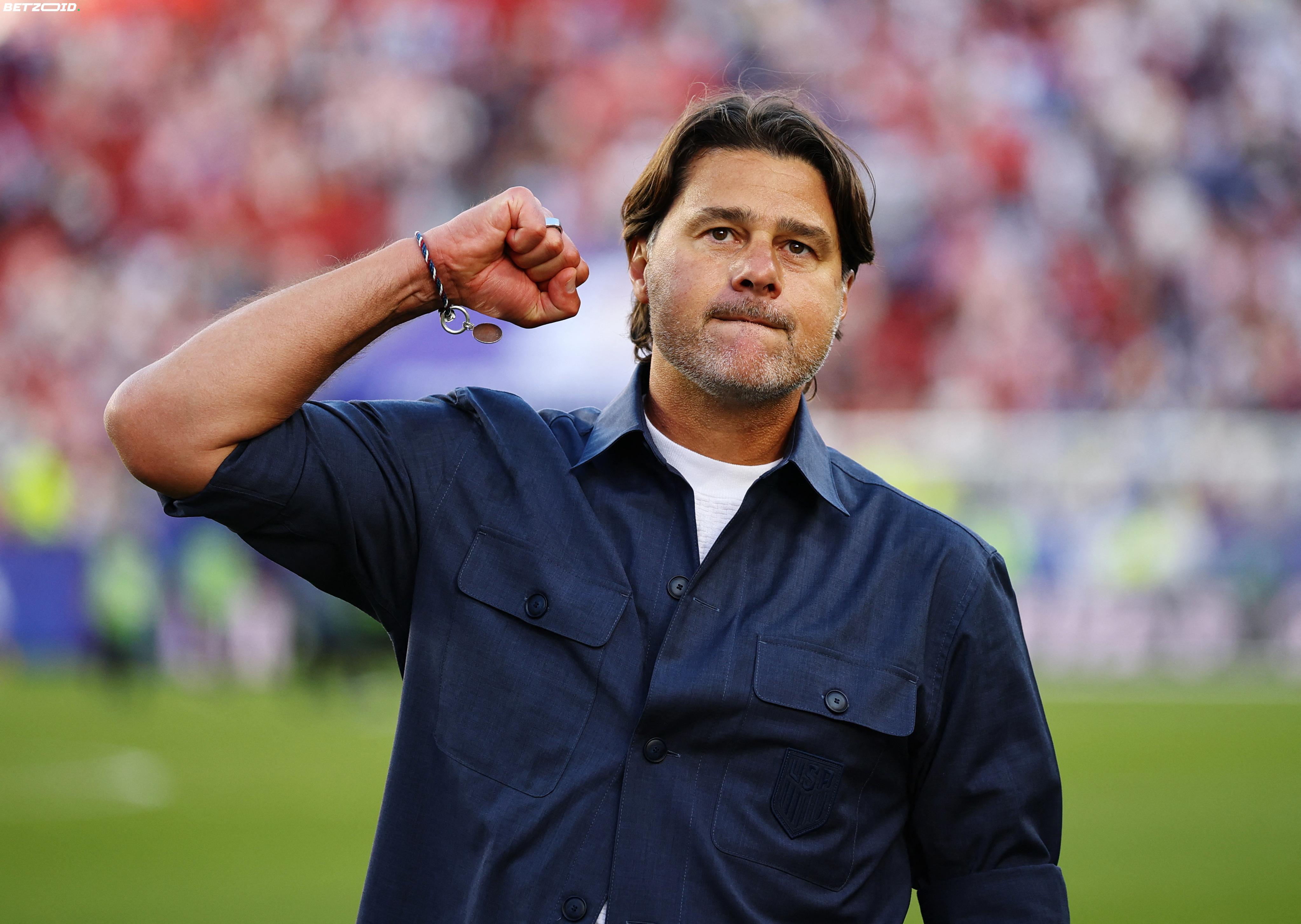
"You're only entitled to speak a little out of place if you're Messi and you've won eight Ballon d'Ors." That's Mauricio Pochettino, putting 16-year-old Cavan Sullivan firmly in his place — and it's a decent summary of the tone he's setting as the USMNT's 2030 World Cup cycle officially kicks off against Peru, Chile, Mexico, and Canada this fall.
Pochettino surprised a lot of people by signing on for another four years. Some are still skeptical he'll see it through. But regardless of how long he lasts, the problems he inherits into this cycle are real and specific. Here are the five that matter most.
The Sullivan question — now or later?
Cavan Sullivan is the story everyone wants to talk about, and for good reason. The Philadelphia Union teenager scored five goals in five games heading into camp, and has a move to Manchester City already arranged. He's not a prospect. He's a player.
But Pochettino has been deliberate in cooling expectations, and his comments about Sullivan's media tone were pointed. Whether that's a genuine philosophical stance on youth development or a power play to keep a teenager humble is hard to say. Either way, Sullivan's integration into the senior squad is the most immediate decision Pochettino faces — and how he handles it will tell us a lot about his man-management in this new era. Sullivan's odds of featuring heavily in qualifying will shift considerably depending on what Pochettino does here.
The defensive crisis nobody wants to admit
Chris Richards is a genuine international-quality centre-back. The problem is what's beside him.
Tim Ream is 38 and showing it. Cameron Carter-Vickers and Auston Trusty have been underwhelming at international level despite strong club form at Celtic. Miles Robinson makes too many errors. George Campbell and Mark McKenzie haven't pushed through. That's the depth chart in full, and it's thin.
The most intriguing name is Noahkai Banks — a young prospect who could have been a long-term answer — but Germany are pushing hard for his commitment. If Banks goes elsewhere, Pochettino has a genuine structural problem at the back that won't resolve itself by the time qualifying gets serious. Any USMNT defensive line odds should be viewed with that in mind.
Goalkeeper is the other side of the same coin. This was once the USMNT's most reliable position — Tony Meola, Kasey Keller, Brad Friedel, Tim Howard built a generation of credibility there. Since Brad Guzan retired, it's fallen apart. Matt Turner's move to Europe didn't work. Matt Freese took over and made a glaring error at the 2026 World Cup. Young options like Gaga Slonina, Chris Brady, and Diego Kochen exist, but none are proven at this level. Pochettino has to find a number one, and he has to do it soon enough that the answer is actually ready by 2030.
The Pulisic problem and the rest question
Christian Pulisic skipping the 2025 CONCACAF Gold Cup to rest didn't go down well with supporters, and the fallout from that decision is still shaping the conversation. The intended benefit — a fresher Pulisic for the World Cup — didn't even materialize. He went into the 2026 tournament in poor form and started the 2026/27 season battling fitness issues.
That outcome makes the calculus harder to defend. By 2030, Pulisic, Weston McKennie, Antonee Robinson, and Tyler Adams will all be at or near 30. Managing their minutes will be a legitimate concern — but doing it in ways that alienate the fanbase, and don't even produce the intended results, is a problem Pochettino has to solve with actual policy, not ad hoc decisions.
There's also the MLS question lingering in the background. Pochettino's first two years showed that raiding domestic football for undervalued talent works — Alex Freeman, Max Arfsten, Jack McGlynn, and Sebastian Berhalter all emerged through that process and earned European moves. But leaning too heavily on MLS as a talent pipeline has its limits. The players with the highest ceilings are usually the ones who left early. Getting the balance right between nurturing domestic prospects and prioritizing European-based players is a judgment call Pochettino will face every single camp.
- How quickly does Cavan Sullivan get real minutes and responsibility?
- Who partners Chris Richards in central defence — and what happens if Noahkai Banks commits to Germany?
- Can any of Slonina, Brady, or Kochen become a reliable international goalkeeper by 2030?
- What is the actual policy on resting star players — and will it be communicated clearly to fans?
- How much does Pochettino rely on MLS talent versus pushing harder to unearth European-based options?
Four years sounds like a long time. In international football, it never is.