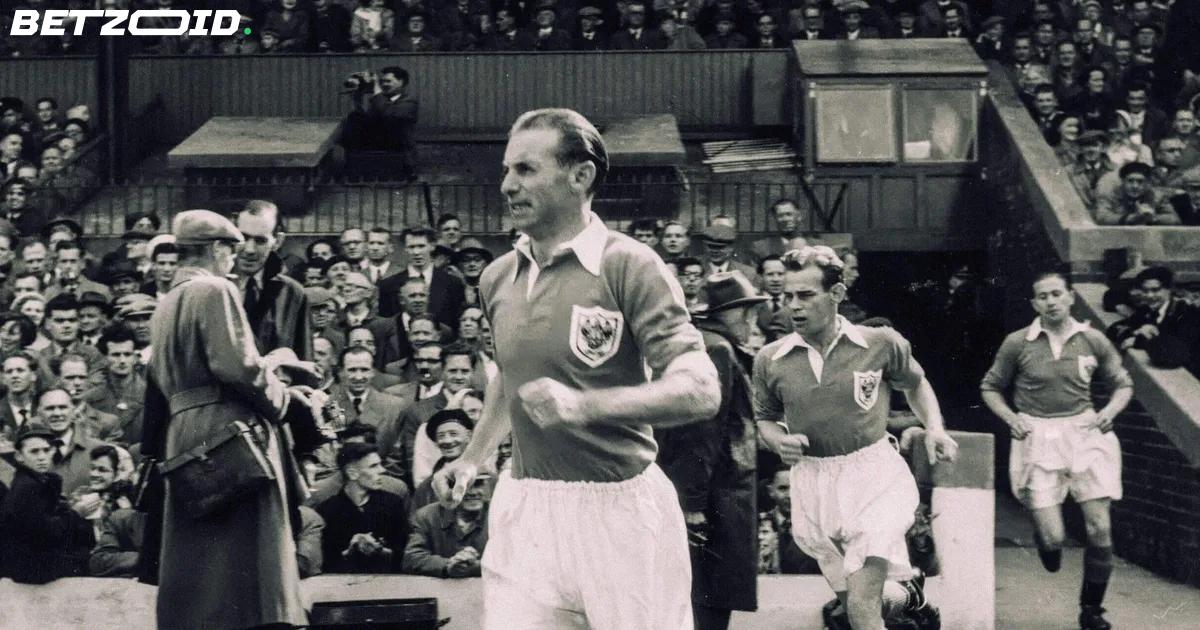
"The years may wrinkle the skin but, without enthusiasm, it wrinkles the soul." Stanley Matthews said that while being filmed in the back seat of a car, driving himself to a match — at 50 years old. That tells you everything about the man.
With the Ballon d'Or ceremony approaching, it's worth going back to the beginning. Matthews won the inaugural award in 1956, the first of only four Englishmen ever to do so. He was 41 at the time. He'd won the Football Writers' Footballer of the Year eight years earlier, in 1948 — then won it again in 1963, aged 48. These aren't typos. That's just what his career was.
The winger who rewired the position
What made Matthews genuinely different wasn't longevity — it was thought. As a teenager playing Stoke City reserves, he looked at how defenders operated and decided they had it backwards. Full-backs waited and closed wingers down. Matthews decided to charge at them instead.
"Once on top of him, I'd put into operation the body swerve I was cultivating," he wrote in his autobiography. The defender, he said, "looked absolutely dumbfounded."
Gabriel Hanot, the L'Équipe journalist who would later conceive the European Cup, put it precisely: "It's not the defender chasing the attacker; the defender, in an extraordinary paradox, is suddenly the one who is being chased." Matthews flipped the dynamic of the position and never looked back. He also decided wingers should supply goals rather than score them — a shift so fundamental it still shapes how the role is understood today.
Alfredo Di Stefano — a man not known for generosity toward rivals — was blunt about it: "I hear some modern players being described as 'great'. They are not. They are good, some very good, but none are great in the way Stan was great."
The Matthews Final — and why he hated that name
The 1953 FA Cup final is the moment most people reach for first. Blackpool 4-3 Bolton. Matthews, 38 years old, had lost two previous finals — 1948 and 1951. With 25 minutes left, Blackpool were losing 3-1. What followed was the kind of sporting theatre that doesn't get written; it just happens.
Matthews crossed for Stan Mortensen to make it 3-2. Mortensen scored again for 3-3. Then, in the final seconds, Matthews jinked down the right and crossed for Bill Perry to win it. The crowd had been chanting "On Stanley, on." He'd kept his promise to his dying father to one day win the cup.
The press called it "The Matthews Final." In his autobiography, Matthews titled the chapter "The Mortensen Final" — because Mortensen had scored a hat-trick and Matthews felt the name was wrong. He was like that. Never booked in his career, never sent off, never retaliated despite playing an era when defenders could legally maim wingers. The Belgian players applauded him back to his position after he'd set up all five England goals in a 5-2 win in Brussels in 1947. The Belgian press called him Le Sorcier — The Wizard.
His professional career ran from 1930 to 1965. He started in Stoke's reserves aged 15. He retired five days after his 50th birthday, following a 3-1 win over Fulham. Franz Beckenbauer's words on his death in 2000 were simple: "Football has lost its greatest player. Wherever you went in the world, they knew the name Stanley Matthews."
At his April 1965 testimonial, Di Stefano, Eusebio, Raymond Kopa, and Uwe Seeler all showed up. At the end, Lev Yashin and Ferenc Puskas lifted Matthews onto their shoulders and carried him to the dressing room. He left his boots on the peg.