Picture this: June 2022, Austin, Texas. The U.S. men's national team shows up for a World Cup kit photoshoot. But when the players see the jerseys, everything stops.
For 30 minutes, some players refuse to continue. U.S. Soccer staffers frantically make calls. The whole thing threatens to become a full-blown crisis.
"The team wasn't too fond," midfielder Tyler Adams says diplomatically. "We didn't feel that [the kits] represented us."
Fast forward to today, and that mini-rebellion changed everything. The USMNT's new 2026 World Cup kits just dropped, and this time the players love them. Why? Because they literally designed them.
"We literally picked everything," Adams reveals. "I feel like we had more say than Nike had in it, to be honest with you."
From Crisis to Collaboration
The 2022 situation wasn't pretty. When those kits finally released, winger Tim Weah tweeted to fans: "We just as angry as y'all !!!" That's how bad it was.
But it sparked real change. U.S. Soccer and Nike completely overhauled their design process, giving players input at three distinct stages instead of springing finished jerseys on them at photoshoots.
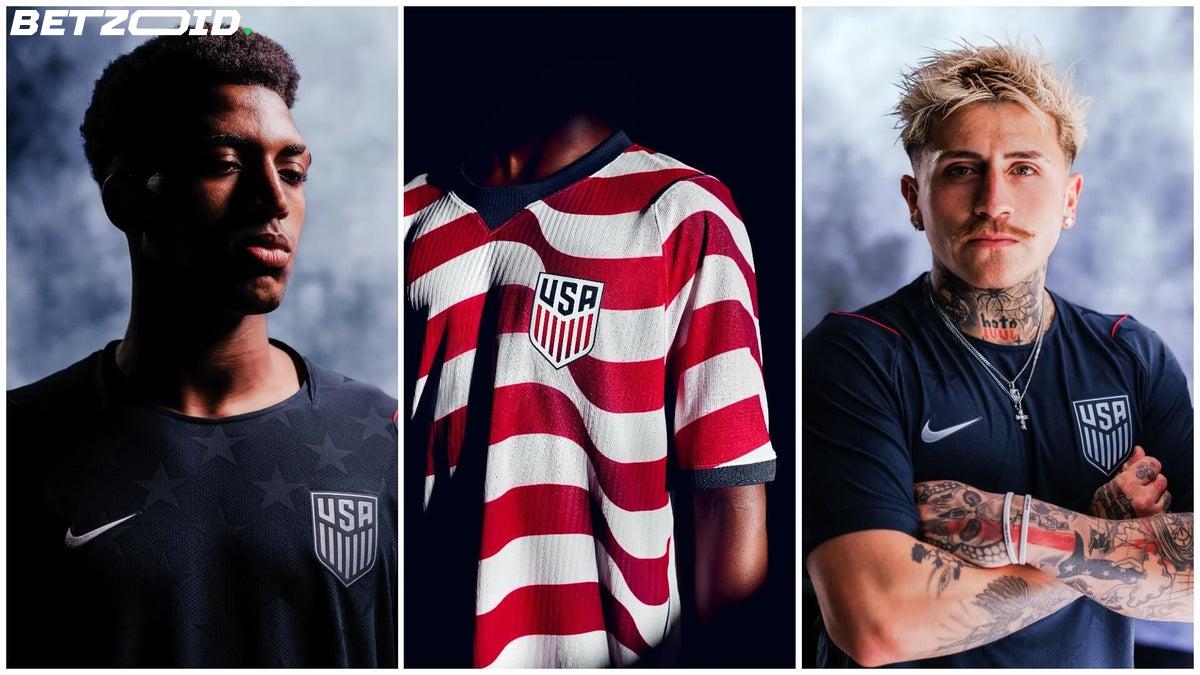
Adams, Christian Pulisic, Weston McKennie, Folarin Balogun, Ricardo Pepi, and Matt Turner all got involved. Together they created two kits: a bold red-and-white "stripes" jersey and a dark obsidian "stars" kit.
"The players were very cognizant of [the fact that] we have a very diverse fan base," says Maribeth Towers, U.S. Soccer's VP of consumer products. Some fans want loud, patriotic designs. Others want something more subtle.
The stripes kit is "wild and really crazy," according to Nike designer Yazmin Rosete. It's for the USA-chanting crowd who want something unmistakably American in the World Cup stands.
Players Demanded a Re-Do
But here's where it gets interesting. For the second kit, players had a specific request: "We just want something we can wear to the club."
Some players wanted all black. U.S. Soccer vetoed that idea. But when Nike presented their first design for the "stars" kit in June 2024, the players rejected it. Too bright. Stars too visible. Not subtle enough.
"They had to do a re-do on it," Towers admits. The final version is near-black with reflective stars that barely show from a distance. It's exactly what the players wanted—something they could wear on a Friday night with jeans.
The whole process took nearly two years. Nike interviewed players individually in November 2023, asking what representing the U.S. meant to them. They laid out fabric samples in Dallas. They got feedback at every stage.
Adams jokes that McKennie "was coming up with some crazy designs that no one agreed with." But eventually, themes emerged. The players wanted stars and stripes. They wanted an identity like Brazil's yellow or Holland's orange. Something consistent, not constantly changing.
When players finally saw the finished kits in October, the reaction was completely different from 2022. "The entire team applauded," Towers says. Nike's product director claims some players "literally fell out of their chairs."
For anyone betting on the USMNT's World Cup performance, this might seem like a minor detail. But team unity and confidence matter. Players who feel represented and heard tend to perform better. And heading into a home World Cup in 2026, that psychological edge could be valuable.
"These jerseys," Adams says, "represent us perfectly."