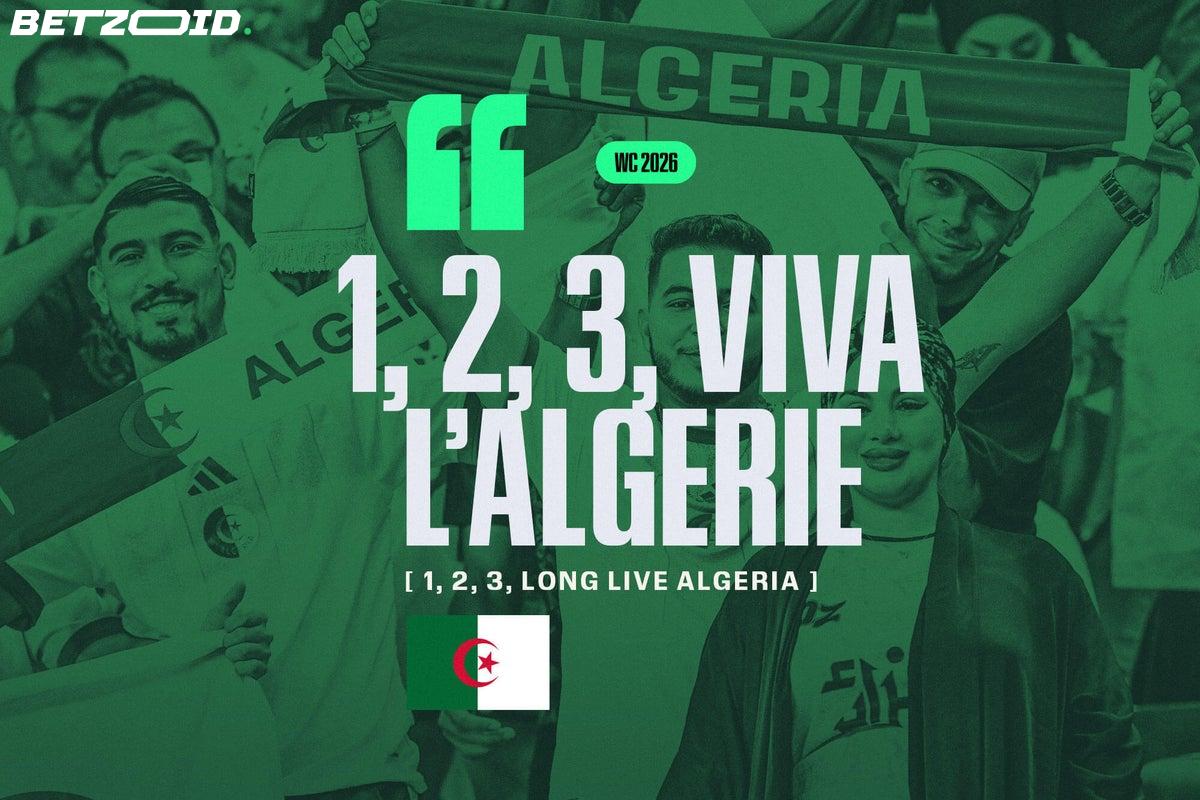
"When you see a match in Copa America or the Champions League, you can spot a supporter with an Algerian flag — it's weird." Film director Amine Kabbes isn't complaining. He's proud. That flag, that presence, that refusal to be invisible — it's the whole point.
Algeria arrive at the 2026 World Cup for group-stage clashes against Argentina, Jordan and Austria carrying something most squads don't: a chant with actual historical weight. "1, 2, 3, viva l'Algérie" isn't a terrace song someone made up in the 1990s. It traces back, at least in popular memory, to the port of Algiers during the French occupation — locals reportedly trying to signal "1, 2, 3, free Algérie" to a passing American ship, which misheard it as a celebration. After independence in 1962, the cry became exactly that.
Football as proof of existence
"Supporting the national team is related to the history of Algeria," says Kabbes. "We have a desire to be in the world because, before 1962, we didn't exist. With football, we can exist and prove we are here."
That framing matters. Algeria's national side has roots in the National Liberation Front — the main nationalist movement during the War of Independence in the 1950s and early '60s. Football wasn't just sport. It was a political act, a declaration. And for supporters, it still feels like one.
The 1982 World Cup still burns. Algeria won two of their three group games but were eliminated on goal difference after West Germany and Austria played out a result — the infamous Disgrace of Gijon — that conveniently sent both European sides through at Algeria's expense. Supporters born decades later know the story in detail. "I know the 1982 team as if I was living with them," says Kabbes. "These are memories that I didn't experience, but my father used to tell me stories." That result, incidentally, is why World Cup final group-stage rounds now kick off simultaneously.
The diaspora dimension
The Algerian football community is genuinely global. Significant populations in France, the UK, the US and beyond mean the national team draws from a wide diaspora pool — which creates its own tensions. Should players who've spent their entire lives abroad, and might only be switching allegiances because they can't break into another national squad, represent Algeria?
London-raised supporter Yassine Tebib is fine with it, provided the players "are really proud to represent the country." Algerian-American Adam goes further: "Just because these players are dual nationals does not mean that they don't embody what Algeria is." He's heading to Kansas City and Santa Clara to watch all three group games in person.
Following those dual-national players has sent Algerian fans down genuinely obscure football rabbit holes. Tebib was watching Swiss Super League games to track Mohamed Amoura — now at Wolfsburg — during his time at Lugano. "I was watching really random games, just to follow the players."
"It's their oxygen," says Mohamed Benhassir of football's place in Algerian life. "It'll always be their oxygen." Algeria's domestic league doesn't carry the same global profile as Egypt's, but the national team has always punched with a different kind of intensity. Two AFCON titles, some memorable World Cup moments, and a fanbase that will find a way to get a flag on camera at literally any match on the planet.
Win in Kansas City or Santa Clara this summer, and there will be horns in Algiers, Paris, London, and Madrid. The tune is already decided: "1, 2, 3, viva l'Algérie."