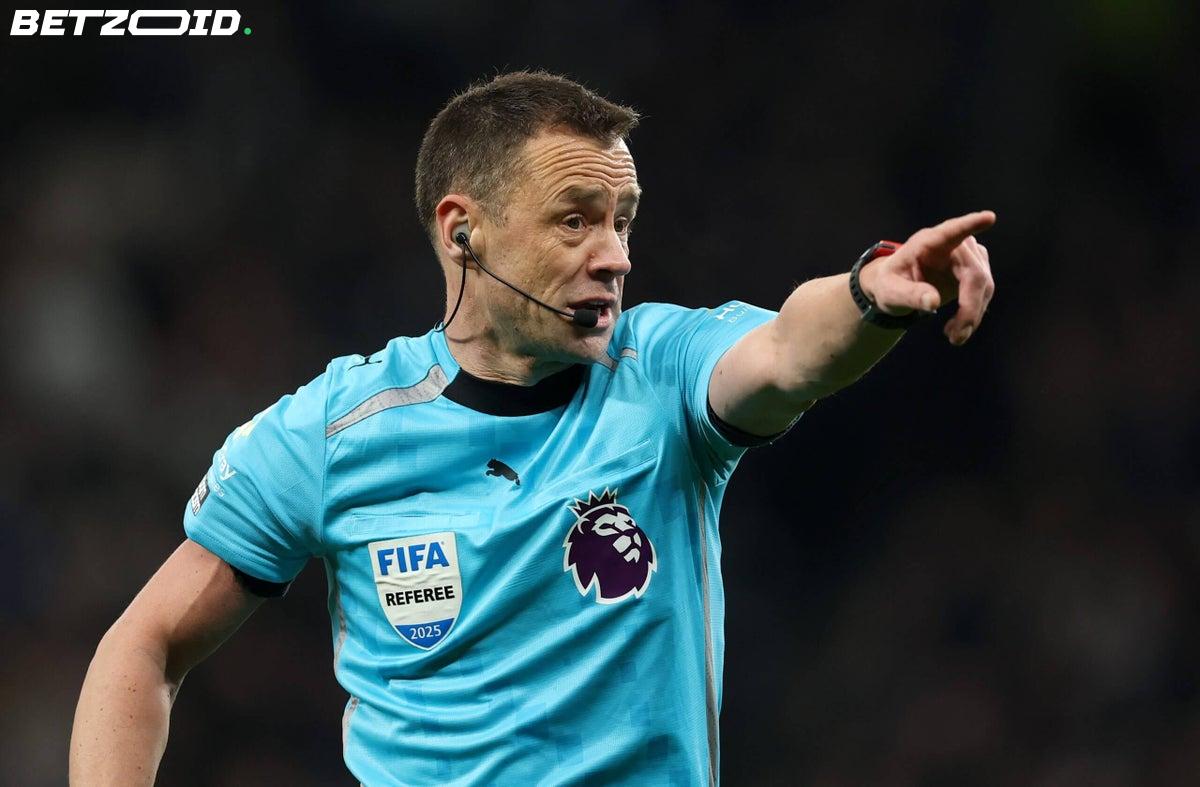
Stuart Attwell hasn't officiated a single Nottingham Forest match — not as referee, fourth official, or VAR — since April 2024. That's not a scheduling quirk. The PGMOL has been deliberately keeping him away from them, and that's a problem worth examining.
The backstory: Attwell was VAR for Forest's Premier League defeat to Everton at Goodison Park, a match that produced three penalty decisions in Everton's favour during a tight relegation battle. Forest's response was to post a tweet identifying Attwell as a Luton Town supporter — Luton being another club scrapping to stay up at the time. The FA came down hard. Forest were fined £750,000, a record punishment for a social media offence, and the tweet was deleted. The authorities backed Attwell completely and publicly.
Who's actually winning here?
Privately, though? The PGMOL has been quietly engineering his absence from Forest fixtures ever since. Three months ago, Attwell was listed as fourth official for Forest's FA Cup tie at Wrexham, then replaced before the match by Darren England without explanation. The PGMOL refused to comment when asked directly.
There's precedent for this kind of management — Mark Clattenburg was kept away from Goodison Park for years after a fractious Merseyside derby in 2007. Kevin Friend, a Bristol City supporter, was never assigned their games. Those decisions make intuitive sense. A referee managing fixtures involving a club he openly supports is a legitimate conflict.
Attwell being barred from Forest is different. The suggestion that he can't handle their matches impartially isn't credible — it's the residue of a PR crisis that Forest themselves created and were punished for. The PGMOL fined the club a record amount for attacking his integrity, then quietly validated their complaint by removing him. That's a contradiction that deserves scrutiny.
Nothing in the reporting suggests Forest pushed for this arrangement. Whether the decision came solely from the PGMOL, or whether Attwell himself wanted distance from the situation, remains unclear. Either way, the outcome is that a club's public meltdown has ended up reshaping appointment decisions — which sets an uncomfortable precedent for everyone else.
Ekitike and the injury that ends careers early
Away from the officiating noise, Liverpool's Hugo Ekitike is facing something far more serious than a suspension or a dip in form. The forward ruptured his Achilles tendon during the Champions League defeat to Paris Saint-Germain last week — and the recovery timeline is as grim as it sounds.
He'll be out for months. He won't make France's World Cup squad. Those are the immediate consequences.
The longer concern is statistical: around 20 per cent of professional footballers who suffer a ruptured Achilles never return to their previous physical level. One in five. Not due to failed surgery or poor rehabilitation, but because the injury is that destructive to explosive movement, the kind Ekitike's game depends on entirely.
Surgery addresses the structural damage. What it can't guarantee is the speed and the spring. Early rehabilitation restricts even walking. The mental rebuilding that follows months of immobility is its own challenge, separate from the physical one.
In a Liverpool season that has underdelivered on almost every front, Ekitike had been one of the few genuinely encouraging stories — sharp, direct, a natural finisher who looked like a proper addition rather than a panic buy. Losing him now doesn't just hurt their remaining fixtures. It throws a shadow over the club's forward planning for next season too. Any market value calculations around him will be sitting in a drawer until the full extent of his recovery becomes clear.
The Achilles, not the ACL, is the injury that keeps top-level sports medicine professionals up at night. The numbers explain why.