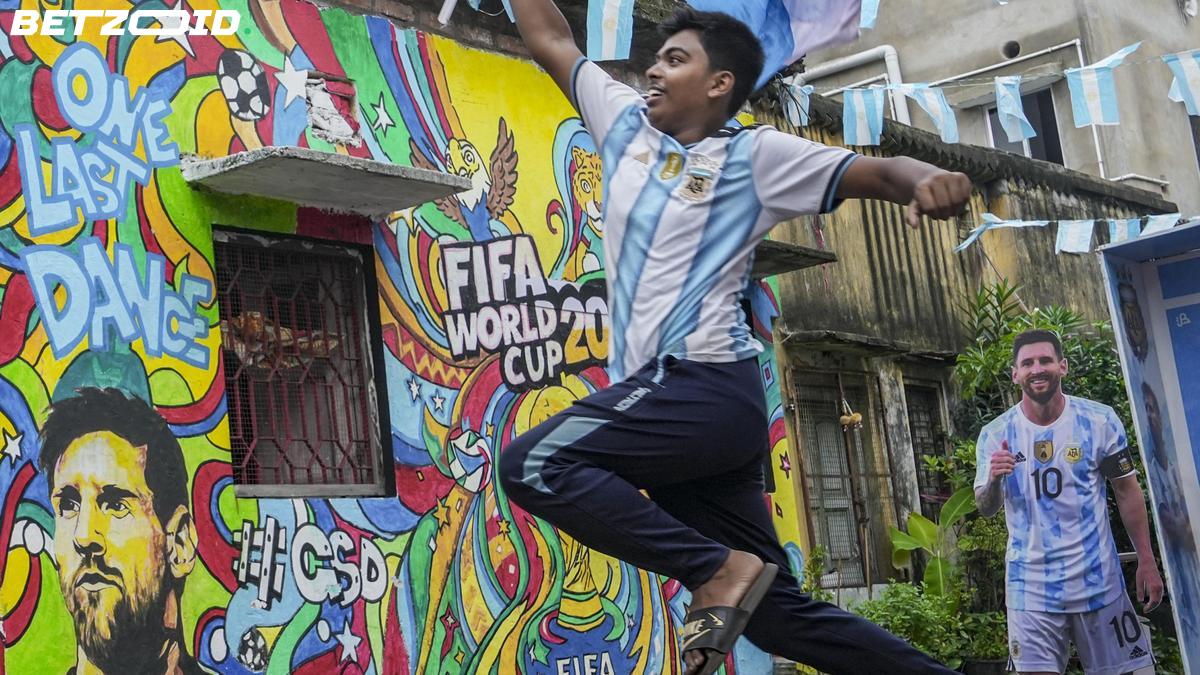
"They are surprised," Lionel Scaloni said of his players. "Thrilled that a country on the other end of the world supports us, loves us and feels proud wearing our blue-and-white stripes." Nearly 16,000 kilometres from Buenos Aires, hundreds of millions of people feel exactly that way.
Inside Mercedes-Benz Stadium on Wednesday night, before Argentina had even kicked a ball against England, the blue-and-white songs were already going. Some of those voices carried the accents of Kolkata, Dhaka, Kochi, and Varanasi. This isn't a fringe phenomenon or a novelty subplot. South Asia's devotion to Argentina is one of the most genuine, long-standing expressions of football loyalty anywhere on the planet.
Maradona opened the door. Messi never closed it.
It started with 1986. A man named Vipul from Varanasi — now in Atlanta watching his team reach yet another World Cup final — was a young man when Maradona dismantled England in Mexico. Television was still a novelty in India. He hunted down a faded replica jersey at Delhi's Sarojini Market and never really stopped wearing Argentina in his heart. His son Anmol grew up on a different Argentina — the Messi Argentina, the one defined by the 2014 final tears, Copa America near-misses, and ultimately Qatar 2022. Different hero. Identical devotion. Together they watched Argentina beat England again and now they're heading to New Jersey hoping to see Messi lift a second World Cup.
That father-son story repeats itself across India and Bangladesh in ways that can't be manufactured by marketing campaigns or broadcasting deals. Joy Uthuppu in Kerala painted his entire house blue and white. Rupak Saha turned up in Atlanta wearing East Bengal colours — but shouting for Messi. "We want Messi to give us another World Cup," he said. "We are all here for him."
There's no logical explanation for it if you go looking for one. No shared language. No colonial sports history connecting the subcontinent to South American football. No geographical proximity. And yet every four years it happens anyway, reliably, intensely, on a scale that still catches Argentina's own players off guard.
The political noise hasn't shifted the neutrals
Argentina haven't exactly been universally loved at this tournament. The Falklands banner brandished by Lo Celso after the semifinal will run and run. Accusations of favourable refereeing decisions have followed them through multiple rounds, and their confrontational style on and off the pitch has irritated opponents throughout. None of it has dented the global pull.
Inside stadiums, neutral support tilts toward Argentina more visibly than any other nation here. Every Messi touch still draws that collective intake of breath — and among the neutrals making that noise, South Asians are disproportionately present. That matters for the final's atmosphere, and Argentina's betting support reflects the same dynamic: they go into the final in New Jersey as clear market favourites, carried partly by the sheer weight of goodwill they generate across continents.
It's because Argentina has always sold something beyond results. Maradona gave people the idea that individual brilliance could beat institutional power. Messi showed that perseverance across decades of heartbreak could eventually pay off. Those are stories that travel. They hit differently in places where football is watched at 3am, where jerseys are sourced from market stalls, where following a team 16,000 kilometres away is an act of pure, irrational love.
As Atlanta emptied into the Georgia heat Wednesday night, the songs continued down the streets. Some of those singing will fly back to Buenos Aires. Others have longer journeys — back to Dhaka, Kolkata, Kochi, Chennai. They'll make the same trip again if Argentina are still standing.